02/12/2021

(AU The Conversation) More Than 200 Australian Birds Are Now Threatened With Extinction – And Climate Change Is The Biggest Danger

The Conversation | 

Shutterstock

Authors
  •  is Professor of Conservation and Sustainable Livelihoods, Charles Darwin University
  •  is a University Associate, University of Tasmania
Up to 216 Australian birds are now threatened – compared with 195 a decade ago – and climate change is now the main driver pushing threatened birds closer to extinction, landmark new research has found.

The Mukarrthippi grasswren is now Australia’s most threatened bird, down to as few as two or three pairs. But 23 Australian birds became less threatened over the past decade, showing conservation actions can work.

The findings are contained in a new action plan released today. Last released in 2011, the action plan examines the extinction risk facing the almost 1,300 birds in Australia and its territories. We edited the book, written by more than 300 ornithologists.

Without changes, many birds will continue to decline or be lost altogether. But when conservation action is well resourced and implemented, we can avoid these outcomes.

Without change, threatened birds such as the southern emu wren, pictured, will be lost. Barry Baker

The numbers tell the story

The 216 Australian birds now at risk of extinction comprise:
  • 23 critically endangered
  • 74 endangered
  • 87 vulnerable
  • 32 near-threatened.
This is up from 134 birds in 1990 and 195 a decade ago.

We assessed the risk of extinction according to the categories and criteria set by the International Union for Conservation of Nature in its Red List of threatened species.

As the below graph shows, the picture of bird decline in Australia is not pretty – especially when compared to the global trend.

Authors supplied

What went wrong?
Birds are easily harmed by changes in their ecosystems.
Dean Ingwersen/BIRDLIFE AUSTRALIA


Birds are easily harmed by changes in their ecosystems, including introduced species, habitat loss, disturbance to breeding sites and bushfires. Often, birds face danger on many fronts.

The southeastern glossy black cockatoo, for example, faces no less than 20 threats.

Introduced cats and foxes kill millions of birds each year and are considered a substantial extinction threat to 37 birds.

Land clearing and overgrazing are a serious cause of declines for 55 birds, including the swift parrot and diamond firetail. And there is now strong evidence climate change is driving declines in many bird species.

A good example is the Wet Tropics of far north Queensland.

Monitoring at 1,970 sites over 17 years has shown the local populations of most mid- and high-elevation species has declined exactly as climate models predicted.

Birds such as the fernwren and golden bowerbird are being eliminated from lower, cooler elevations as temperatures rise.

As a result, 17 upland rainforest birds are now listed as threatened – all due to climate change.

The Black Summer bushfires of 2019-20 – which were exacerbated by climate change – contributed to the listing of 27 birds as threatened.

We estimate that in just one day alone – January 6, 2020 – about half the population of all 16 bird species endemic or largely confined to Kangaroo Island were incinerated, including the tiny Kangaroo Island southern emu-wren.

Some 91 birds are threatened by droughts and heatwaves. They include what’s thought to be Australia’s rarest bird, the Mukarrthippi grasswren of central west New South Wales, where just two or three pairs survive.

Climate change is also pushing migratory shorebirds towards extinction. Of the 43 shorebirds that come to Australia after breeding in the Northern Hemisphere, 25 are now threatened.

Coastal development in East Asia is contributing to the decline, destroying and degrading mudflat habitat where the birds stop to rest and eat.

But rising seas as a result of climate change are also consuming mudflats on the birds’ migration route, and the climate in the birds’ Arctic breeding grounds is changing faster than anywhere in the world.

The Black Summer bushfires devastated some bird populations. James Ross/AAP

The good news

The research shows declines in extinction risk for 23 Australian bird species. The southern cassowary, for example, no longer meets the criteria for being threatened. Land clearing ceased after its rainforest habitat was placed on the World Heritage list in 1988 and the population is now stable.

Other birds represent conservation success stories. For example, the prospects for the Norfolk Island green parrot, Albert’s lyrebird and bulloo grey grasswren improved after efforts to reduce threats and protect crucial habitat in conservation reserves.

Intensive conservation efforts have also meant once-declining populations of several key species are now stabilising or increasing. They include the eastern hooded plover, Kangaroo Island glossy black-cockatoo and eastern bristlebird.

And on Macquarie Island, efforts to eradicate rabbits and rodents has led to a spectacular recovery in seabird numbers. The extinction risk of nine seabirds is now lower as a result.

There’s also been progress in reducing the bycatch of seabirds from fishing boats, although there is much work still to do.

The Albert’s lyrebird has been a conservation success. Barry Baker

Managing threats

The research also examined the impact of each threat to birds – from which we can measure progress in conservation action. For 136 species, we are alarmingly ignorant about how to reduce the threats – especially climate change.

Some 63% of important threats are being managed to a very limited extent or not at all. And management is high quality for just 10% of “high impact” threats.

For most threats, the major impediments to progress is technical – we don’t yet know what to do. But a lack of money also constrains progress on about half the threats.

What’s more, there’s no effective monitoring of 30% of the threatened birds, and high-quality monitoring for only 27%.

Nevertheless, much has been achieved since the last action plan in 2010. We hope the new plan, and the actions it recommends, will mean the next report in 2030 paints a more positive picture for Australian birds.

Links

(ScienceAlert) Mysterious Vanishing Of Advanced Chinese Civilization 4,000 Years Ago Finally Solved

ScienceAlert - Peter Dockrill

Detail from ancient Liangzhu jade carving. (Liangzhu Archeology Ruins Management Bureau)

About 5,300 years ago, an ancient civilization emerged in the east of China, building a brilliant city the likes of which had perhaps never been seen before in all of Asia – nor possibly even the whole world.

The surviving traces of the Liangzhu culture, which rose up along the banks of the Yangtze River Delta in China's east, are a testament to what this unique Neolithic society was capable of in the final stretches of the Stone Age.

The archaeological ruins of Liangzhu City demonstrate numerous signs of social, cultural, and technological advancements for the period, especially in agriculture and aquaculture.

Sophisticated architectural features, meanwhile – including clever hydraulic engineering that enabled canals, dams, and water reservoirs – led to allusions of Liangzhu being a Neolithic "Venice of the East".

None of these marvels would last, however.

Aerial view of palace area of Liangzhu. Hangzhou Liangzhu Archaeological Site Administrative District Management Committee

After a single innovative millennium, the Liangzhu culture mysteriously collapsed around 4,300 years ago, and the ancient city was abruptly abandoned. Exactly why has never been fully understood, although many have suggested some form of catastrophic flooding led to the sudden decline.

"A thin layer of clay was found on the preserved ruins, which points to a possible connection between the demise of the advanced civilization and floods of the Yangtze River or floods from the East China Sea," explains geologist Christoph Spötl from the University of Innsbruck in Austria.

"However, no clear conclusions on the cause were possible from the mud layer itself."

Now, we have a clearer picture of the deluge that drowned this astounding place.

In a new study, Spötl and an international team of researchers went far deeper than the ancient mud deposits, examining mineral formations (or speleothems) such as stalagmites from two underwater caves in the region, which preserve chemical signatures of climatic conditions long ago.

Stalagmites in Shennong Cave. (Haiwei Zhang)

Led by first author Haiwei Zhang from China's Xi'an Jiaotong University, their analysis of the stalagmite samples shows the collapse of Liangzhu City coincided with a period of extremely high precipitation that likely lasted for decades over 4,300 years ago, probably due to increased frequency of El Niño–Southern Oscillation conditions.

"This is amazingly precise in light of the temporal dimension," Spötl says.

"Massive monsoon rains probably led to such severe flooding of the Yangtze and its branches that even the sophisticated dams and canals could no longer withstand these masses of water, destroying Liangzhu City and forcing people to flee."

According to the researchers, previous instances of climate change in the Yangtze River Delta region may have also impacted other Neolithic cultures that inhabited the area before the Liangzhu society rose up in a period of dry and relatively stable environmental conditions.

But history and weather meant this prosperous city could not endure forever.

"Archeological studies show the presence of large-scale hydraulic complexes such as large earthen dams near the Liangzhu city, which were constructed between [5,300 and 4,700 years before present]," the researchers write in their study.

"This suggests that the Liangzhu society was effectively managing water resources by using hydraulic infrastructure for flood mitigation and/or irrigation to survive in a dry climate."

With time, however, that dry climate seems to have gotten progressively drier, culminating in a possible 'megadrought' around 4,400 years ago, at which point dam construction appears to have ceased, since existing dams would have been sufficient under the arid conditions.

And then the rains came, falling in two distinct burst periods between roughly 4,400–4,300 years ago.

"Our speleothem records, together with geochemical evidence of flood deposits above the Liangzhu culture layer, suggest that massive rainfall in the entire middle-lower reaches of the Yangtze River Valley might have induced fluvial flooding and/or overbank marine flooding transported by the Yangtze River plume and thus impeded human habitation and rice farming," the authors explain.

"Massive flooding and inundation due to poor drainage in the low-lying land may have forced the Liangzhu people to abandon their capital city and dwellings in the Taihu Plain, ultimately leading to the collapse of the entire Liangzhu civilization."

For hundreds of years afterward, humid conditions remained, during which time other ancient cultures temporarily rose up to succeed the Liangzhu – at least, until another megadrought likely led to the "final demise" of Neolithic human societies in the region.

At about the same time, Chinese society was about to begin a transformational new chapter, with the founding of the Xia dynasty in 2070 BCE, considered to be the first dynasty of China, led by Yu the Great.

"While many documents indicate that the leader Yu built the Xia Dynasty because he successfully managed river flooding, some studies suggest that Yu's control of the flooding can be ascribed to climate change," the researchers explain, noting that their own speleothem data also back up the idea.

"This observation provides new robust evidence that the rise of the Xia Dynasty occurred in the context of a major climate transition from wet to dry, in line with the Chinese historic records and previous studies."

The findings are reported in Science Advances.

Links

(AU Climate Council) Steamy And Stormy: Climate Change And Summer 2021-22

Climate Council


La Niña is set to shape Australia’s summer 2021-22 with above-average rainfall forecast for eastern parts of the continent; elevating flood risks. Most of Australia, except in parts of the southeast, should expect above average maximum summer temperatures.

This explainer distils the latest advice from the Bureau of Meteorology on what to expect this summer. It takes stock of extreme weather risks, takes a close look at the impact of La Niña – the dominant climate driver affecting our weather now – and puts it all in the context of our changing climate.

What is La Niña, and how is it shaping the 2021-22 summer in Australia?

The Bureau of Meteorology declared that a La Niña is underway on November 23, 2021. Australia’s weather is influenced by a number of “climate drivers”, including the El Niño Southern Oscillation, Indian Ocean Dipole, Southern Annular Mode and Madden-Julian Oscillation.

These are cyclical fluctuations in ocean surface temperatures and ocean-atmosphere interactions in the Pacific Ocean, Indian Ocean, Southern Ocean and the tropics respectively. They influence year-to-year variations in temperature, rainfall and other weather patterns.

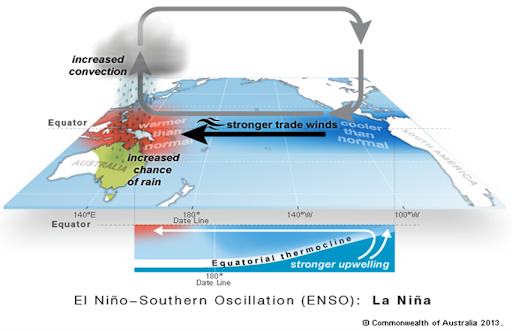
La Niña is one phase of the El Niño Southern Oscillation. It occurs when equatorial trade winds become stronger; bringing cooler water up from deeper in the ocean. This results in a cooling of the surface of the central and eastern tropical Pacific Ocean.

The stronger trade winds also help warm surface water accumulate in the western Pacific and to the north of Australia. These warmer waters in the western Pacific mean more clouds develop as warm, moist air rises. This can result in heavy rainfall to the north of Australia.

Source: Bureau of Meteorology (2013).

Every La Niña event is different, as the effects of La Niña may be amplified or dampened by the other climate drivers. 

The current La Niña is expected to persist until late summer or early autumn 2022. However, there are reasons to expect that this La Niña will not be as disruptive as the exceptionally strong event of 2010-12, including the fact that the 2010-12 La Niña coincided with a negative phase of the Indian Ocean Dipole. This tends to amplify the effects of La Niña. Right now, the Indian Ocean Dipole is in a neutral phase. 

But the Southern Annular Mode (SAM) is forecast to remain at positive levels to the end of the year. La Niña conditions in the Pacific Ocean, and the positive SAM phase are influencing the above average rainfall outlooks. See BoM’s latest ‘Climate Driver Update’ for more information.

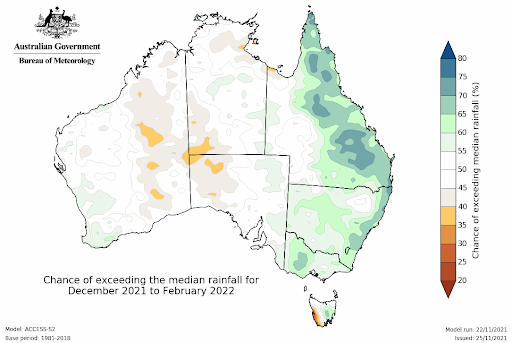
According to the Bureau of Meteorology’s December to February (summer) outlook , and consistent with typical La Niña conditions, rainfall between December to February is likely to be above average for eastern Australia, particularly eastern parts of Queensland. 

Source: Bureau of Meteorology (2021)

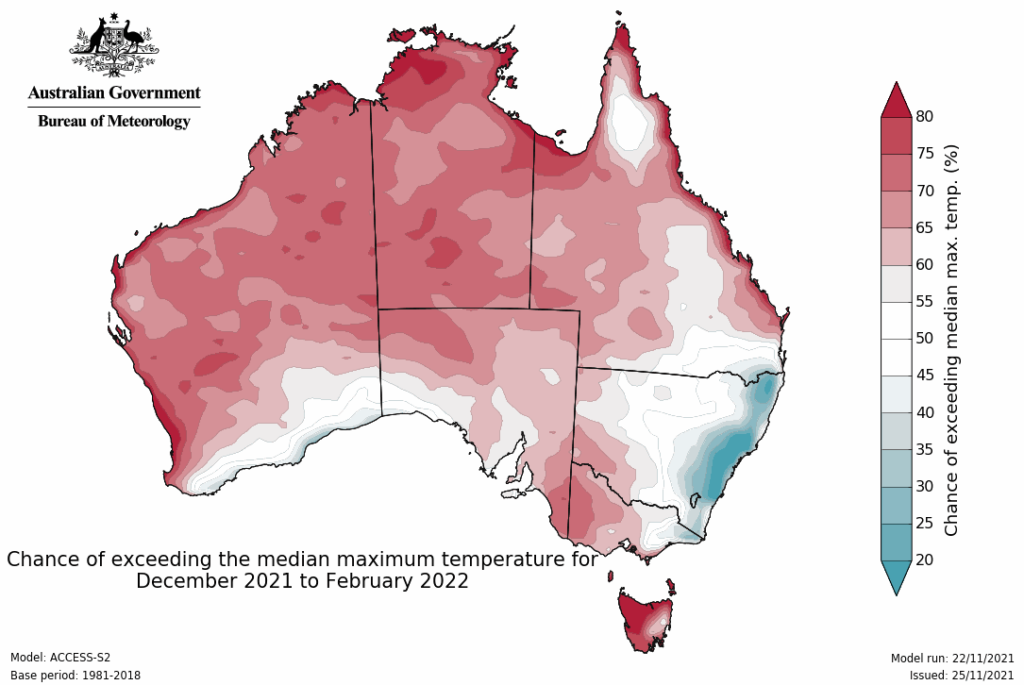
The odds are stacked (1.5 to 3 times more likely) in favour of some unusually high maximum temperatures for most of the country away from the southeast. Below average daytime temperatures are likely for eastern NSW.

Source : Bureau of Meteorology (2021)

What extreme weather risks are we looking at this summer?

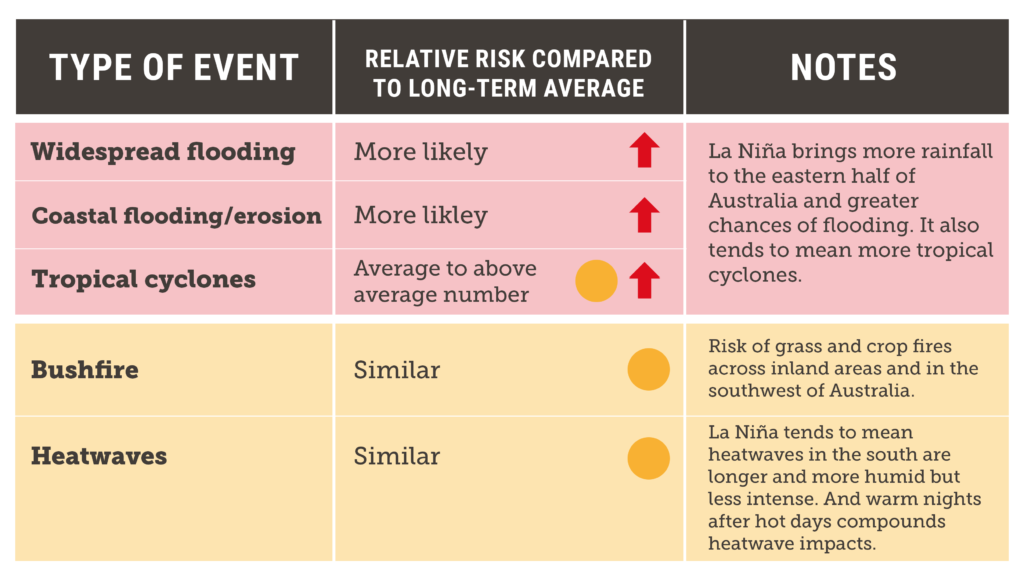
The Bureau of Meteorology’s Summer Outlook 2021-22 shows it is likely to be wetter than average for eastern parts of the continent, with higher risk of heavy rainfall and widespread flooding for these areas.

When it comes to cyclones, during La Niña years there are typically more cyclones in the Australian region than during non-La Niña years. During the 2010-12 La Niña there were several notable cyclones, including Cyclone Yasi – one of the strongest and costliest in Australia’s history.

Every year in which there have been more than one severe landfalling tropical cyclone in Queensland was a La Niña year. The Bureau of Meteorology has predicted an average to slightly-above-average number of cyclones for the 2021-22 season.


What does this mean for bushfire risks?

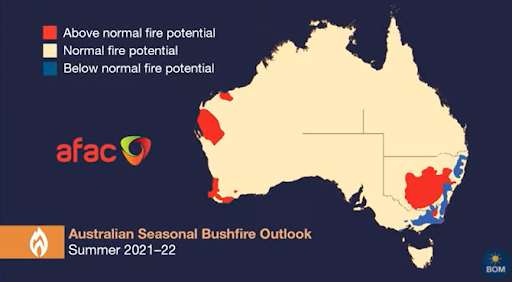
Above-average rainfall may seem like good news when it comes to reducing bushfire risks. However, rain in spring and early summer means lots of grass growth. If these grasses dry out quickly in the warm weather, the risk of fast-running grass fires increases.

The Bureau of Meteorology has warned that over summer 2021-22 we need to be mindful about grass and crop fires, particularly across inland areas and in the southwest of the country where we have had high grass growth over winter and spring. 

All in all, 2021-22 is unlikely to see a repeat of the horrendous conditions we experienced in the lead up to and during the Black Summer, although we must not be complacent. Sadly, due to accelerating climate change, we have entered a new era of greater fire risk and must be even more vigilant than before.

Source: Bureau of Meteorology (2021)

How does it all relate to climate change?

While the La Niña event will influence our weather this summer, it is important to remember that these short-term cyclical drivers are now occurring in the context of a warming climate.

Australia’s temperature and rainfall variability are also influenced by global warming caused by human activities, primarily the burning of coal, oil and gas and land use changes like deforestation. All weather now occurs in an atmosphere that is warmer, wetter and more energetic.

Australia’s climate has warmed by around 1.44°C between 1910 and 2019. A warmer atmosphere can hold more water vapour – seven percent more for every degree of warming. A warmer and wetter atmosphere also provides more energy for weather systems that generate intense rainfall.

This means that while climate change may only result in a modest increase in the overall amount of rain globally – limited by the moisture holding capacity of the atmosphere – it’s leading to a dramatic increase in the heaviest and most damaging rainfall events. 

In recent decades, and especially across northern Australia, a greater proportion of our rain is coming in the form of short, intense downpours. This trend is set to continue, and increases the risk of dangerous floods.

Ignoring climate change is costly

 Australians are already paying the price for the carbon pollution that’s been added to the atmosphere over the past two centuries.

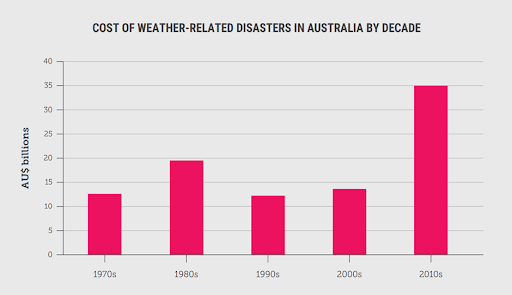
The cost of extreme weather disasters in Australia has more than doubled since the 1970s, reaching $35 billion for the decade 2010-2019.

Queensland bears the highest burden with the state’s total losses from extreme weather disasters since the 1970s around three times those of Victoria, and about 50% greater than NSW. On a per person basis, Queensland’s losses were more than twice the national average.

Source: Climate Council (2021) Based on data from EM-DAT, the International Disaster Database: https://www.emdat.be/

For more information, see the Climate Council report, ‘Hitting Home: The Compound Costs of Climate Inaction’.

Governments, like the Australian Government, that failed to reduce emissions over the past decade have sentenced Australians, and communities worldwide, to a far more dangerous future than if they had heeded repeated warnings from scientists.

Due to this past inaction, gradual, measured steps are no longer enough to avoid catastrophe. At this point, truly transformative action is required. That means at least halving global emissions over the coming decade and reaching net zero emissions globally by 2040 at the latest.

Australia, as a developed country with abundant potential for renewable energy, should aim to reduce its emissions by 75% by 2030 and reach net zero by 2035.

No developed country has more to lose from climate change-fuelled extreme weather, or more to gain as the world transforms to a zero-carbon economy, than Australia does. It is in all of our interests to do more to cut emissions, urgently and rapidly.

For more information, see ‘Aim High, Go Fast: Why Emissions Need to Plummet this Decade’ which is the Climate Council’s science-backed vision for what Australia’s best effort could look like.

Stay Safe this Summer

Stay safe everyone, and if you haven’t already done so, check your state/territory’s fire and emergency agency for advice on how to manage the summer’s extreme weather risks.

Links

01/12/2021

(AU The Guardian) ‘Vandals’: Victoria, Queensland Fume Over Federal Climate Intervention

The Guardian

The Commonwealth has used new powers to cancel States’ participation in global climate action

The latest move on emissions is ‘a global embarrassment’ for the federal government, says Victoria’s energy, environment and climate change minister, Lily D’Ambrosio. Photograph: Dean Lewins/AAP

The Morrison government has used sweeping new powers to override state and territory government support for an international agreement to cut greenhouse gas emissions.

The federal government has deployed recently passed laws to overturn the participation of five states and territories in the global Under 2 Coalition.

In an email dated 23 November, an official with the Department of Foreign Affairs and Trade told his counterpart in the Victorian government that its participation in the coalition was “no longer in operation”.

The email warned the Victorian government that under the new Foreign Relations (States and Territories) Act 2020, sign up to the agreement was now illegitimate.

The email said Victoria had 14 days to tell the global organisation it had “failed to properly classify” the state’s involvement in a 2015 Memorandum of Understanding.

Two-hundred-and-sixty sub-national governments worldwide have signed up to the Under 2 coalition, representing 1.75 billion people and 50% of the global economy.

Members commit to keeping global temperature rises to well below 2C, with efforts to reach 1.5C.

Thirty-five states and regions in the coalition have committed to reaching net zero emissions by 2050 or earlier.

“[T]he MOU has also been invalidated for a number of other states and territories,” the official said, naming the ACT, Northern Territory, Queensland and South Australia. He did not cite NSW, which has lately signed up.

Lily D’Ambrosio, Victoria’s energy, environment and climate change minister, said DFAT had used a technicality that was “illogical” to cancel her state’s participation.

“It’s just a really ridiculous technicality,” D’Ambrosio said. “It’s egregious. They are vandals.”

The move came less than a fortnight after the Glasgow climate summit ended. The Morrison government had weathered extensive criticism at the event for being among the few rich nations to avoid raising their 2030 emission reduction targets.

“This is going to be a global embarrassment, not for the Victorian government but the federal government that has already covered itself in ridicule on the climate change stage,” D’Ambrosio said. “Rather than addressing the urgency of climate change, they are actually putting forward more barriers.”

A spokesperson for Foreign Affairs Minister Marise Payne said the Under 2 Coalition MOU had not come to the minister for a decision.

“The MOU was not properly notified by the relevant states and territory under the Foreign Relations Act 2020 and was therefore automatically invalidated by operation of the Act,” the spokesperson said.

DFAT was also approached for comment, as was energy minister Angus Taylor.

The DFAT official suggested in the email if Victoria wanted to sign up to the Under 2 coalition’s 2021 MOU, his department would consider approving it. He also said Victoria should join with other jurisdictions to make a single submission.

“Under what conditions would they be prepared to consider an application?” D’Ambrosio said. “Are they saying that if there’s one or two states that maybe hadn’t wanted to pursue it or have delayed it, then everyone else will be held up?”

Meaghan Scanlon, Queensland’s minister for the environment and the Great Barrier Reef, said her state had also received the cancellation advice.

“Clearly, the Morrison government aren’t content with their own failures on climate change, they’re now trying to stop the states from taking action.” she said.

“Surely their time would be better spent funding renewable energy projects or delivering a credible policy on reducing emissions, than on playing silly bureaucratic games,” Scanlon said.

Queensland intends to re-apply “because it is an important and useful coalition of like-minded sub-national governments that want to act on climate action”.

Shane Rattenbury, the ACT’s climate change minister, said his government is yet to told of the cancellation, and continued to work with the global group, most recently this week on zero-emission vehicles.

“The Under 2 coalition is a helpful network of sub-national governments to work together on climate action,” he said.

NSW is understood to be discussing with DFAT the application of the new act on its involvement in the coalition.

Chris Bowen, federal Labor’s climate spokesperson said the intervention would probably viewed internationally as another blow to Australia’s reputation.

“The states are doing their best to fill the federal climate vacuum but this demonstrates the need for national leadership,” Bowen said.

“It’s a blight on Scott Morrison that he hasn’t updated the medium-term targets the coalition government agreed to revisit,” he added.

Polly Hemming, an adviser in the Australia Institute’s Climate and Energy Program, said local governments had played an important role in advancing climate action.

Examples include California lifting its ambitions to cut emissions during the Trump years in the US, and in Australia where states have long led the way.

“While the commonwealth government is the only level of government that can commit Australia to a foreign treaty, it’s the state governments that will face the full costs of climate change induced disasters,” she said.

“The ACT legislative assembly and Sydney city council have endorsed a global fossil fuel non-proliferation treaty,” Hemming added.

“We can only wonder if they will be getting emails from federal bureaucrats in the near future as well?”

Links

(RenewEconomy) Coal Power Plants Are Killing Millions With Air Pollution And Must Be Closed, Research Find

RenewEconomy

New research says up to six million early deaths could be avoided through the strategic closure of the worst polluting power stations. (Credit: Canva).

The early and strategic closure of the world’s worst polluting power stations, including inefficient fossil fuel and biomass plants, could avoid the premature deaths of up to six million people by 2050, new research has found.

The research, published in the journal Nature Climate Change, found that retiring the most polluting and most harmful power stations – by focusing on addressing air pollution concerns as well as reducing greenhouse gas emissions – would save millions of lives.

The research has been led by professor Qiang Zhang, of Tsinghua University in Beijing, who modelled the potential impacts of both greenhouse gas emissions and air pollution caused by power generation, particularly coal.

The research identified several power stations that were disproportionately responsible for air pollution and poor health – and it found that policies based on climate change concerns alone were not sufficient to protect public health.

“Our detailed and dynamic analysis of climate, pollution and health impacts from the future power systems at the level of individual generating units reveals that air pollution deaths are not an automatic and fixed co-benefit of all climate mitigation,” the research paper says.

“Rather, pollution controls and strategic retirements of the most-polluting and harmful power plants may ultimately determine the extent to which health co-benefits are realised.”

The research found that between 2010 and 2018, 91 per cent of the premature deaths caused by power station pollution occurred in lower-income or emerging economies.

These included India, China and other countries across Southeast Asia where softer regulatory controls, closer proximity of power stations to densely populated regions and higher industrial activity caused smog and other particulate pollution.

The worst offenders were smaller coal generators, especially those below 300MW in generation capacity, which are more likely to be found in developing countries, which accounted for more than half of air pollution related deaths.

Coal plants made up 46 per cent of the world’s generation capacity, but were responsible for 80 per cent of power generation-related air pollution deaths.

“Even assuming successful climate change mitigation and strong pollution controls, implementing our data-driven approach to targeting super-polluting units for retirement and replacement could save millions of lives worldwide by the middle of the century,” the report says.

The research challenges the assertions of some within the Morrison government that Australia’s ongoing exports of fossil fuels were helping to alleviate poverty and improve health across the Asian region.

The research is the latest addition to a growing body of evidence that the ongoing use of fossil fuels is not just a global environmental concern due to global warming, that it is also a significant public health concern, contributing to substantial increases in air pollution that causes major health problems and premature deaths.

Links

(AU Bloomberg Green) These Australian Coal Mines Are Methane Super-Emitters

Bloomberg Green

New estimates based on satellite data show Glencore’s Hail Creek mine spewed 230,000 tons of the powerful greenhouse gas a year in 2018 and 2019.

A satellite image of Glencore's open cut Hail Creek coal mine in Australia's Bowen Basin.
Source: Maxar


Just inland of Australia's east coast, roughly 200 miles from the Great Barrier Reef, a single coal mine run by Glencore Plc emitted so much super-warming methane in a year that it had the same climate warming impact as the annual pollution from more than 4 million U.S. cars.

The Hail Creek coal mine leaked an estimated 230,000 tons of methane a year in 2018 and 2019, according to researchers with SRON Netherlands Institute for Space Research, who analyzed satellite data from the European Space Agency. Because methane traps over 80 times more heat than carbon dioxide in its first two decades in the atmosphere, the mine had the same short-term warming impact as roughly 19 million tons of CO₂ a year.

The report is one of the first efforts by researchers to quantify just how much methane is coming from individual mines in Australia. Coal itself produces the most CO₂ emissions out of all fossil fuels and nearly 200 countries have agreed on the need to reduce its use to avoid the worst effects of climate change. The new study shows that there's an added danger: disastrous amounts of methane emitted during the mining process.

The Hail Creek mine is among a handful of coal operations in Australia’s Bowen Basin identified by the researchers as super-emitters, including mines run by BHP Group and Anglo American Plc. Hail Creek, which Glencore took over from Rio Tinto Group in August 2018, was the biggest offender.

It accounts for 20% of Australia’s methane emissions from coal mining even though it produces just 1% of the nation’s coal output, according to the report, published Monday in the Environmental Science & Technology journal.

The researchers grouped five other mines in the Bowen Basin into two clusters because it was difficult to distinguish their individual contributions due to their close proximity. Broadmeadow, owned jointly by BHP and Mitsubishi Corp., and Anglo’s Moranbah North and Grosvenor mines released 190,000 tons of methane annually in 2018 and 2019, according to the report. Glencore's Oaky North and Anglo's Grasstree mines emitted an estimated 150,000 tons of methane a year.

Glencore said its Bowen Basin coal business reports emissions in line with Australia's requirements. Anglo American said it submits methane emissions annually, by location, to the country's clean energy regulator and also makes disclosures at a business level in its annual report. A spokesperson for BMA, BHP’s joint-venture with Mitsubishi, said the company publishes emissions from its Australian operations in accordance with the country’s standards.

None of the operators said how much methane comes from the individual mines identified by the Dutch researchers. BHP spokesman Ben Dillaway told Bloomberg in July its Broadmeadow and Goonyella Riverside mines cumulatively emit an average of about 32,000 tons of methane a year.

The new analysis underscores just how big a problem coal is for Australia, which lags other developed nations in tackling climate change. Although it’s extremely vulnerable to the impacts of rising temperatures, Australia was among the last advanced economies to set a target to zero out emissions, has been criticized over the credibility of its plan, and refused to join a global pledge to reduce methane emissions 30% by 2030.

Learn more about the planet-warming power of methane.
The cheap and easy climate fix that can cool the planet fast.
 See the graphic


The findings suggest there may be “a large underreporting of methane emissions in the national inventory,” authors including Pankaj Sadavarte and Ilse Aben wrote. They speculated that the outsize releases from Hail Creek could have come from surface mining operations and efforts to drain gas when expanding the facility.

The research underscores the wide range of climate impacts from different mines. According to the International Energy Agency, the world’s dirtiest coal emits as much as 100 times more methane than cleaner operations. Most of the methane reductions from coal should come from a “drastic fall” in its use, the IEA said in an October report, though steps to minimize leaks “need to happen in parallel.”

The Dutch researchers estimated that all six mines spewed a combined 570,000 tons of methane a year over the study period, accounting for roughly 55% of the reported methane emissions from coal mining in Australia — despite only contributing about 7% of the nation's production.

A closer view of Hail Creek coal mine.
Source: Maxar

Australia’s Department of Industry, Science, Energy and Resources said in a March report that it’s “premature to use satellite data to quantify emissions from methane sources.’’ The Dutch scientists used observations from the ESA's Sentinel-5P satellite to estimate daily methane flux rates from the mines and compared those with emissions from global inventories and figures used in Australia’s reports to the United Nations Framework Convention on Climate Change.

The main caveat with this approach is that the Sentinel-5P “is designed for quantifying methane over large regions rather than precise attribution to individual facilities,” said Riley Duren, chief executive officer of Carbon Mapper. The nonprofit has received funding from Bloomberg Philanthropies.

But Duren said that the findings — that just a handful of mines appear to be responsible for a disproportionate amount of emissions — broadly align with what his team has found studying U.S. coal mines in southwest Pennsylvania using instruments with much higher spatial resolution. Just four underground mines in that region appear to be responsible for 22% of total U.S. methane emissions from underground mines, or about 300,000 tons.

The Dutch research is also similar to another analysis by Kayrros SAS. The French geoanalytics firm found earlier this year that for every ton of coal produced in the Bowen Basin, an average of 7.5 kilograms of methane is released. That was 47% higher than the average global methane intensity estimated by the IEA, according to Kayrros.

Geologically older and deeper coal deposits tend to contain more methane than shallower seams, according to the IEA, which is why emissions from surface mines such as Hail Creek tend to be lower than underground mines. But it’s harder to mitigate leaks from open pit reserves, where emissions are often spread over larger areas and more diffuse.

Ilse Aben, one of the Dutch researchers, said they were surprised by the large methane emissions coming from Hail Creek. “I hope getting attention for this forces people to explain what is happening there,” said Aben. “It requires an explanation.”

— With assistance by Anjali Cordeiro, and Jane Pong

Links

30/11/2021

(Scientific American) Marine Oxygen Levels Are The Next Great Casualty Of Climate Change

Scientific American

The increasing frequency of dead zones will affect billions of people who rely on the ocean for survival

Thousands of dead fish float in the Boca Ciega Bay located near the mouth of Madeira Beach in July 2021 in Madeira Beach, Florida. Ocean water that has lost much of its oxygen content has led to such die offs of marine life in Florida and other parts of the US. Credit: Octavio Jones/Getty Images

Last summer, more than 100 miles of Florida’s coastal waters became an oxygen-depleted dead zone, littered with fish that could be seen even into Tampa Bay. On the other side of the country, Dungeness crabs were washing onto Oregon’s shoreline, unable to escape from water that has, in dramatic episodes, become seasonally depleted of oxygen over the past two decades.

While much of the conversation around our climate crisis focuses on the emission of greenhouse gases and their effect on warming, precipitation, sea level rise and ocean acidification, little is said about the effect of climate change on oxygen levels, particularly in oceans and lakes. Water without adequate oxygen cannot support life, and for the three billion people who depend on coastal fisheries for income, declining ocean oxygen levels are catastrophic.

As ocean and atmospheric scientists focused on climate, we believe that oceanic oxygen levels are the next big casualty of global warming. To stop this, we need to build on the momentum of the recent COP26 summit and expand our attention to the perilous state of oceanic oxygen levels—the life support system of our planet. We need to accelerate ocean-based climate solutions that boost oxygen, including nature-based solutions like those discussed at COP26.

As the amount of CO2 increases in the atmosphere, not only does it warm air by trapping radiation, it warms water. The interplay between oceans and the atmosphere is complex and interwoven, but simply,oceans have taken up about 90 percent of the excess heat created by climate change during the Anthropocene. Bodies of water can absorb CO2 and O2, but only to a temperature-dependent limit.

Gas solubility decreases with warming temperatures; that is, warmer water holds less oxygen. This decrease in oxygen content, coupled with a large-scale die-off of oxygen-generating phytoplankton resulting not just from climate change, but from plastic pollution and industrial run-off, compromises ecosystems, asphyxiating marine life and leading to further die-offs. Large swaths of the oceans have lost 10–40 percent of their oxygen, and that loss is expected to accelerate with climate change.

The dramatic loss of oxygen from our bodies of water is compounding climate-related feedback mechanisms described by scientists in many fields, hundreds of whom signed the 2018 Kiel Declaration on Ocean Deoxygenation. This declaration has culminated in the new Global Ocean Oxygen Decade, a project under the U.N. Global Ocean Decade (2021–2030).

Yet, despite years of research into climate change and its effect on temperature, we know comparatively little about its effect on oxygen levels and what falling oxygen levels, in turn, may do to the atmosphere. To address this unfolding crisis, we need more research and more data.

In the past 200 years, humans have shown remarkable ability to change the planet by altering the timescales in which the Earth cycles chemicals such as CO2. We need to evaluate any possible solutions for their impact on not just greenhouse gases but other critical elements of life, such as oxygen levels.

As the financial world invests in climate change solutions focused on CO2 drawdown, and possibly including future geoengineering efforts such as iron fertilization, we run the risk of causing secondary harm by exacerbating oxygen loss. We need to evaluate potential unintended consequences of climate solutions on the full life support system.

Beyond enhanced monitoring of oxygen and the establishment of an oxygen accounting system, such an agenda encompasses fully valuing the ecosystem co-benefits of carbon sequestration by our ocean’s seaweed, seagrasses, mangroves and other wetlands. These so-called “blue carbon” nature-based solutions are also remarkable at oxygenating our planet through photosynthesis.

The theme of COP26 chosen by the host country (U.K.) was “nature-based solutions.” And we saw a lot of primarily terrestrial focused (forestry) initiatives and commitments that are an excellent step forward. We hope this year’s conference and next year’s COP27 help oceanic nature-based solutions to come into their own, propelled by the U.N. Global Ocean Decade.

Putting oxygen into the climate story motivates us to do the work to understand the deep systemic changes happening in our complex atmospheric and oceanic systems. Even as we celebrated the return of humpback whales in 2020 to an increasingly clean New York Harbor and Hudson River, dead fish littered the Hudson River in the summer as warmer waters carried less oxygen.

Ecosystem changes connected to physical and chemical systems-level data may point the way to new approaches to climate solutions—ones that encompass an enhanced understanding of the life support system of our planet and that complement our understanding of drawdown to reduce emissions of carbon dioxide. Roughly 40 percent of the world depends on the ocean for their livelihoods. If we do not stop marine life from oxygen-starvation, we propagate a further travesty on ourselves.

Links

Lethal Heating is a citizens' initiative