Sunday, January 16, 2022

(AU ABC) Is Nuclear Energy An Essential Weapon In The Fight Against Climate Change — Or A Toxic White Elephant?

ABC Rural - Daniel Mercer

EDF nuclear plant in Bugey, France
Nuclear power provides about 70 per cent of France's electricity needs. (Reuters: Benoit Tessier)

Key Points
  • There are calls to overturn Australia's longstanding ban on nuclear energy, which produces no emissions
  • Nuclear power provides about 10 per cent of the world's energy needs, though none in Australia
  • Critics say extremely high construction costs and time delays make nuclear power uneconomic
Mike Young sometimes wonders why nuclear power has become such an accepted part of life in his native Canada when it is still so deeply controversial in his adopted home of Australia.

After all, he notes, Canada and Australia are remarkably similar in their size, heritage and political sensibilities, and both have the largest reserves of the nuclear fuel uranium in the developed world.

Yet for all the similarities between the two countries, the entrenched views towards nuclear power could hardly be more different, and Mr Young thinks one of the answers might be simple.

"The British didn't test nuclear weapons in Canada," the former uranium mining executive says in reference to the testing regime carried out in Australia in the 1950s.

Interest renewed in nuclear power

Fanned by the winds of change sweeping across the world's energy system in the shift towards a carbon neutral future, interest in the potential of nuclear power has been growing in some quarters.

aerial shot of Ranger uranium mine
The Northern Territory's Ranger was Australia's largest uranium mine until it stopped operating this year. (Supplied: ERA)

The attention centres on the emissions-free nature of nuclear power which, unlike renewable energy sources such as wind and solar, can produce around-the-clock regardless of the weather.

For Mr Young, it is an attribute that should put the nuclear option firmly on the table as the world tries to wean itself off fossil fuels such as coal, diesel and gas.

"It needs to be part of the mix," Mr Young said.

"You have to remember that by 2050, the forecast is we'll double electricity demand.
"To preclude anything, it just means you're going to continue to use fossil fuels for longer."
Around the world, nuclear power meets about 10 per cent of energy demand, a figure that has stayed relatively stable for decades.

While countries that were once major generators of nuclear power such as Japan and Germany have pared back or closed down their industry, others have keenly pursued the technology.

Among them are a host of developing countries such as China, the United Arab Emirates and India, where dozens of plants worth tens of billions of dollars are in the pipeline.

Nuclear energy costs 'crippling'

But conspicuous by their absence are developed countries rushing to build new nuclear plants.

And it is no coincidence according to financial analyst Tim Buckley, who says nuclear cannot compete with renewable energy in the contest for investors' cash.

A man in a suit stands outside on a bright day.
Tim Buckley says nuclear power doesn't stack up economically. (ABC News: Daniel Irvine)

Mr Buckley is the director of energy finance studies for Australia at the Institute of Energy Economics and Financial Analysis (IEEFA), a think tank funded by environmental philanthropists.

He said the high capital cost of nuclear power stations and their tendency to suffer budget and time blowouts made them uneconomic.

"The cost of nuclear is almost always double whatever anyone estimates," Mr Buckley said.
"There's not a nuclear power plant in the world, that I'm aware of, that's been built without massive government subsidies.
"Why? Because a corporate can't take a $20 billion punt.

"And we're not talking Aussie dollars; we're talking euros, or pounds or American dollars — serious money.

"No company can afford that, particularly if there's a 10-year delay."

According to Mr Buckley, long delays in construction meant interest costs often became crippling for nuclear plants.

He pointed to the litany of bankruptcies and high-profile exits from companies such as GE, Toshiba and French giant Areva to argue the nuclear industry was a "graveyard" for corporations.

'Keep existing plants running'

An electricity pylon carries power from a nuclear power station in the UK
Backers say replacing coal with nuclear will keep a lid on transmission costs. (Source: Unknown)

Despite this, Mr Buckley said existing nuclear plants should be allowed to run for as long as possible because they would help efforts to rein in global emissions.

Citing an article by clean energy guru Michael Liebreich, he said it was "criminal" that Germany was moving to shut down its nuclear energy industry — a move that had increased the country's reliance on coal-fired energy and imports of nuclear power from France.

And Mr Buckley, a former investment banker, said that for all the publicity they generated, nuclear disasters such as the Fukushima meltdown in Japan in 2011 were exceptionally rare.

"Where you've got well managed, properly supervised, independently regulated nuclear that's already had that massive investment in getting built, let them run for as long they can," he said.

"At the end of the day, having a liveable planet is probably more important than the risk of a Fukushima, so let's actually go for a liveable planet and stop lignite (brown coal) first, stop coal second and do nuclear third."

Tania Constable, who heads industry lobby the Minerals Council of Australia, said she doubted the world could meet its net zero goals within the next 30 years without an increase in nuclear power.

Ms Constable said Australia was well placed to take advantage of any increase in demand for nuclear power, given its significant reserves of yellow cake.

To that end, she noted there were several uranium mining projects across Western Australia, South Australia and Queensland waiting in the wings.

Opportunity for Aussie miners

She said the key would be a sustained increase in prices, which have been depressed since 2011 but have shot up in recent months.

Nuclear power - Price graph
Spot and contract uranium prices have been rising for the first time in years. (Supplied: Cameco)

"Because we've seen the price of uranium increasing, those companies that have had projects mothballed ... are now almost at the point where they can make decisions to move projects back into operation," she said.

"I think that's a great thing for states, a great thing for the industry, and is necessary if we want to see reliable, clean energy at a global level."

While nuclear power has been characterised by giant plants that can produce up to 12 gigawatts at a time — enough to meet a third of the demand in the National Electricity Market — Ms Constable said the industry was changing.

She said that significant work was underway to develop so-called small modular reactors that could replace coal-fired power stations and even power remote towns and mine sites.

It's a view echoed by Mr Young, who until this year ran WA uranium mining hopeful Vimy.

He believes small reactors are likely to have a much brighter future than mega plants of the past, saying modular versions would be cheaper and easier to build and install.

And he suggested modular plants might help engender a more sympathetic view towards nuclear in Australia, which differs from many developed countries in having no nuclear energy.

Mr Young said public hostility to nuclear appeared to be easing, pointing to the Morrison government's decision to buy nuclear-powered submarines and Labor's support for the proposal as evidence.

Naval personnel stand on top of a US Navy submarine sitting in a harbour
Australia has agreed to buy nuclear-powered submarines from the US or UK. (AP: US Navy/File)

"The problem is building big reactors in a country like Australia is just not going to happen," he said.

"But what is happening is the development of small modular reactors.
"Now, I personally think that some time in the 2030s we'll get those in Australia replacing coal plants.
"And if you do it where the coal plants are, you've got all your (poles and wires) already in and you don't have to build a whole new transmission system."

Future 'renewable, not nuclear'

Mr Buckley remains unconvinced by the arguments for small nuclear reactors.

He said the technology was yet to be proved at a pilot stage let alone a commercial level.

Mr Buckley said renewable energy costs would continue to drop, making other options including nuclear power unviable.

"This is not a single plant operational in the world, and there's a very good chance there won't be even a demonstration small scale nuclear reactor plant this decade," Mr Buckley said.
"So why is anyone even talking about it?"
Faced with claims that nuclear was required to replace the base-load generation of coal and gas, Mr Buckley was equally forthright.

He said a combination of technologies and strategies would underpin the grid's switch to net zero.

SOLAR FARM APA
Solar panels costs have plummeted over the past decade, accelerating uptake. (Supplied: APA Group)

Among these were more high-voltage poles and wires to accommodate ever increasing amounts of renewable energy, storage services such as batteries and "pumped-hydro" schemes, and a properly designed electric vehicle policy.

He acknowledged there would also be a need for gas-fired peaking power plants for some time yet.

However, he argued nuclear would not be needed.

"If we use imagination, if we use engineers, if we use the grid, if we use technology, if we use artificial intelligence, the reality is the grid is going to be far more resilient in 10 years than it is today," he said.

"I'm not saying the system can work tomorrow 100 per cent renewable but ... it's got to be ready for that because it's coming whether you like it or not."

Links

(AU SMH) Ocean Temperatures Set Heat Records, Raising Fresh Concerns For Marine Life

Sydney Morning Herald - Laura Chung

The world’s oceans recorded their hottest year in more than 60 years with greenhouse gases driving increasing temperatures, amid concerns the ocean’s ecosystems will be unsustainable in the warmer climate.

The annual study, which draws on data between 1958 and 2021, published in the journal Advances in Atmospheric Sciences, found that ocean heat content during the past five years was the warmest in its records, driven largely by anthropogenic greenhouse gases.

Warmer ocean temperatures are expected to lead to more intense weather systems.
Warmer ocean temperatures are expected to lead to more intense weather systems. Credit: Brook Mitchell

ANU institute for climate, energy and disaster solutions director Professor Mark Howden said oceans played a vital role in absorbing about 90 per cent of the heat and gases in the atmosphere.

He said the results were worrying and continued a long-standing trend of rising ocean temperatures, particularly given records had been broken despite last year’s La Nina event, which brings cooler conditions.

As oceans continue to warm, marine heatwaves are likely to become more common.

They are already twice as frequent as they were 40 years ago.
Weather Ocean swimmer Lauren Tishendorph, who swims around the eastern suburbs, said the water had been noticeably warm since the end of last year.
Sea temperatures inch towards record high but marine ecosystems could suffer

“If we keep a foot on [the] climate change accelerator, there will be 40 to 60 times the number of marine heatwaves around Australia by the end of the century,” he said.

The study found that since 1958 the world’s oceans had absorbed between 4.7 and 5.7 zettajoules of energy per year in the upper 200 metres of the ocean.

A zettajoule is a measurement referring to a vast amount of heat energy – estimated to be about twice the world’s total human-generated energy production in a year.

It represents a huge amount of extra heat being stored in the seas. The study also found the rate of heat absorption had increased markedly in recent years, with eight times as much heat being absorbed on average between 1986 and 2021, compared to 1958-85.

Professor Howden added the report provided a sense of urgency to reduce the impact of climate change, with technology and business already leading the way. Political will was lagging, he said.

Climate policy A mountain near Limni village on the island of Evia, about 160km north of Athens on fire last year as Greece grappled with its worst heatwave in decades.
The past seven years were the hottest on record, a new climate report shows

“The only solution to this is reducing greenhouse gas emissions,” he said. “These days, business is leading the way and community is leading the way,” he said.

“There’s little on earth that is not affected in one way or the other by climate.”

Physical oceanographer Ian Young at the University of Melbourne said warmer ocean temperatures would create more intense weather systems, such as storms and tropical cyclones.

He added that increasing greenhouse gases in the ocean, especially carbon dioxide, would have an impact on the seas’ acidity.

“Carbonic acid eats away at calcified organisms, like shells. Animals are having their shells eaten away by the acidity of the ocean,” he said.

Global coral cover is forecast to decline 95 per cent under 2 degrees of warming, and 70 per cent under 1.5 degrees.

Recycling crisis Bev and Graham Hordern at home in Moss Vale. Over their shoulder is the site of what may become the nation’s largest plastic recycling facility.
A big blue in a small Southern Highlands town over a giant plastics plant

Australia Institute of Marine Science coral biologist Dr Neal Cantin said there were sections of the Great Barrier Reef that were several degrees warmer than they were historically for this time of year, with scientists monitoring for bleaching events.

But he added that global marine ecosystems were all at risk of warming ocean temperatures.

“I don’t think coral reefs will be able to keep up with these warming trends. Coral reefs are the poster for ecosystems – they are the base of the system.

Coral is sensitive to subtle changes in temperature and light,” he said.

“The oceans are warming faster than they have ever warmed on record, animals and ecosystems that are dependent on temperatures are going to respond negatively.”

The release of the study coincides with the publication of the Copernicus Climate Change Service report that found the past seven years had been the seven warmest on record despite the La Nina weather pattern. The report showed the world has already warmed between 1.1 and 1.3 degrees above pre-industrial levels.

A preliminary study of satellite data by Copernicus, which provides climate data to the European Union, found that greenhouse gas emissions continued to rise despite the economic slowdown caused by the COVID-19 pandemic.

Carbon dioxide levels reached an annual global record of approximately 414 parts per million and methane an annual record of approximately 1876 parts per billion.

Links

(Sustainability Magazine) Top 10 Climate Change Solutions

Sustainability Magazine - India Berry


We take a look at ten solutions to global warming and climate change Climate change is an ever growing issue for the world.

Manufacturing, agriculture, transport, and construction are some of the main industries that contribute to global warming and climate change.

Here in this list we look at 10 different solutions to combat climate change and its effects.


10. Food Choice


Agriculture is one of the largest contributors to climate change, the production of factory farmed meat is bad for the environment as well as being unethical, choosing local free range providers is better for sustainability.

Cow farming in particular affects the climate the most due to the methane gases, opting for dairy free options or plant based foods can reduce the effects that the food industry has.


9. Place of production


Producing products in the place where they are intended to be sold means there is no need for overseas transportation of products.

Buying and consuming products in places like local shops and farmers markets reduces the need for shipped goods which then reduces our carbon footprint.


8. Reduce Waste


Waste is a big problem for the sustainability of every industry, in the clothing market many companies produce trending items which inevitably then go out of trend resulting in an increased amount of waste.

Choosing items which can last a lifetime reduces the amount of waste.

The food industry also creates a lot of waste, due to the over-purchasing of food, buying food in bulk packs can mean some of it goes off before it can be used, opting for smaller packs of products results in less waste.


7. Digitalise


In schools and workplaces paper usage is avoidable, having students and employees using computers, laptops or tablets reduces the amount of paper use and waste.

With innovations such as digital pens for tablets means paper usage can be further reduced within the majority of industries.


6. Transport Choice


The large majority of transport options burn fossil fuels to operate, opting to use public transport when available is a more sustainable option because of the lesser amount of vehicles being used.

When in close distance of a location, opting to walk or cycling instead of drive reduces carbon dioxide emissions and can save money.


5. Recycling


Landfills not only ruin areas of the environment but also give off carbon dioxide.

Using recycling schemes makes sure items that can be repurposed don't end up in landfill and reduce the need for raw materials.


4. Electric Vehicles


Using and burning fossil fuels is one of the largest causes of climate change and cars are a big part of this problem running on petrol and diesel.

Choosing an electric car instead reduces the climate effect of cars. In industries where vehicles are frequently used such as transport and deliveries reduces our overall carbon footprint.


3. Save Energy


Reducing energy within homes and businesses helps to combat climate change.

Simple changes such as LED light bulbs can make a large difference to your energy consumption.

Other energy saving measures include washing clothes with cold water, air drying clothes and choosing more energy efficient appliances.


2. Reusing


Repurposing materials allows people and businesses to use less raw materials, and purchase less.

Businesses reusing waste materials takes pressure off raw materials and our environment.

People repurposing unneeded materials in the household is not only sustainable but can also save money.

Opting to repair instead of purchase reduces the need for more products.


1. Consumer Choice


The way consumers shop affects climate change and sustainability.

Buying from companies that mass produce un sustainable products has many effects on the environment and social sustainability and leads to more waste.

Choosing to buy pre owned products such as electricals, homeware and clothing reduce the need for production of new items and raw materials.

Purchasing items from companies that use recycled, or sustainably sourced decreases the effect on our climate and environment.

Links

Saturday, January 15, 2022

(The Conversation) Ocean Heat Is At Record Levels, With Major Consequences

The Conversation -

Author
Dr. Kevin Trenberth is a Distinguished Scholar at the National Center for Atmospheric Research (NCAR) in Boulder, Colorado, USA.
Dr. Trenberth is an affiliate faculty at the University of Auckland, New Zealand.
He studies climate variability and change.
The world witnessed record-breaking climate and weather disasters in 2021, from destructive flash floods that swept through mountain towns in Europe and inundated subway systems in China and the U.S., to heat waves and wildfires.

Typhoon Rai killed over 400 people in the Philippines; Hurricane Ida caused an estimated US$74 billion in damage in the U.S.


Globally, it was the sixth hottest year on record for surface temperatures, according to data released by NASA and the National Oceanic and Atmospheric Administration in their annual global climate report on Jan. 13, 2022.

But under the surface, ocean temperatures set new heat records in 2021.


As climate scientist Kevin Trenberth explains, while the temperature at Earth’s surface is what people experience day to day, the temperature in the upper part of the ocean is a better indicator of how excess heat is accumulating on the planet.

The Conversation spoke with Trenberth, coauthor of a study published on Jan. 11, 2022, by 23 researchers at 14 institutes that tracked warming in the world’s oceans.


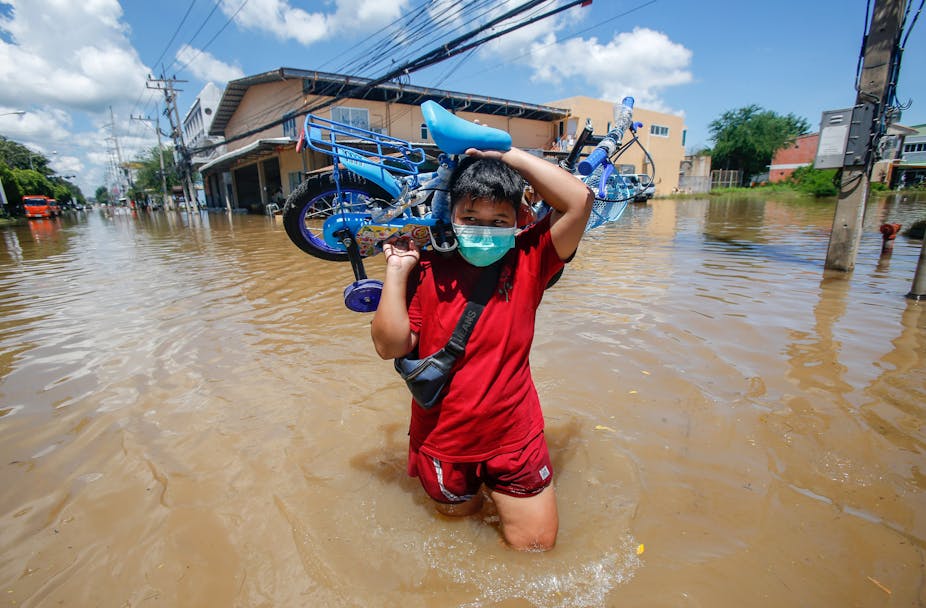
A person carries a child's bike through flood water
A tropical storm’s rain overwhelmed a dam in Thailand and caused widespread flooding in late September. It was just one of 2021’s disasters. Chaiwat Subprasom/SOPA Images/LightRocket via Getty Images

Your latest research shows ocean heat is at record highs. What does that tell us about global warming?

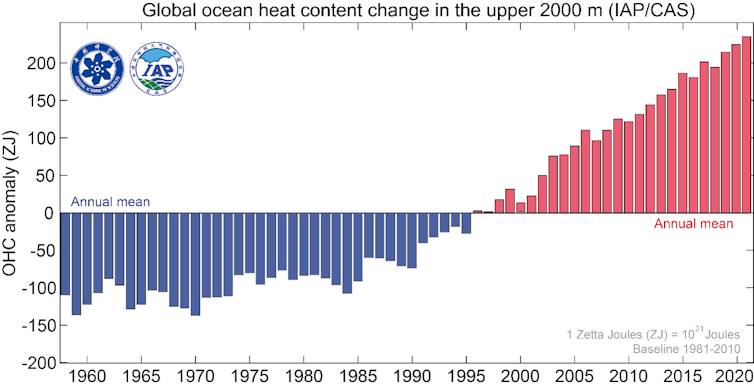
The world’s oceans are hotter than ever recorded, and their heat has increased each decade since the 1960s. This relentless increase is a primary indicator of human-induced climate change.

As oceans warm, their heat supercharges weather systems, creating more powerful storms and hurricanes, and more intense rainfall. That threatens human lives and livelihoods as well as marine life.

The oceans take up about 93% of the extra energy trapped by the increasing greenhouse gases from human activities, particularly burning fossil fuels. Because water holds more heat than land does and the volumes involved are immense, the upper oceans are a primary memory of global warming.

I explain this in more detail in my new book “The Changing Flow of Energy Through the Climate System.”

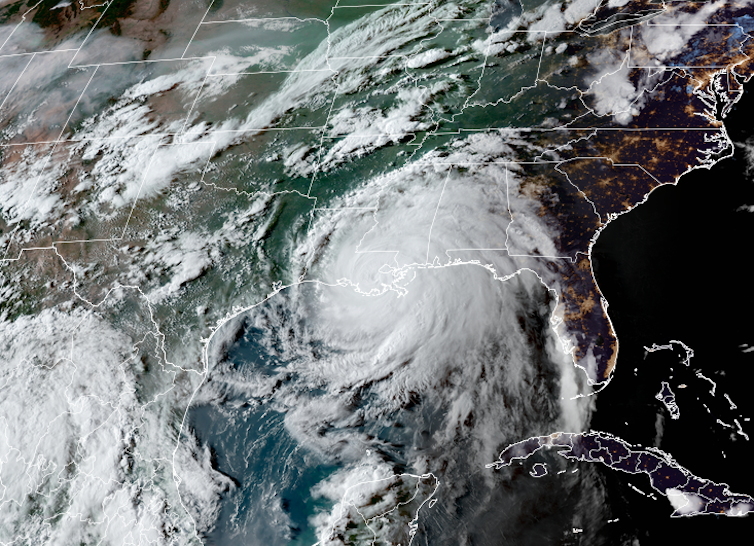
Hurricane Ida making landfall on the Louisana coast
Hurricane Ida did $74 billion in damage from Louisiana to the Northeast in 2021. RAMMB/CIRA/Colorado State University

Our study provided the first analysis of 2021’s ocean warming, and we were able to attribute the warming to human activities. Global warming is alive and well, unfortunately.

The global mean surface temperature was the fifth or sixth warmest on record in 2021 (the record depends on the dataset used), in part, because of the year-long La Niña conditions, in which cool conditions in the tropical Pacific influence weather patterns around the world.

Ocean heat content in the upper 2,000 meters of the world’s oceans since 1958, relative to the 1981-2010 average. Ocean temperature records go back to the 1950s. The units are zettajoules. Lijing Cheng

There is a lot more natural variability in surface air temperatures than in ocean temperatures because of El Niño/La Niña and weather events.

That natural variability on top of a warming ocean creates hot spots, sometimes called “marine heat waves,” that vary from year to year.

Those hot spots have profound influences on marine life, from tiny plankton to fish, marine mammals and birds. Other hot spots are responsible for more activity in the atmosphere, such as hurricanes.

While surface temperatures are both a consequence and a cause, the main source of the phenomena causing extremes relates to ocean heat that energizes weather systems.

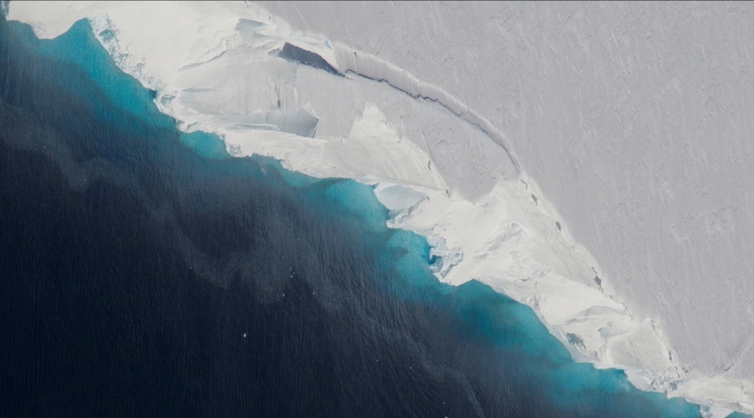
Scientists are concerned about the stability of Antarctica’s Thwaites Glacier, which holds back large amounts of land ice. NASA

We found that all oceans are warming, with the largest amounts of warming in the Atlantic Ocean and in the Southern Ocean surrounding Antarctica.

That’s a concern for Antarctica’s ice – heat in the Southern Ocean can creep under Antarctica’s ice shelves, thinning them and resulting in calving off of huge icebergs. Warming oceans are also a concern for sea level rise.

In what ways does extra ocean heat affect air temperature and moisture on land?

The global heating increases evaporation and drying on land, as well as raising temperatures, increasing risk of heat waves and wildfires. We’ve seen the impact in 2021, especially in western North America, but also amid heat waves in Russia, Greece, Italy and Turkey.

The warmer oceans also supply atmospheric rivers of moisture to land areas, increasing the risk of flooding, like the U.S. West Coast has been experiencing.

2021 saw several destructive cyclones, including Hurricane Ida in the U.S. and Typhoon Rai in the Philippines. How does ocean temperature affect storms like those?

Warmer oceans provide extra moisture to the atmosphere. That extra moisture fuels storms, especially hurricanes. The result can be prodigious rainfall, as the U.S. saw from Ida, and widespread flooding as occurred in many places over the past year.

The storms may also become more intense, bigger and last longer. Several major flooding events have occurred in Australia this past year, and also in New Zealand. Bigger snowfalls can also occur in winter provided temperatures remain below about freezing because warmer air holds more moisture.

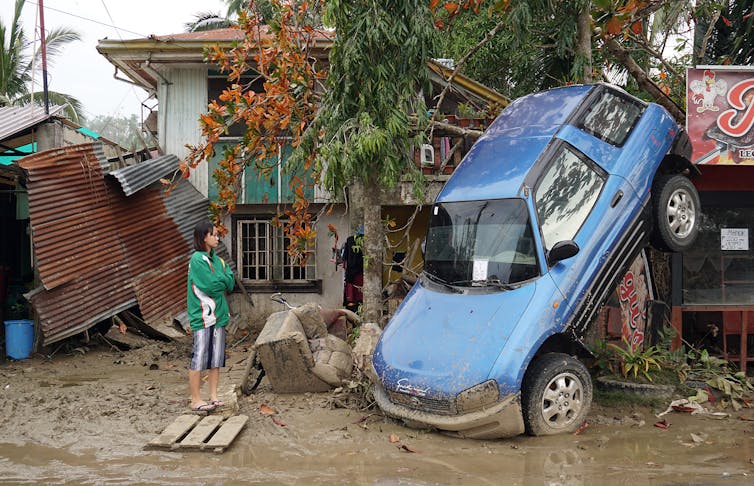
A woman stands, arms crossed, staring at a car propped on its nose against a business after the typhoon.
A resident in the Philippines looks at a vehicle swept away by flood water during Typhoon Rai. Cheryl Baldicantos/AFP via Getty Images

If greenhouse gas emissions slowed, would the ocean cool down?

In the oceans, warm water sits on top of cooler denser waters. However, the oceans warm from the top down, and consequently the ocean is becoming more stratified. This inhibits mixing between layers that otherwise allows the ocean to warm to deeper levels and to take up carbon dioxide and oxygen. Hence it impacts all marine life.

We found that the top 500 meters of the ocean has clearly been warming since 1980; the 500-1,000 meter depths have been warming since about 1990; the 1,000-1,500 meter depths since 1998; and below 1,500 meters since about 2005.

The slow penetration of heat downward means that oceans will continue to warm, and sea level will continue to rise even after greenhouse gases are stabilized.

The final area to pay attention to is the need to expand scientists’ ability to monitor changes in the oceans.

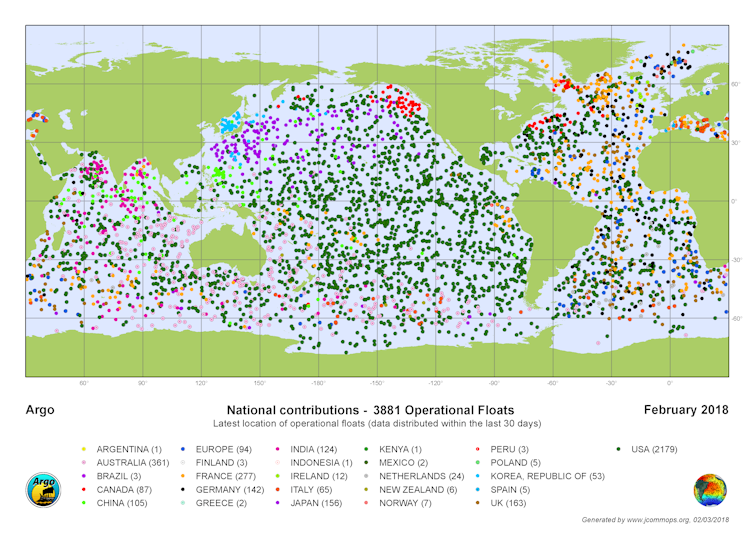
One way we do this is through the Argo array – currently about 3,900 profiling floats that send back data on temperature and salinity from the surface to about 2,000 meters in depth, measured as they rise up and then sink back down, in ocean basins around the world.

These robotic, diving and drifting instruments require constant replenishment and their observations are invaluable.

Argo floats keep tabs on ocean changes around the world. Howard Freeland, 2018, CC BY-ND


Links

(AU ABC) Channel Country Gas Development Could Increase National Emissions By 60 Per Cent, Report Says

ABC News - Nathan Morris

A pattern of channels among green herbage and wildflowers near Windorah in July 2019.
The channels in Queensland's south west after flooding in 2019 — not far from where gas development is proposed. (ABC Southern Queensland: Nathan Morris)

Key Points
  • Professor Ian Lowe says emissions from a proposed Queensland gas development is incompatible with government pledges to cut carbon
  • The Queensland government says emissions reduction targets "are achievable"
  • "Fugitive emissions" in Queensland are the highest in the nation and "the long-term trend is increasing" 
A new report by a leading climate change expert has found that proposed gas development in the Lake Eyre Basin could increase Australia's total annual emissions by 60 per cent. 

Last month the ABC revealed that, without consulting traditional owner groups, the Queensland government had progressed plans for gas development in the environmentally fragile Channel Country, a vast system of flood plains in the state's south west.

A report, commissioned by environmental group Lock the Gate by leading climate change scientist Emeritus Professor Ian Lowe from Griffith University, modelled the potential carbon emissions if the gas projects in Queensland went ahead.

The Queensland component of the gas is in the Cooper-Eromanga Basin, and Professor Lowe found that if just 25 per cent of the resource was recovered, the emissions it would produce would be "incompatible" with Queensland's emission reduction targets.
"It would increase greenhouse gas emissions by about 60 per cent of Australia's current total national emissions from all sources: electricity, transport, manufacturing agriculture," he said.
"The high level of production would be about 300 million tonnes of carbon dioxide a year, and Australia's current total emissions from all causes is about 500 million tonnes a year."

An aerial shot of cattle grazing in a green paddock
The Channel Country's flood plains are home to a large sustainable grazing industry. (Supplied: OBE Organic)

The Queensland government has pledged to reduce emissions by 30 per cent of 2005 levels by 2030, but Professor Lowe's report found that even "the low export scenario would result in Scope 1 emissions alone that are more than 50 per cent of Queensland's proposed reduction of 31 million tonnes a year from all sources by 2030."

"Even a modest level of production would be incompatible with Queensland stated emission reduction targets," he said.

A map of locations in the Channel Country have production licences from Origin Energy
More than 250,000 hectares of land in the Channel Country is subject to Origin Energy's applications. (Supplied: Queensland Government)

Targets 'achievable'

But the Queensland government said its emissions targets were "achievable".
"In fact, Queensland achieved 20 per cent of its renewable energy target by 2020 and is almost halfway to reaching its 2030 emissions reduction target, having reduced emissions by 14 per cent since 2005," a spokesperson said.
Traditional owners call for a pause
on Channel Country fracking plans
Birds eye view of the veins of the Kati Thanda-Lake Eyre basin river systems
The Lake Eyre Basin contains an estimated 334 trillion cubic feet of "unconventional gas", meaning to release the gas from the predominantly shale rock formation, gas wells would need to be depressurised by extracting groundwater or hydraulic fracturing, also known as fracking. 

There is concern among traditional owners and graziers in the area, but the Queensland government spokesperson said that additional approvals were still required before gas development could occur in the region, and they would be "subject to stringent assessment criteria".

Fugitive emissions

Professor Lowe said the Lake Eyre Basin contained high levels of additional CO2, which would be released directly into the atmosphere during gas extraction.

"The gas there contains significant amounts of carbon dioxide, so just producing the gas to be burned somewhere else would result in the release of significant amounts of carbon dioxide into the Australian atmosphere," he said.

A map of the Lake Eyre Basin
The Lake Eyre Basin covers large parts of four Australian states and territories. (ABC News: Alex Palmer)

The other factor was the "fugitive emissions" from gas production, the methane gas that either escapes or has to be vented from production pipelines for safety.

Queensland has the highest fugitive emissions from coal and gas mining in the nation, and they continue to rise.

A 2018 Queensland government report found fugitive emissions represented "11 per cent of Queensland's total emissions and the long-term trend is increasing emissions".

"Methane is a much more powerful greenhouse gas than carbon dioxide, and so the leakage, if gas were produced in the Channel Country, would add significantly to our greenhouse gas production locally," Professor Lowe said.
"In typical natural gas fields, about 5 per cent of the gas leaks into the atmosphere, in some bad cases at 7 or 8 per cent."
A coal seam gas well and all of the piping and water extraction infrastructure.
Coal seam gas mining is widespread further east of the Channel Country, and criss-crosses farm land. (ABC Southern Queensland: Nathan Morris)


A spokesperson for the Queensland government said it had a plan to reduce fugitive emissions.

"The Palaszczuk government has committed in its draft 30-year-plan for the resources industry to work with industry to investigate ways to reduce fugitive emissions from resource activities, particularly in the Bowen Basin," they said.
"It also expects industry to reduce emissions, including fugitive emissions."
'Making enormous money'

After gas prices fell during 2020, international demand for the resource has rebounded, and the International Energy Agency forecasts more growth in the coming years.

"All these gas companies at the moment are trying to produce as much gas and ship as much gas as they possibly can," Bruce Robertson said, an Energy Finance Analyst with the Institute for Energy Economics and Financial Analysis (IEEFA).

"Even if it's not contracted gas, they're making enormous money on it."

Coal seam gas wells near Chinchilla
Coal seam gas wells in an area south of Chinchilla in southern Qld, near the Tara residential estate. (AAP: Supplied)


However, last year another report from the International Energy Agency said:
"Beyond projects already committed as of 2021, there are no new oil and gas fields approved for development in our pathway [to net-zero], and no new coal mines or mine extensions are required."
Mr Robertson said this was at odds with the continued enthusiasm for fossil fuel projects in Australia.

"In every state and territory, we're seeing new areas opened up for exploration by the current governments," he said.

"We're seeing this massive expansion of the gas industry, which is entirely inconsistent with any climate commitments."

While demand for gas remained strong now, Mr Robertson thought that would change.
"The change is very rapid when it occurs, and all the factors are in place for that change to occur in gas and when it comes it will come very quickly," he said.
"In New South Wales, for example, the state where I live, there are 17 battery projects, grid-scale battery projects in the planning system right now." 

Resources a major economic driver

Farmer welcomes CSG Farmer Ian Hayllor stands near gas drilling rig on his farm near Dalby in June 2021.

A report in December 2021 by the Federal Department of Resources found oil and gas projects "accounted for the largest share of committed projects by value".

The Queensland government also reports that the resources industry directly employs around 80,000 people in the state.

And according to Australian Petroleum Production and Exploration Association (APPEA), liquefied natural gas (LNG) and oil projects generated $13.20 billion in royalties and contributed $55 billion to national GDP. 

Links

Lethal Heating is a citizens' initiative