The world has just experienced the hottest 12-month period ever
recorded, with average temperatures breaching the 1.5°C climate target.
Key Details
The EU's Copernicus climate service recorded the global mean temperature between February 2023 and January 2024 at 1.52°C above the 1850-1900 pre-industrial average: European Union Earth Observation
This temperature was 0.64°C hotter than the previous all-time high during 1991-2020.
January 2024 was the hottest global January on record, marking the eighth consecutive month of record temperature highs.
Average global sea surface temperatures for January 2024 also broke a record at 20.97°C, exceeding the previous 2016 record January by 0.26°C.
This breach of the Paris Agreement climate target across an entire year sets an alarming precedent.
Climate scientists emphasise that urgent action to reduce carbon dioxide emissions can still slow warming.
Whether
Australia is able to achieve net zero by 2050 will depend on our
political choices and the decisions of Australian governments in the
next few years. Illustration: 360info
Ross Garnaut AC
Ross Garnaut is an economist whose career has been built around the analysis of and practice of policy connected to development, economic policy and international relations in Australia, Asia and the Pacific. He has held senior roles in universities, business, government and other Australian and international institutions. Ross Garnaut is:
Professor Emeritus within the University of Melbourne in Business and Economics
Fellow of the Australian Academy of Sciences
Distinguished Fellow of the Economic Society of Australia
Distinguished Life Member of the Australian Agricultural and Resource Economics Society
Honorary Professor of the Chinese Academy of Social Sciences
Doctor of Letters, honoris causa, Australian National University
Doctor of Science in Economics, honoris causa, University of Sydney
Ross Garnaut is the author or editor (alone or jointly with others) of 48 books in addition to numerous influential articles in scholarly journals and books on international economics, public finance, and economic development.
Donald
Trump might be a speed hump on the road to net zero, but the business
and climate case for renewables leaves Australia in the box seat to
capitalise.
The start of
a second Trump US presidency has led many to question the future
outlook for energy in Australia and around the world, and what impact
the new US administration will have on the move towards net zero.
Economist
Ross Garnau, professor emeritus at both the Australian National
University and the University of Melbourne, spoke to Info 360 about
where things stand.
Q: Last
November, you seemed to think there were real prospects for renewables
in the world and the move towards net zero. You thought that the
political and international settings for the environment were
favourable. What’s your feeling today?
A: I certainly thought there were prospects of moving forward. A number of aspects of the international settings were favourable.
China
is not only the world’s main producer of capital goods for the new
economy, but also by far the world’s biggest user of renewables.
Last
year China produced more renewable energy than the rest of the world combined. Europe and other economies of North-East Asia are also making good progress.
And
that creates a huge opportunity for Australia to use some of our
renewable energy resources to support new industries exporting goods,
especially to Europe and North-East Asia — countries that can’t generate
the renewable energy to do it themselves.
The
election of Trump doesn’t change the physics [of climate change] one
bit. Atmospheric physics doesn’t care who wins American elections or
what commentators are saying on Fox News.
Climate change is getting more severe
and that will require a response, even though that may be an ignorant
response. If it turns out to be an ignorant response, that would
undermine our social and political order.
But
it may also engender a positive response. I certainly think [Trump’s
election] will have a negative effect on the US’s interaction with the
international community. It may not have such a big negative effect in
the United States, because Trump may not find it easy to repeal all the
Biden measures.
Q: One of the first executive orders Trump signed was to withdraw from the Paris Agreement again. How do you see the impact of that decision on the rest of the world?
A: That’s
up to the rest of the world. It will be influential. But, the rest of
the world can choose to resist that influence.
If the rest of the world
bows to the influence, that could seriously affect commitments towards
net zero in major economies generating a large amount of greenhouse
gases, such as China, Japan, Korea, the European countries, and India.
That would certainly have a big negative effect on international development towards net zero.
But
it’s not certain that will be the case. China sees a geopolitical
opportunity in America’s withdrawal from Paris. It’s already actively promoting its own decarbonisation.
China is a huge ship to turn around, but it’s turning around. And it
has momentum now in moving its industries towards a zero-carbon economy.
It
will use its industrial strength to enhance cooperation with other
countries wanting to move to net zero. And the speed of that move
depends on their domestic politics and whether governments of the centre
right or centre left, remain in power in the big European countries,
such as Germany, France, and the UK. If they do, there is every prospect
of the Paris commitments surviving, despite the change in US.
But
if the US developments become instrumental in changing political
direction in the rest of the world, then that will have a big negative
effect on the world’s action on climate change.
Q: For
big carbon-emitting businesses will that mean they can do whatever they
want in terms of gas and oil exploration in the US? Do you expect that
to follow in the rest of the world as well?
A: We
still have a lot of business commitments to taking action on climate
[change]. But for some businesses those commitments are only skin deep,
dollar deep, and we’ve already seen some reversals in the rest of the
world.
Macquarie Bank, for example, headquartered in Australia has retreated on Paris commitments. Many companies around the world will use the US changes to pull back on those commitments.
We
can’t rely on voluntary action by business to deliver good outcomes.
You need policy and incentives because most businesses will only do what
is profitable. Nevertheless, there are opportunities for businesses
that are prepared to stay the course on climate commitments and they
will be in a strong position when America comes back to the Paris
agreements, as it may.
Q: What about business decisions in Australia, particularly for gas and oil exploration?
A: The
mood has certainly moved. The barriers to Australia increasing its
emissions and not meeting emissions targets has been weakened. However,
both the government and opposition remain committed to net zero.
If we in Australia allow too much gas development, it will become impossible for us to achieve net zero by 2050.
The outcome depends on our own political choices and the decisions that
Australian governments make over the next few years, at a time that
Trump is signalling that he has little to no interest in renewables.
Q: How
do you see the opportunities for renewable development in Australia?
I’m thinking particularly of opportunities for rural Australia.
A:Renewable energy is the cheapest form of energy.
There’s lots of smokescreens around that but serious people in business
know that you wouldn’t invest now in a coal-based power station because
it would not be as cheap as investing in the best renewables backed by
storage.
Cyclone Alfred formed in the Coral Sea towards the end of February when sea surface temperatures were almost 1C hotter than usual
The surf at Snapper Rocks on the Gold Coast. Sea levels worldwide have risen by 20cm due to climate change, ‘which can make damages worse when storms like Cyclone Alfred hit’, an expert says. Photograph: Jason O’Br
Tropical Cyclone Alfred hit south-east Queensland on Saturday, bringing destructive winds, extreme flooding and storm surges to millions of people around Brisbane, the Gold Coast and northern New South Wales.
After last year was recorded as the hottest on record around the world, and the hottest for Australia’s oceans, what role could the climate crisis be playing in Tropical Cyclone Alfred and its impacts?
Like all weather systems on the planet, tropical cyclones are forming in a world that is heating rapidly, mostly because of the burning of fossil fuels.
The planet – and the world’s oceans – are retaining more of the sun’s energy because of the extra greenhouse gases in the atmosphere.
But tropical cyclones are complex. They need ocean temperatures of at least 26.5C and the right setup of atmospheric conditions to form. In particular, they need low wind shear – that is, very little change in the wind, no matter how high they are blowing.
Dr Savin Chand is an expert on tropical cyclones and climate change in the Australian region. “Climate change isn’t causing tropical cyclones to form because they have been forming for millennia, but the environment in which they’re forming is becoming more hostile [to their formation],” the associate professor at Federation University said.
“But when they do form, we know that sea surface temperatures that are their source of energy are much warmer now than they used to be.”
Chand has led research that has argued the number of tropical cyclones has fallen by 13% in the 20th century. This was in line with expectations from climate scientists that global heating could actually reduce the total number of cyclones that form – but, of those, there will be a shift to higher intensity systems.
“These sea surface temperatures and warming in the atmosphere provide fuel to the systems so, when they do form, they have more energy to feed on and this tends to make them more intense than they used to be,” Chand said.
How could climate change have affected Cyclone Alfred?
Cyclone Alfred formed in the Coral Sea towards the end of February when sea surface temperatures were almost 1C hotter than usual.
The same area of low pressure and rising air known as a monsoon trough that birthed Cyclone Alfred actually spawned two other cyclones, Rae and Seru, which moved east, while Alfred took a path south-east and off the Queensland coastline.
This year was the Coral Sea’s warmest summer on record.
A chart showing the rise in temperatures in the summer in the Coral Sea since 1910.Illustration: BoM/Bureau of Meteorology
Data from the Bureau of Meteorology shows ocean temperatures off Brisbane and to the south have been between 0.5C and 1C hotter than normal in recent days.
On Tuesday, Tropical Cyclone Alfred was far enough south to come into contact with a weather system common at lower latitudes – an area of high pressure – that grabbed Tropical Cyclone Alfred and pushed it west towards the south-east Queensland coastline.
On Wednesday, Cyclone Alfred was moving through this area as it approached the coast. It was expected to cross on Saturday morning as a category one system.
What is climate change doing to the impacts from cyclones?
There are three main impacts that scientists and authorities are concerned about from Tropical Cyclone Alfred’s move to the Queensland coast: damage from extreme winds, flooding from intense rain, and damage at the coast from storm surge and damaging waves.
A warmer atmosphere can hold more water that can fall as rain and, generally, the atmosphere can hold 7% more moisture for each 1C of warming. But rainfall intensities can be greater than this because, as raindrops form, they also release energy into a system.
Dr Andrew Dowdy, an associate professor and expert on tropical cyclones at the University of Melbourne, and his colleagues have advised that for Australia, infrastructure or building planners should consider that each degree of warming could increase rainfall by as much as 15%.
Dowdy points to several characteristics from climate change that can make the impacts from Cyclone Alfred worse. “Climate change has heated the oceans so the dice [are] loaded for a greater chance of hot water around Australia, like what we saw this summer,” he said.
“These hot ocean temperatures can help supercharge tropical cyclones with more extreme rainfall and flood risks.”
When ocean heat up from climate change, they expand, pushing up sea levels. The melting of ice attached to land like ice sheets and glaciers also raises sea levels.
Dowdy said sea levels around the globe had already risen by 20cm due to climate change, “which can make damages worse when storms like Cyclone Alfred hit”.
“This includes more severe flood risks in tidal waterways like around the Gold Coast and the Brisbane River, as well as more severe coastal erosion.”
Sanam Mahoozi PhD Candidate in
Journalism City St George's University
of London
Women and girls are
disproportionately
affected by the climate crisis. They are more likely to suffer
health consequences
as a result of floods, droughts, heatwaves, air pollution,
wildfires and other environmental disasters.
At the same time, women also tend to be responsible for
securing food,
water
and energy for the rest of their families. When extreme
weather makes these resources scarce, their lives and
livelihoods are at risk.
Despite all of this, women are alarmingly
underrepresented
in climate change and environmental reporting.
A global
analysis
by the non-profit Media Diversity Institute found that
only one in four sources quoted in online news stories
about climate change, published between 2017 and 2021,
were women.
That means the stories being told about
climate change are mostly through the eyes and
experiences of men.
I study how the media covers environmental issues in
authoritarian countries like Iran and throughout the
Middle East and North Africa, one of the world’s most
climate-vulnerable regions, which faces extreme heat,
water shortages and
sand and dust storms.
As part of research for my recently completed PhD, I
have found that women are rarely quoted as sources in
news about climate change and environmental degradation,
and those that do speak up are often threatened.
Not enough women ‘on record’
Finding sources in
authoritarian
countries is already difficult, but finding women who
are willing to share their testimonies with journalists
is even harder.
In Iran, environmental issues are highly
politicised. Discussing
water shortages
or air pollution can be interpreted as criticism of the
government. Anyone speaking to a journalist can
expect
intimidation, arrest or even death. Naturally, many
sources hesitate to talk. But for women, the barriers
are even greater.
In 2024, I reported on a heatwave in Iran where temperatures
exceeded
50°C in some provinces. Through “off-the-record” conversations, I
learned that the extreme heat was causing women to suffer
heatstroke, menstrual problems, even miscarriages.
Yet, when I analysed the media coverage, there was little mention of
this. Most
articles
focused on how the government had to shut down schools and offices.
I reached out to women in different parts of Iran, including mothers,
students and medical professionals. Some spoke to me anonymously, but
even women in leadership positions within the government or environment
sector wouldn’t talk for
fear of a reaction
from the state intelligence apparatus.
This is a pattern I’ve seen throughout my research and reporting. If
women cannot safely speak out, their struggles remain invisible.
Though, there is some imbalance in media coverage of women too.
For
example, Swedish activist
Greta Thunberg
has been recognised in media consumed mostly in wealthier countries in
Europe, North America and Australasia (what is often called the global
north). But in Asia, Africa and Latin America (often called the global
south) where climate change is hitting hardest, I have found women
leading environmental movements rarely get the same level of attention.
This is despite the fact there are numerous women environmental leaders
in this part of the world.
In Iran, wildlife and conservation activists
Niloufar Bayani and Sepideh Kashani were
imprisoned
and tortured for over six years after being falsely accused of espionage
by the intelligence arm of the Islamic revolutionary guard corps.
Their work was dedicated to protecting Iran’s environment, particularly
the critically endangered Asiatic cheetah, highlighting the risks faced
by those advocating for
conservation under repressive regimes.
Bayani wrote a manifesto about the climate crisis and
educated
women in Tehran’s notorious Evin prison in 2023, when she was still
serving a decade-long sentence.
— Center for Human Rights in Iran (@ICHRI)
April 22, 2021
Another woman, Juliet Kabera of Rwanda, is an
advocate
for banning plastic bags and single-use plastics and attended global
treaty negotiations to tackle plastic waste and cut global production.
These women, and their work and sacrifices, are often missing from media
coverage about the environment.
My PhD research on environmental reporting in the Middle East and North
Africa, which echoes
other work in this area, found that women are often depicted as
victims
of climate disasters rather than experts, leaders or solution-makers.
Women in the global north are more frequently included in
discussions
about climate policy, activism or research, than their counterparts in
the global south.
When the media misses the perspectives of women living through crises,
we miss their ideas and experience. As a result, environmental policies
may not reflect the breadth of the problem, or address the needs of
those who are most affected.
If women are more impacted by climate change and are leading the fight,
why aren’t they also leading the conversation in the media?
There is strong evidence linking climate change to changes in
cyclone behaviour affecting Australia, particularly demonstrated by
recent events like Cyclone Alfred (March 2025).
Here's the breakdown:
Climate Change Connection to Cyclone Intensity
Warmer oceans fuel stronger cyclones Sea surface temperatures off Australia's east coast reached
record highs between October 2024 and February 2025,
providing energy for Cyclone Alfred to intensify rapidly.
Warmer waters increase wind speeds and rainfall
capacity, with global studies showing cyclones now retain
strength longer and move more slowly.
Increased rainfall intensity Alfred delivered up to 40% of Brisbane’s annual rainfall in 24
hours, a trend tied to climate-driven evaporation rates.
For every 1°C of warming, rainfall intensity increases by
at least 7%—a factor amplified in slow-moving cyclones like
Alfred.
Higher storm surges
Sea levels have risen 20 cm since 1900 due to fossil fuel
emissions, exacerbating Alfred’s storm surge. This
allowed floodwaters to penetrate further inland, threatening
20,000 homes in Brisbane alone.
Southward Shift in Cyclone Tracks
Cyclone Alfred’s path toward Brisbane and northern NSW marks
an unusual southward shift, attributed to expanding warm
ocean zones. Research indicates cyclones are
increasingly forming in subtropical regions due to:
Poleward expansion of warm ocean currents.
A 30 km per decade coastal creep in cyclone intensity
zones since 1982.
Southern cities like Brisbane lack cyclone-resistant
infrastructure, heightening disaster risks.
Slower Cyclones = Prolonged Damage
Alfred’s slowed movement over southeast Queensland resulted from
weakened steering winds—a phenomenon linked to climate-driven
circulation changes. This caused:
Power outages and infrastructure strain affecting millions.
Scientific Consensus and Uncertainties
While the CSIRO notes that specific cyclone paths remain hard to
attribute directly to climate change, key trends are clear:
Fewer cyclones overall, but a higher proportion are severe
(Category 3+).
Slower decay over land, increasing inland flooding risks.
The IPCC and Australian Academy of Science warn of more
intense cyclones and southward expansion.
Policy Implications
Prime Minister Anthony Albanese’s assertion that climate change
intensifies disasters aligns with Climate Council and ClimaMeter
analyses, though CSIRO emphasizes nuanced attribution timelines.
Regardless, Alfred’s impacts underscore the urgency of emissions
reduction and adaptive infrastructure in southern regions. Cyclone Alfred exemplifies how climate change is reshaping
Australia’s disaster profile, demanding updated preparedness
strategies for unprecedented weather extremes.
A
general view of a Taiyuan New Energy Co wind farm, during an organised
media tour, in Jiuquan, Gansu province, China October 17, 2024.
REUTERS/Tingshu Wang/File Photo
BEIJING: China says it will develop a package
of major projects to tackle climate change as it moves to bring its
carbon dioxide emissions to a peak before 2030 and become carbon neutral
by 2060.
The
world's largest producer of climate-warming greenhouse gas said it
would develop new offshore wind farms and accelerate the construction of
"new energy bases" across its vast desert areas, the National
Development and Reform Commission, the country's economic planner, said
in an official report published on Wednesday.
"China will actively and prudently work towards peaking carbon emissions and achieving carbon neutrality," the report read.
Among the proposed projects cited in the report by the state planning agency was a controversial hydropower facility on the Yarlung Tsangpo river in Tibet, which has raised concerns in India about its potential impact on downstream water flows.
It
also said it would develop a direct power transmission route connecting
Tibet with Hong Kong, Macao and Guangdong in the southeast.
However,
coal will remain a key fuel, with the NDRC report saying the country
will continue to increase coal production and supply this year even as
it plans for trials of low-carbon technology at its coal-fired power
plants and to promote initiatives aimed at substituting fossil fuels
with renewables.
China has been struggling to strike a balance between fostering economic growth and meeting its environmental goals.
The
NDRC said the 3.4% reduction in the amount of carbon emissions per unit
of economic growth last year "fell short of expectations", blaming
rapid growth in energy consumption as well as extreme weather.
China is not expected to meet its five-year goal to bring carbon intensity down by 18% by the end of this year, and it has not yet announced an annual target for 2025.
It
will also struggle to meet a separate target to cut the amount of
energy consumed per unit of growth by 13.5% by the end of this year,
despite exceeding expectations with a 3.8% reduction last year, analysts
said.
"Despite
the world record expansion of renewables, an inconvenient truth is that
China's economy hasn't become much more energy efficient in recent
years," said Yao Zhe, global policy advisor with Greenpeace in Beijing.
Liz Ritchie-Tyo Professor of Atmospheric Sciences, Monash University
Andrew Dowdy Principal Research Scientist in Extreme Weather, The University of Melbourne
Hamish Ramsay
Principal Research Scientist, Environment, CSIRO
Cyclone Alfred has now been delayed, as the slow-moving system stalls
in warm seas off southeast Queensland.
Unfortunately, the expected slow
pace of the cyclone will bring even more rain to affected communities.
This is because it will linger for longer over the same location,
dumping more rain before it moves on. Alfred’s slowing means the huge waves triggered by the cyclone will last longer too, likely making coastal erosion and flooding worse.
Cyclone Alfred is unusual – the first cyclone in half a century to come this far south and make expected landfall.
When unusual disasters strike, people naturally want to know what
role climate change played – a process known as “climate attribution”.
Unfortunately, this process takes time if you want details on a specific
event.
We can’t yet say if Alfred’s unusual path and slow speed are linked to climate change. But climate change is
driving very clear trends which can load the dice for more intense
cyclones arriving in subtropical regions. These include the warm waters
which fuel cyclones spreading further south, and cyclones dumping more
rain than they used to.
So, let’s unpick what’s driving Cyclone Alfred’s behaviour – including the potential role of climate change.
A Bureau of Meteorology update on Cyclone Alfred dated Thursday, March 6.
Not necessarily climate linked: Alfred’s southerly path
Many cyclones make it as far south as Brisbane – but they’re nearly
all far out at sea. Weather patterns mean most cyclones heading south
are diverted to the east, where remnants can hit New Zealand as large
extratropical storms.
The fact that Alfred is set to make landfall is very unusual. But we
can’t yet definitively say this is due to climate change. Cyclones are
steered by winds and weather patterns, and the Coral Sea’s complex
weather makes cyclone paths here very hard to predict.
Alfred’s abrupt westward shift is due to a large region of high
pressure to its south, which has pushed it directly towards heavily
populated areas of southeast Queensland and northern New South Wales.
These steering winds are not very strong, which is why Alfred is moving
slowly.
In 2014, researchers showed
cyclones are reaching their maximum intensity in areas further south in
the southern hemisphere and north in the northern hemisphere than they
used to. In 2021, researchers also found cyclones were reaching their maximum intensity closer to coasts, moving about 30 km closer per decade.
Climate link: Warmer seas
Cyclones typically need water temperatures of 26.5°C or more to form.
More than 90% of all extra heat trapped by greenhouse gas emissions is stored in the seas. The oceans are the hottest on record,
and records keep falling. But normal seasonal variability and shifting
ocean currents are still at work too, and we can get unusually warm
waters without climate change as a cause.
What we do know is that ocean temperatures around much of Australia have been unusually warm.
The northeastern Coral Sea, where Cyclone Alfred formed, experienced the fourth-hottest temperatures on record for February and the hottest on record for January.
In the Coral Sea, sea surface
temperatures were the fourth highest on record in February 2025 and the
highest on record in January 2025. This figure shows the trend over time
for February.Bureau of Meteorology, CC BY-NC-ND
We also know Australia’s southern waters are warming up too.
The energy available to power tropical cyclones in subtropical
regions has also increased in recent decades, due largely to rising
ocean temperatures.
Average sea surface temperatures in central and southern Queensland on Thursday March 6th. Point Danger is on the Gold Coast.Bureau of Meteorology, CC BY-NC-ND
Climate link: Fewer cyclones but more likely to be intense
In the northern hemisphere, researchers have found a trend towards
fewer cyclones over time. But of those which do form, a higher
proportion are more intense.
It’s not fully clear if the same trend exists in the southern
hemisphere, though we are seeing fewer cyclones forming over time.
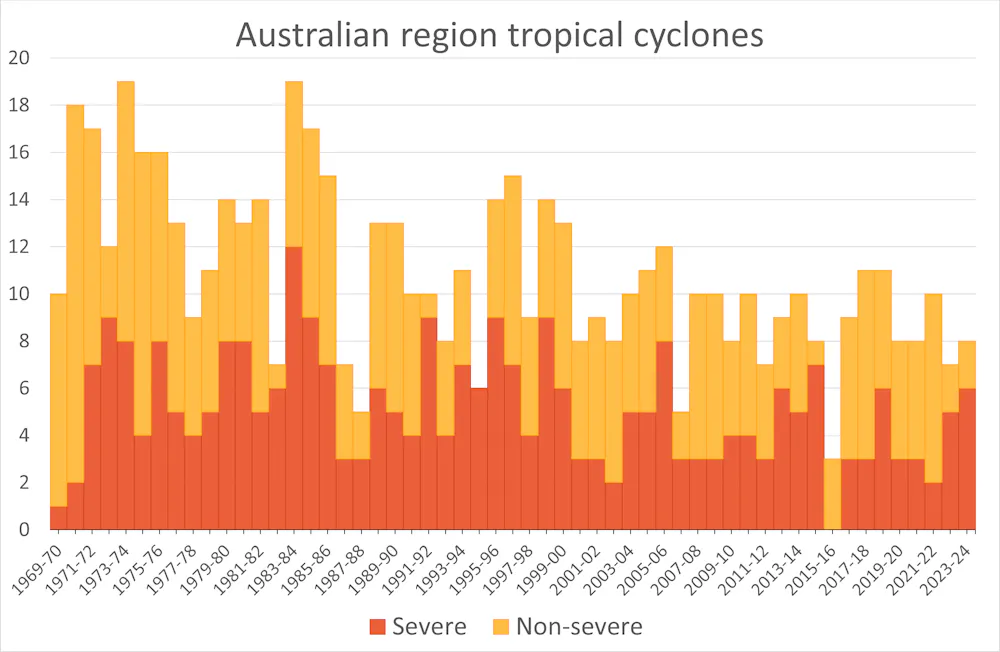
This summer, eight tropical cyclones have formed in Australian
waters. Six were classified as severe (category 3 and up). Historically,
Australia has experienced a higher proportion of category 1 and 2
cyclones, which bring weaker wind speeds.
On average, we see about 11 cyclones form and 4-5 make landfall. There has been a downward trend in the number of cyclones forming in the Australian region in recent decades.
Fewer cyclones, but more likely to
be intense: this figure shows the number of severe (Category 3 and up)
and non-severe tropical cyclones (Category 1 and 2) since 1970/71.Bureau of Meteorology, CC BY-NC-ND
Climate link: Cyclones dumping more rain
The intensity of a cyclone refers to the speed of the wind and size of the wind-affected area.
But a cyclone’s rain field is also important. This refers to the area
of heavy rain produced by storms when they’re at cyclone intensity and
afterwards as they decay into tropical lows.
The rate of rainfall brought by cyclones in Australia isn’t necessarily increasing, but more cyclones are moving slowly, such as Alfred. This means more rain per cyclone, on average.
Rising ocean temperatures mean more water evaporates off the sea
surface, meaning forming cyclones can absorb more moisture and dump more
rain when it reaches land.
Why are cyclones slowing down? This is likely because air current
circulation in the tropics has weakened. This has a clear link to
climate change. Wind speeds have fallen 5 to 15%
in the tropics, depending on where you are in the world. It’s hard to
pinpoint the change clearly in our region, because the historic record
of cyclone tracks isn’t very long.
For every degree (°C) of warming, rainfall intensity increases 7%. This is well established. But newer research is showing the rate may actually be double this or even higher, as the process of condensation releases heat which can trigger more rain.
Clear climate link: Bigger storm surges due to sea level rise
When a cyclone is about to make landfall, its intense winds push up a
body of seawater ahead of it – the storm surge. In low lying areas,
this can spill out and flood streets.
Because climate change is causing baseline sea levels to rise, storm
surges can reach further inland. Sea-level rise will also make coastal
erosion more destructive.
Huge swells have forced beach closures ahead of Cyclone Alfred’s arrival.Jason O'Brien/AAP
What should we take from this?
We can’t say definitively that climate change is behind Cyclone Alfred’s unusual track.
But factors such as rising sea levels, slower cyclones and warmer
oceans are changing how cyclones behave and the damage they can do.
Over time, we can expect to see cyclones arriving in regions not
historically affected – and carrying more rain when they arrive.