19/04/2025

Could humanity be extinct within 10,000 years? A new book is the wake up call our species needs

 The Conversation -

Shutterstock


AUTHOR
Strategic Professor
Palaeontology
Flinders University
In H.G. Wells’ dystopian 1895 novel The Time Machine an unnamed Victorian scientist travels to the year 802,701.
 
Instead of finding a flourishing, enlightened human civilisation reaping the cumulative benefits of millennia of economic and intellectual growth, he finds a horror scene. 
 
Here, gentle humans called Eloi are now the farmed food for the troglodyte-like Morlocks.

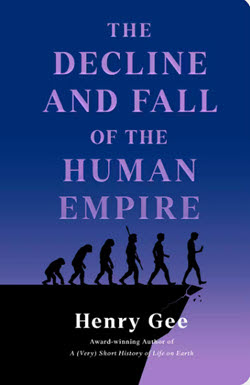
Science writer Henry Gee paints a less horrific but equally worrying picture of humanity’s future in his book The Decline and Fall of the Human Empire. Unlike Wells, Gee doesn’t see the human species capable of surviving longer than the next 8000-12,000 years.

This number is not an educated guess, or pessimistic opinion. It is based on statistical analyses that show our species is quickly degenerating amidst the chaos of our rapidly declining environments.

Review: The Decline and Fall of the Human Empire: Why Our Species Is on the Edge of Extinction – Henry Gee (Picador)

While all this might sound depressing, this book is a strangely engrossing read, addictive because of its continuum of interesting facts about our species’ origins and inevitable decline, and how we have impacted our planet in many unexpected ways. At times sarcastic, Gee’s book is more than just a monologue on our future. It could well be the ultimate wake up call to action for all of us.

A senior editor at Nature magazine, with a PhD in bovine palaeontology, Gee is also an accomplished writer of both popular science books and sci-fi novels. He writes in simple prose garnished with wit and humour, distilling complex science into an accessible read, a rare craft which won him the 2022 Royal Society Trivedi Science Book Prize for his previous book, A (Very) Short History of Life on Earth.

Henry Gee. John Gilbey/Macmillan
His new book takes a stoic look at humanity’s ultimate decline. 

This is something, he argues, we as a species cannot avoid, due to our damaging impact on the planet’s many environments, some of which are vital for our future food security. 

He does offer some hope for our survival beyond this time-frame, but it would rely on drastic, unlikely solutions.

The book is organised into three parts: Rise, Fall and Escape. 

Each details the story of our unique species from its prehistoric beginnings though to our success as the dominant mammal on Earth, and finally, to our fate in being too successful.

The rise of our species

“Rise” summarises a deluge of recent information about our ancient origins. Our modern human species, Homo sapiens, diverged from earlier human species around 300,000 years ago. We lived alongside a number of other such species at this time.

Genetics tells us a lot about our current population stability. Early human species almost went extinct before leaving Africa due to severe climatic events some 930,000–813,000 years ago, when the breeding population shrunk to an estimated 1,280 individuals on the entire planet. 

Modern Homo sapiens evolved later as a result of interbreeding amongst and between other archaic human species such as Neanderthals and Denisovans, the latter known from ancient DNA preserved in isolated small bones. 

Modern homo sapiens is a result of interbreeding amongst other archaic human species.
frank60/shutterstock

Only a small number of modern humans who evolved in Africa ever moved away from this continent, starting around 60,000 years ago. These eventually became our living human population of the world today. 

As Gee points out, “migration, is of course, the natural state of humanity”, a lesson with great implications for how we treat migrants today, many of whom are forced to flee war-torn or environmentally degraded areas.

I found this section full of fascinating new perspectives. For example, I didn’t know human populations in the past were very small. Fossil human remains are incredibly rare in most sites, full of many other kinds of mammals or bird remains.

Secondly, the populations of early Homo sapiens show great variability, indicating past populations were mostly isolated, not mixing very much. Small populations are more susceptible to natural disasters, so are easily wiped out by floods, tsunamis, fires, volcanic eruptions or other local events, keeping population numbers small.

Despite all this, we rose to over one billion people on the planet by the 1800s and to 8 billion today, fuelled by massive increases in agriculture and technology. The former provided enough food to sustain larger populations, the latter lengthened lifespans.

However, some researchers predict our population will peak at around 9.73 billion by about 2064, declining to 8.79 billion by 2100.

Other scenarios from the same source, involving better education and contraceptive access, predict the 2100 population at around 6.29 billion, and a decline from then onwards, eventually leading to a collapse once other factors, such as our declining fertility rates (leading to older populations, and labour shortages), kick in.

The fall of our species

The story of the royal Hapsburg family demonstrates how inbred human populations can lead to a host of debilitating disorders in future generations. 

Portrait of King Charles II
by
Juan CarreƱo de Miranda
Wikimedia Commons, CC BY
Between 1450-1750 there were 73 Hapsburg marriages, many between near relations. Uncles married nieces. First cousins twice removed married. 

This culminated in Charles II, the last Hapsburg king of Spain, who suffered many bouts of disease including rickets all his short life (he died at age 38) and couldn’t conceive any offspring. This is clearly not good for the species.

Random pandemics or diseases can, of course, strike populations without warning. Several evolved due to the growth of agriculture, when humans and animals came into closer contact. 

Viruses like flu, TB and plague are some examples of animal-borne diseases that jumped to humans, exactly as COVID did in 2020, though in that case not from a domesticated source.

The decline in our ability to reproduce as efficiently as in past populations is another worry for our species. 

The loss of the Y Chromosome in men, which is degenerating rapidly, is a disturbing trend, (though it may be addressed through genetic technology in the future). However, in some countries, male sperm counts and sperm quality are declining at an alarming rate.

The first detailed account of this, by Danish gynaecologist and obstetrician Elisabeth Carlesen and her team, showed sperm counts halved between 1940 and 1990. In Nigeria, sperm count and quality has dropped by 72.6% over the past 50 years.

Why is this happening? We don’t know yet. Gee cites as possible causes the increased human exposure to fossil fuel derivatives (in micro-plastics, and through other pollutions), climate change, or simply, our lifestyles.

To keep our population stable, every woman on the planet needs to have 2.1 babies (this number is the TFR or Total Fertility Rate). Even today many countries are dipping below this. 

China had a fertility rate of 1.18 in 2022. Japan’s was 1.26 in 2022 although the total fertility rate of all African nations in this year was 4.155. Globally, however, fertility rates are decreasing rapidly.

Survival or extinction?

The timing for our species extinction or “Doomsday scenario” is calculated using a statistical method developed by Princeton astrophysicist J. Richard Gott

The method is based on a statistical argument that we are living in the 95% range of humanity now, so we are more than 2.5% away from either the beginning or end of the species. (NB, this reasoning is complex, fully explained in the book.)

The average age of other human species (now all extinct) is mostly less than 2-3 million years. Our species has only been around about 300,000 years. However, if we are nearer the end of our species than the beginning, (assuming multiple factors leading to environmental collapse would happen sooner rather than later), Gee states,

I’d venture – with suitable hand-waving – that Homo sapiens will disappear from the Earth within the next 10,000 years.

Another argument about our imminent demise comes from “extinction debt”: when species destroy their habitat and eventually run out of resources. We humans have become the dominant species, pushing many thousands of species to extinction by altering habitats for growing food, harvesting wood, dumping our waste and so on.

Humans use about 25% of the world’s plants’ generation of photosynthesis as our food, a figure that has doubled since 1910. Humans and our domesticated animals make up 96% of all the mass of mammals on the planet. Around 70% of all birds on Earth comprise our poultry populations. And on it goes. The balance of nature is now changed forever, so predicting stability in long-term food security is way more difficult.

About 70% of birds on earth are poultry.
David Tadevosian/shutterstock


We humans represent a new force of evolution changing the biomass and reshaping most of our terrestrial ecosystems. We are also changing many marine ones, due to increased pollution, large-scale, over-fishing and the impacts of commercial shipping routes.

What to do?

All of this begs the question what can we do now? The answer is not about saving our species forever (all species have a finite lifespan). It’s matter of how much time do we have?. We can extend our species chances of longer survival if we can save our planet from further destruction and imminent environmental collapse, but we must we act now to do so.

The solution is simple. Science gives us clear directions as to how to mitigate climate change (by seriously reducing our production of greenhouse gases causing it); and how to restore damaged habitats (by cleaning them up). Politics unfortunately usually gets in the way of saving the planet due to human greed taking priority over any serious attempts at real progress in this area.

Gee has an elegant, if highly unlikely solution to saving our species. It might just be possible in the next century or so, he writes, with the increased pace of technology, to sustainably develop human colonies on the moon or Mars. We need first to develop a self-sustaining ecosystems that will provide food, clean air and all the resources necessary for life in order to survive on long distance space travels.

Despite various attempts, it has not been possible so far to survive in our own self-contained, mini-ecosytems, as seen by the failure of Biosphere 2 in the Arizona desert in the 1990s. 
Goodreads
This gigantic terrarium (1.27 hectares) had 3000 species of animals and plants, with eight humans living inside its enclosed walls. 

It seemed to work well for a while, but over time bacteria in the soil took too much oxygen while the thick concrete walls sucked all the carbon dioxide out of the air, starving plant life. Crops failed and their pollinators, the birds and bees, also died. 

The experiment lasted under three years before the humans inside had to break the seal to let fresh air in.

Gee predicts the settlement of space will one day happen, but he suggests we are at least two to three centuries away from that goal.

While the topic of this book might seem a little depressing, it is really a powerful wake up call to all of us, based on the very latest scientific research.

The stoics say if we can’t do anything about a problem, we shouldn’t worry about it. But in this case there is a lot we can all do. 

Voting for the right people who will enact change is the first step. 

This book should be mandatory reading for all politicians.

Climate Change Books

  • The Uninhabitable Earth: Life After Warming - David Wallace-Wells
  • This Changes Everything: Capitalism vs. The Climate - Naomi Klein
  • The Sixth Extinction: An Unnatural History - Elizabeth Kolbert
  • The Climate Book - Greta Thunberg
  • The New Climate War - Michael E. Mann
  • Saving Us: A Climate Scientist’s Case for Hope and Healing in a Divided World - Katharine Hayhoe
  • All We Can Save: Truth, Courage, and Solutions for the Climate Crisis - Ayana Elizabeth Johnson & Katharine K. Wilkinson
  • How to Avoid a Climate Disaster - Bill Gates
  • The Future We Choose: Surviving the Climate Crisis - Christiana Figueres & Tom Rivett-Carnac
  • Climate Injustice - Friederike Otto
  • 18/04/2025

    AUSTRALIA: Climate Change Good Friday Review - Lethal Heating Editor BDA

    Australia is at the forefront of some major climate change shifts.
    Following are the latest developments.

    Great Barrier Reef Faces Sixth Mass Bleaching Event

    The Great Barrier Reef has experienced its sixth mass coral bleaching since 2016, with the summer of 2024–25 marking the second consecutive year of widespread bleaching.
    Marine heatwaves driven by climate change are severely altering the reef's ecosystem. Conservationists warn that Australia's next government may represent the reef's last chance for survival.
    While the current government has allocated $1.2 billion for reef conservation through 2030, experts call for urgent climate action, including a 90% reduction in climate pollution by 2035 and an end to new fossil fuel projects. Link

    Record-Breaking Heat and Extreme Weather

    Australia has witnessed record-breaking heat both on land and in adjacent oceans during the 2024–25 summer.
    Major floods in the north and unprecedented sea surface temperatures over the northwest region have been observe. Such extreme events, once rare, are becoming more frequent due to human-driven climate change. Link

    Health Impacts and Rising Climate Litigation

    A recent report reveals a 37% rise in dangerous heat exposure in Australia over the past two decades.
    This increase correlates with a surge in climate-related health issues, including cardiovascular diseases. Consequently, Australia has become the world's second-highest hotspot for climate litigation, reflecting growing public concern over health and environmental impacts. Link

    Political Discourse and Climate Policy

    Political debates around climate policy are intensifying.
    In a recorded address, Coalition MP Colin Boyce suggested that allowing power blackouts could be a strategic move to shift public opinion against renewable energy and net-zero policies. He advocated a "do nothing" approach, implying that experiencing blackouts would make the public more sceptical of renewable energy initiatives. Link  Link

    Australia's Climate Performance Ranking

    Australia has dropped two ranks in the Climate Change Performance Index, now standing at 52nd among the low-performing countries.
    While fossil fuel subsidies have declined, some major subsidies remain. Key demands include halting the approval and support for the expansion of fossil fuel production. Link

    Upcoming Federal Election and Climate Acton

    With a federal election set for May 3, there is a heightened focus on climate policies.
    Advocacy groups urge voters to support candidates committed to reducing Australia's climate pollution and enhancing climate resilience. Link

    Links

    Global Population & Climate Change: Why Urgent Action is Essential - Lethal Heating Editor BDA

    As the world’s population surpasses 8 billion people, humanity faces a defining challenge: how to sustain life on Earth while confronting the escalating threat of climate change.

    The connection between population growth and climate change is complex but undeniable.

    The way we live, consume, and produce energy is placing unprecedented pressure on our planet’s natural systems.

    Without urgent action, we risk pushing Earth’s climate beyond the threshold of habitability for millions.

    The Pressure of Population Growth

    While population growth has slowed in some parts of the world, it continues rapidly in others, particularly in regions with limited resources and infrastructure. 

    More people means more demand for food, water, housing, energy, and transportation—all of which require the use of land, fossil fuels, and other finite resources. Urban areas are expanding, forests are shrinking, and natural ecosystems are being cleared to make way for human development.

    Though population size is a factor, it's important to note that consumption levels—especially in wealthier nations—are far more damaging per capita. A child born in a high-income country typically has a carbon footprint dozens of times larger than one born in a low-income region.

    Climate Change: Problems We Can No Longer Ignore

    We’re already witnessing the consequences of a warming planet. The past decade has been the hottest in recorded history. Climate change is no longer a distant threat—it's happening now, and it's accelerating.

    Key Problems Include:

    • Rising global temperatures, leading to more frequent and intense heatwaves, droughts, and wildfires.

    • Melting glaciers and polar ice, contributing to sea level rise that threatens coastal cities and island nations.

    • Unpredictable weather patterns, causing floods in some regions and droughts in others—both harmful to agriculture and water access.

    • Biodiversity loss, as ecosystems collapse and species are driven to extinction.

    • Health impacts, including the spread of vector-borne diseases and respiratory issues from pollution.

    • Climate-induced migration and geopolitical instability, as people are forced to leave uninhabitable areas.

    We Know the Solutions

    The good news? We already have many of the tools and technologies needed to combat climate change. What’s required is the political will, global cooperation, and public engagement to scale them up quickly.

    Key Solutions:

    • Shift to renewable energy sources like solar, wind, and hydroelectric power.

    • Improve energy efficiency in buildings, appliances, and transportation.

    • Protect and restore forests, wetlands, and oceans, which act as carbon sinks.

    • Rethink food systems by promoting sustainable farming and reducing meat consumption.

    • Invest in public transportation, walkable cities, and clean infrastructure.

    • Empower communities, especially women and girls, with access to education and voluntary family planning, helping to reduce population pressures over time.

    • Adopt climate policies such as carbon pricing, green subsidies, and climate-smart regulations.

    The Clock Is Ticking

    Scientists are clear: to avoid the worst impacts of climate change, we must cut global greenhouse gas emissions by at least 50% by 2030. That’s less than a decade to transform nearly every sector of our economies.

    The Intergovernmental Panel on Climate Change (IPCC) warns that every fraction of a degree of warming avoided matters. Limiting global temperature rise to 1.5°C above pre-industrial levels is still possible—but only if we act decisively, immediately, and together.

    A Call to Action

    This is not just an environmental issue—it's a human issue. The choices we make today will shape the world our children and grandchildren inherit. Climate change is a global problem, but also an opportunity: to build a cleaner, fairer, and more resilient world for all.

    Let’s not wait for disaster to force our hand. The time for action is now.

    Links

    16/04/2025

    Sea Ice is Melting Faster Than We Thought - And Yes, it’s a Big Deal for Australia!

    Lyrebird Dreaming - Gregory Andrews


    If you’ve been feeling like the weather’s getting weirder, storms more intense, and seasons out of whack - you’re not imagining it. One of the world’s most respected climate scientists, James Hansen, has released new evidence confirming what many of us already feel in our bones: climate change is accelerating, and the models we rely on are underestimating just how fast it’s moving.

    Hansen’s latest paper, reveals that global heating is picking up pace - driven not just by carbon emissions, but also by a dangerous feedback loop as polar ice sheets melt. This is throwing the planet’s systems out of balance. Sea ice is hitting record lows in both the Arctic and Antarctic. Ocean warming is now so intense that even the fresh water from melting ice - once thought to momentarily buffer surface temperatures - is being overwhelmed.

    For most Australians, this might seem like distant science. But it matters. A lot. There’s nothing between us and Antarctica except ocean. When ice sheets melt, sea levels rise. And that’s not just a problem for penguins and polar bears. It’s a threat to every coastal town in Australia - from the Torres Strait to Tasmania. It means more flooding, saltwater intrusion, collapsing insurance markets, and a housing crisis far worse than what we’re already facing.

    Accelerated polar melt also disrupts the ocean’s conveyor belts - the currents that drive rainfall patterns, fish migrations, and seasonal stability. As these systems destabilise, we’ll see even more of what we’ve already been witnessing: flash droughts, bushfires in winter, collapsing fisheries and once-in-a-generation floods happening every other year.

    But here’s the kicker: we’re not hearing a word about this from either major party right now. In the midst of an election!

    Election silence on climate is deafening

    Election talk is mostly about the “cost of living” and “housing affordability”. But no one seems to be connecting the dots: nothing threatens our cost of living more than climate change. It’s already making food more expensive, insurance unaffordable, and energy systems more vulnerable to extreme heat and storms.

    Yet Labor and the Liberals are refusing to have a serious conversation about climate action. Worse still, they keep approving new coal and gas projects. It’s like putting more fuel on a house that’s already on fire.

    Hansen’s paper should be front-page news. It shows the ice is melting faster than expected and that existing climate models are giving us a false sense of security. If we wait for them to catch up, we’ll have waited too long.

    Real zero, not net zero. Urgency, not delay

    We don’t need more greenwashing, nuclear power plants or vague 2050 promises. We need real zero emissions - as fast as humanly possible - and we need politicians with the courage to treat this like the emergency it is.

    The science is clearer than ever. The silence from our so-called ´major parites’ is louder than ever. And the stakes - for our coastlines, our economy, and our kids - have never been higher. That’s why on election day I will be putting credible independents like David Pocock and Jessie Price first on my ballot paper. They care about our kids and country, not parties and power.


    Links

    Climate Change and Pandemic Disease: A Growing Global Threat - Lethal Heating Editor BDA

    Climate change is a public health emergency. The world is witnessing its intensifying effects - rising temperatures, melting ice caps, shifting weather patterns, an increase in extreme natural disasters, and now infectious diseases, including pandemics.

    2025-04-15_1

    Climate change can increase the likelihood, frequency, and severity of pandemic diseases, according to scientific evidence.

    1. The Ecological Connection

    The relationship between climate change and infectious disease is rooted in the disruption of natural ecosystems. As forests are cleared and habitats are altered due to agriculture, urban development, or climate shifts, wildlife is forced to move into new territories. This migration increases contact between animals and humans, creating more opportunities for zoonotic spillover-the transmission of pathogens from animals to humans.

    Viruses such as HIV, Ebola, SARS, and COVID-19 are all believed to have originated in animal populations. As global warming intensifies and biodiversity is lost, the natural barriers that once prevented such diseases from spreading are breaking down. In particular, species like bats - known to host a wide range of viruses - are moving closer to human settlements in response to environmental pressures.

    2. Melting Permafrost and Hidden Threats

    Another alarming factor is the thawing of permafrost in polar regions. These frozen soils, which have remained locked in ice for thousands of years, are now melting due to increasing global temperatures. Scientists warn that ancient viruses and bacteria, some of which humans have never encountered, could be released into the environment. While the full threat of these organisms is not yet known, they pose a potential health risk that could be difficult to predict or contain.

    3. Changing Disease Vectors

    Climate change also alters the behaviour and range of disease-carrying vectors such as mosquitoes and ticks. Warmer temperatures and longer wet seasons allow these insects to survive in areas that were previously too cold, spreading diseases like malaria, dengue fever, chikungunya, Lyme disease, and Zika virus into new regions. This means that populations with little to no immunity - and often limited access to healthcare - are now at greater risk.

    4. Human Displacement and Public Health Strain

    Extreme weather events such as hurricanes, wildfires, droughts, and floods are becoming more frequent and intense, forcing millions of people to flee their homes. Climate refugees often end up in crowded, unsanitary conditions where access to healthcare is limited. These environments are fertile ground for the outbreak and spread of infectious diseases.

    At the same time, health systems in affected areas are being stretched thin. In regions already dealing with the effects of poverty, conflict, or underdevelopment, the added strain of climate disasters and infectious outbreaks can be devastating.

    5. A Call to Action

    The combined threats of climate change and pandemics demand a comprehensive, forward-thinking response. Here's what must be done:

    • Invest in Surveillance and Early Warning Systems
      Global health organisations must enhance surveillance of animal and human populations in areas where spillover risks are high. Real-time data sharing and rapid response systems are essential for catching outbreaks before they spread.

    • Preserve Biodiversity and Ecosystems
      Protecting forests, wetlands, and other natural habitats helps maintain ecological balance. It reduces the risk of wildlife coming into close contact with human populations and serves as a buffer against disease transmission.

    • Accelerate Climate Action
      Reducing greenhouse gas emissions is crucial. Transitioning to renewable energy, adopting sustainable farming practices, and enforcing environmental regulations can slow the progression of climate change and reduce its cascading health impacts.

    • Strengthen Healthcare Infrastructure
      Governments must invest in building resilient healthcare systems that can handle the dual challenges of climate-related disasters and disease outbreaks. This includes improving access to clean water, sanitation, vaccines, and emergency care.

    • Promote Global Cooperation
      Neither climate change nor pandemics respect borders. Solutions must involve international collaboration-through funding, research partnerships, and coordinated response strategies.

    Summary

    Climate change is a public health emergency. It is increasing the risk of pandemics. From melting ice and shifting ecosystems to displaced populations and overwhelmed health systems, the evidence is all around us. To protect our planet and ourselves, we must treat climate change and pandemic preparedness as two sides of the same coin. Only by addressing them together can we build a safer, more resilient future.

    Links

    14/04/2025

    White House ends funding for key US climate body: ‘No coming back from this’

    The Guardian - and

    Nasa cuts contract that convened USGCRP, which released assessments impacting environmental decision-making

    A construction worker takes a water break during a heatwave in Irvine, California, in 2024. Photograph: Allen J Schaben/Los Angeles Times via Getty Images

    The White House is ending funding for the body that produces the federal government’s pre-eminent climate report, which summarizes the impacts of rising global temperatures on the United States.

    Every four years, the US Global Change Research Program (USGCRP) is required by Congress to release a new national climate assessment to ensure leaders understand the drivers of – and threats posed by – global warming. 

    It is the most comprehensive, far-reaching and up-to-date analysis of the climate crisis, playing a key role in local and national decision making about agriculture, energy production, and land and water use.

    The next assessment is due by 2027. But now, Nasa has ended its contract with the consulting firm ICF International, which convened the USGCRP and coordinated the federal agencies that contribute to the quadrennial report.

    “There’s really no coming back from this, and it means we are all less informed about climate impacts, and won’t have the most up-to-date information on risks and threats,” said one federal staffer who was engaged in USGCRP activities, and who requested anonymity to avoid retribution. 

    “USGCRP helped me to leverage resources from other agencies for use in my own work. But without these networks, I’m left without a support system and the latest science on climate change.”

    The end of the contract, first reported by Politico and confirmed by multiple sources to the Guardian, imperils the federal government’s climate research, say experts.

    “The firing of USGCRP staff guts the entire climate research and services ecosystem leaving teetering silos of climate teams, already reeling from federal cuts due to Doge,” the anonymous staffer said.

    Another federal worker with knowledge of the program, who was also granted anonymity, said the contract’s cancellation will mean “the Sixth National Climate Assessment is effectively destroyed.”

    USGCRP staff who hailed from the 15 federal agencies had all been told to abandon the body; its only remaining staff were from ICF and have now been fired, the second worker said. 

    “Climate research as a whole will be hobbled because USGCRP’s interagency working groups are essential coordinating bodies across the entire government, including and beyond the 15 USGCRP member agencies.”

    The move came one day after the rightwing outlet the Daily Wire published an article attacking ICF International saying the firm was “raking in millions to spread climate doom”. Since its publication, the second worker said they had had a “pit in their stomach”.

    The attack on the USGCRP and national climate assessment did not come as a surprise. In the Heritage Foundation’s far-right policy blueprint Project 2025, Russ Vought – now Trump’s head of the office and management and budget – called to end the USGCRP or fill it with pro-oil industry members.

    Since Trump’s second term began in January, the monthly meetings of delegates to the body from federal agencies have been cancelled, the anonymous worker said. “We were waiting for new principles to be sent from each agency, which never happened, so that could have been a sign in retrospect,” they added.

    Andrew Rosenberg, a former Noaa official who is now a fellow at the University of New Hampshire, called the end of the contract “very foolish” and “thoughtless”. 

    National climate assessments provide an important synthesis of “science across fields” – and are not particularly expensive to produce because the authors are all volunteers, he said.

    In February, Trump officials also denied US scientists permission to attend a meeting of the United Nations’ Intergovernmental Panel on Climate Change, the world’s leading climate science entity. 

    The federal government also cancelled its contract with ICF International to maintain US support for and involvement in the body.

    “Extreme weather disasters displaced millions of people and caused billions of dollars in damage in 2024 alone,” said Katharine Hayhoe, a Texas Tech University climate scientist who has served as lead author on three national climate assessments. 

    “Given the accelerating pace and scale of climate impacts today, a sustained and more comprehensive national climate assessment process is so essential,” Hayhoe said. “We need it today, to build a better future tomorrow.”

    The move is a sign of the Trump administration’s fealty to the fossil fuel industry, said Michael Mann, an eminent US climate scientist. The sector donated in record levels to Trump’s re-election campaign.

    “It is pure villainy,” said Mann. “A crime against the planet – arguably, the most profound of all crimes.”

    13/04/2025

    Australian climate change litigation to increase with extreme heat

    The Mandarin -

    Australia has emerged as an attractive jurisdiction for climate litigants as climate change weather impacts more individuals and society.

    (AP Photo/Omar Havana)


    The latest MJA-Lancet Countdown report tracking progress on health and climate change in Australia shows dangerous heat exposure has risen by 37% in the past 20 years.

    The 2025 edition has revealed that while Australia’s dangerous heat exposure has escalated in the past two decades, the country now has the second-highest number of climate change cases globally.

    Lead author and Macquarie University Professor Paul Beggs said Australia’s health-damaging heat “substantially” increased in frequency since the 1970s. 

    “Courts have closely examined detailed evidence about how climate change directly and indirectly affects people’s health, especially for vulnerable groups,” Beggs said.

    “Health was raised as an issue in eleven Australian climate cases between 2014 and 2023.”

    The Countdown report was first published in 2017. It provides an annual assessment of connections between health and climate change in Australia and New Zealand across the domains of health hazards and impacts; adaptation planning; mitigation actions; economics and finance; and public and political engagement. 

    In 2021, Australia’s health care sector produced greenhouse gas emissions that rose to their highest level in a decade. The report concluded this was likely attributed in part to the ways care patterns shifted during the COVID-19 pandemic.

    Other concerning trends identified in the report include a diminishing capacity to respond to bushfires, with the number of volunteer firefighters dropping by 17% over the past seven years, and the dominance of fossil fuels in the domestic energy supply contributing to climate risks.

    Professor Beggs, who is also Lancet Countdown Centre Oceania director, added because of Australia’s particular exposures, long-term tracking for climate hazards was crucial. 

    ANU’s Professor Hilary Bambrick, National Centre for Epidemiology and Population Health director, lauded recent government efforts to deal with “priority risks” via the national climate risk assessment.

    “This past year Australia has taken a crucial step forward in understanding how risks are connected across sectors,” Bambrick said.

    “This assessment should facilitate more considered and coordinated planning and response to increasingly dangerous climate change to better protect human health and wellbeing.”

    The assessment also highlighted Australia’s progress in shifting to renewables, noting renewable energy sources provided nearly 40% of domestic electricity needs. 

    Renewable storage and generation of large-scale and small-scale kinds are also growing.

    Paper co-author Professor Stefan Trueck, who is the director of Macquarie University’s Centre for Transforming Energy Markets, noted that more funding is needed to realise renewables’ potential.

    “Electricity generation from renewables keeps accelerating, fossil fuel generation is shrinking, but ensuring reliability of electricity supply demands even greater investment in renewables and storage,” he said. 

    The Countdown report was published in the Medical Journal of Australia.

    Links

    Lethal Heating is a citizens' initiative