The Guardian -
Friederike Otto
In an exclusive extract from Friederike Otto’s new book, she says
climate disasters result from inequality as well as fossil fuel

|
|
Friederike Otto, associate director of the Environmental Change Institute, University of Oxford, and an associate professor in the Global Climate Science Programme.
Photograph: Alamy
|
My research as a climate scientist is in attribution science. Together with my team, I analyse extreme weather events and answer the questions of whether, and to what extent, human-induced climate change has altered their frequency, intensity and duration.
When I first began my research, most scientists claimed that these questions couldn’t be answered. There were technical reasons for this: for a long time, researchers had no weather models capable of mapping all climate-related processes in sufficient detail. But there were other reasons that had less to do with the research itself.
Let’s imagine extreme flooding in Munich, Rome or London and heavy rainfall in the slums of Durban on the South African coast. How the people in these various places experience this extreme weather depends on the local economic and social conditions and, fundamentally, on their political situation.
Researching weather – and thus, the role of climate change – in the way I do is always political, and this makes it an uncomfortable topic for many scientists. I believe it is important to show that both obstacles – the technical and the political – can be overcome; our climate models have become better and better, and we are coming to realise that research cannot take place at a remove from the real world.

|
|
A burning area of Amazon rainforest in 2020. Photograph: Carl de Souza/AFP/Getty Images
|
For example, to know exactly how big the risk of a drought is – where and for whom – we need a whole lot of information. Three main factors come into play: the natural hazard, our exposure to the hazard, and the vulnerability with which we approach it.
In west Africa in 2022, entire regions suffered from dramatic flooding during the rainy season. These floods were caused in part by above-average rainfall that, as my team and I discovered, was significantly more intense than it would have been without climate change. The rainfall was considered a “natural hazard,” but exacerbated so significantly by human-caused climate change that it was anything but natural.
To a large extent, these floods – particularly in Nigeria – were caused by the release of a dam in neighbouring Cameroon, which flooded large parts of the densely populated Niger delta, home to more than 30 million people. The risk from rainfall is particularly high, both for the people and for local ecosystems and infrastructure such as buildings, bridges, roads and water supply lines.
This region is uniquely exposed to weather and natural hazards. A dam
was supposed to have been built in the Nigerian part of the delta to
hold back the water, but it was never built. Given the poor
infrastructure and high rates of poverty, people in this area are
particularly vulnerable, affected much more adversely than those in
other areas.

|
|
The community of Imburu, north east Nigeria, is almost completely submerged in September 2022.
Photograph: Radeno Haniel/AFP/Getty Images
|
So how does weather become a disaster?
We can’t say exactly how the effects of climate change vary by location and type of weather, but what is absolutely clear is that the more people are in harm’s way and the more vulnerable they are, the greater their risk.
We’ve learned a lot more in recent years about all aspects of risk. For example, it’s now clear that climate change alters heatwaves far more than other weather phenomena. With every study that my team and I perform, we seek to answer the question of what these alterations actually mean for a small section of the global population. In these studies – known as “attribution studies” among experts – we analyse not just historical and current weather data but also information on population density, socioeconomic structures and basically everything we can find about the event itself to gain the most accurate picture of what happened and to whom.
Only after all those steps do we ask whether climate change played a role. To do this, we work with various datasets that take into account a vast range of factors – land use, volcanic activity, natural weather variability, greenhouse gas levels, other pollutants, and much more.
Broadly speaking, we use climate models to simulate two different worlds: one world with human-caused climate change and one without. We then use various statistical methods to calculate how likely or intense heatwaves are in specific places, both with and without human-caused global warming.
But it is vulnerability and exposure that determine if weather becomes a disaster. The effects of extreme events always depend on the context – who can protect themselves from the weather (and how) is always a major factor. This is why the term “natural disaster” is entirely misplaced.
For example, one of our studies from 2021 showed that the food insecurity linked to the drought in southern Madagascar was caused mainly by poverty, a lack of social structures, and heavy dependence on rainfall, but not by human-induced climate change. Nevertheless, just as with the Nigerian floods, international reports talked only of the weather and climate. The international media barely mentioned that, in fact, the local infrastructure, which had remained unfinished for decades, played a decisive role in the disastrous drought.
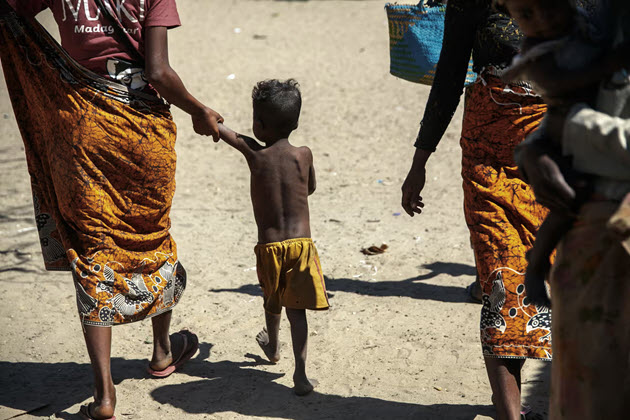 |
| People going to
a Médecins Sans Frontières (MSF) mobile clinic in Befeno, Madagascar,
set up to treat the most serious cases of moderate and severe
malnutrition after the 2021 drought. Photograph: RIJASOLO/AFP/Getty Images |
How extreme events are reported – where the media
focus their attention – doesn’t just influence the responsive measures
we think possible. It also influences who we see as responsible for
implementing the next necessary steps. Describing extreme weather as a
singular moment that tells us something about climate change, and
nothing more, conceals the factors that have just as much (if not more)
impact on the weather’s effects, and provides politicians with a handy
discussion framework as they try to divert attention from poor local
decision-making and planning.
There are two
main reasons infrastructure in both Madagascar and Nigeria is so lacking
and often nonexistent: the sustained destruction of local social
structures under European colonial rule and extreme inequality within
the population – inequality between the genders, between rich and poor,
between different ethnic groups. It is because of factors like these
that climate change becomes such a life-threatening problem.
The
main thing I have learned from extreme weather events is that the
climate crisis is shaped largely by inequality and the still-undisputed
dominance of patriarchal and colonial structures, which also prevent the
serious pursuit of climate protection. By contrast, physical changes
such as heavier rainfall and drier soil have only an indirect effect. In
short, climate change is a symptom of this global crisis of inequality
and injustice, not its cause.
Weather-related
disasters are largely a matter of unfairness and injustice, not
misfortune or fate. This applies at a local level, for example when
patriarchal structures insist that pregnant women living in traditional
societies have to work outdoors in extreme heat because working in the
fields for personal consumption is “women’s work”. Or when financial aid
is paid to the male head of the family and never reaches those
responsible for putting food on the table.
But
injustice is also apparent on a global scale. Climate science is a
field dominated by white men, most with backgrounds in the natural
sciences, who mainly conduct and lead studies focused on the physical
aspects of the climate while disregarding numerous other issues. This is
why far too few studies deal with the global interactions between
social and physical changes in an evolving climate.
It’s
no wonder that we lack credible research findings that could inform us
about the issues of loss and damage in global climate policy on a
scientific basis. This makes it even more difficult to show how
centuries of colonial practices by the global north against the
countries of the global south continue to influence the way we live,
think and act.
It’s hardly news that climate
change is mainly a problem because it damages people’s dignity and
fundamental human rights. In fact, it’s the whole reason we talk about
it on an international level.
The United
Nations climate change conferences have never been about polar bears or
the downfall of the human race. They have always been about human lives
and countless livelihoods – and, of course, about economic issues. This
is demonstrated by the debate on the target of limiting heating to 2C
above preindustrial levels.
While this
includes economic cost-benefit considerations, it is above all a
political goal that doesn’t take science into account at all: not a
single scientific assessment has ever defended or recommended a specific
target – and with good reason, because setting such targets is
ultimately an ethical issue. It can be expressed as a simple political
question: how many more human lives, how many more coral reefs, how many
more insects will we allow ourselves to lose to the short-term
continued use of comparatively cheap fossil fuels in the global north?
Heatwaves
in North America and west Africa, droughts in South Africa and
Madagascar, forest fires in Australia and Brazil, floods in Germany and
Pakistan: these fundamentally different events hit societies that are
battling very different problems, and they all demonstrate the role of
climate change in different ways.
 |
| A swimming pool surrounded by flood waters in Essen, western Germany on 26 December 2023. Photograph: Ina Fassbender/AFP/Getty Images |
But it always proves true that the people who die
are those with little money who can’t readily obtain all the help and
information they need. And that doesn’t have to be the case, no matter
where they are.
In my opinion, the fact this
keeps on happening is due to one particular, and persistent, social
narrative. The basic premise is that burning fossil fuels is essential
to maintaining what we call prosperity, and that “freedom” isn’t
possible if we’re imposing a speed limit.
If
we compared modern society with the society of 300 years ago, we would
unquestioningly attribute many of the achievements of recent centuries –
like access to clean drinking water – to the burning of fossil
energies. Historically, we associate coal, oil, and gas with democracy
and western values, identifying a causal link between charcoal
briquettes and the welfare state: the one affects the other. But even
when this is actually true, we always forget to point out that the
reverse conclusion – one perishes, and the other goes with it – is as
fatal as it is false.
The global north and
global south both continue to argue that, for reasons of fairness, the
countries in the global south must initially have very high greenhouse
gas emissions too, to ensure the growth of their economies. This
completely ignores the fact that in the global north (as well as
elsewhere), the poor pay for the lifestyles of a small number of wealthy
people, be it the workers who toil in the mines for metals or the city
dwellers subjected to greater air pollution due to the use of private
vehicles. Who says that what happens in the global north is naturally
better and must be imposed on the world?
Climate
change would still have existed if Europe hadn’t conquered any colonies
but humans had still burned fossil energy sources – but things would
have looked very different without the west’s ongoing colonial mindset.
In essence, colonial-fossil climate change is therefore not a climate
crisis but a crisis of justice.
Climate
change is a problem that has less to do with a collapsing climate or
other physical conditions than we might think, and the consequences of
this are wider-reaching than we have been willing to admit. It clearly
shows us that the main way in which we currently research and fight
climate change – as a physics problem – falls far too short. Obviously,
we need to transform the way in which we obtain energy. Above all,
however, we need to transform participation in social life and the
application of political and economic power – who makes decisions and
how.
This is an edited extract from Climate Injustice by Friederike Otto,
which will be published by Greystone Books on 24 April (£22)
Climate Change Books


