21/05/2019

It Was Supposed To Be Australia’s Climate Change Election. What Happened?

New York Times - Damien Cave

A farmer feeding his cattle with purchased cotton seeds in the face of a crippling drought in Narrabri, New South Wales, Australia. David Maurice Smith for The New York Times
SYDNEY, Australia — The polls said this would be Australia’s climate change election, when voters confronted harsh reality and elected leaders who would tackle the problem.
And in some districts, it was true: Tony Abbott, the former prime minister who stymied climate policy for years, lost to an independent who campaigned on the issue. A few other new candidates prioritizing climate change also won.
But over all, Australians shrugged off the warming seas killing the Great Barrier Reef and the extreme drought punishing farmers. On Saturday, in a result that stunned most analysts, they re-elected the conservative coalition that has long resisted plans to sharply cut down on carbon emissions and coal.
What it could mean is that the world’s climate wars — already raging for years — are likely to intensify. Left-leaning candidates elsewhere, like Prime Minister Justin Trudeau of Canada, may learn to avoid making climate a campaign issue, while here in Australia, conservatives face more enraged opponents and a more divided public.
“There has to be a reckoning within the coalition about where they stand,” said Amanda McKenzie, chief executive of the Climate Council, an Australian nonprofit. “I think it’s increasingly difficult for them to maintain a position where they don’t talk about climate change.”
Even for skeptics, the effects of climate change are becoming harder to deny. Australia just experienced its hottest summer on record. The country’s tropics are spreading south, bringing storms and mosquito-borne illnesses like dengue fever to places unprepared for such problems, while water shortages have led to major fish die-offs in drying rivers.
Lucas Dow, the chief executive of Adani Australia, in front of conservative campaign signs in Clermont, Queensland, on Tuesday. The town was the site of a violent clash last month over a proposed Adani coal mine. Anna Maria Antoinette D'Addario for The New York Times
“This is all playing out in real time, right now,” said JoĆ«lle Gergis, an award-winning climate scientist and writer from the Australian National University. “We are one of the most vulnerable nations in the developed world when it comes to climate change.”
And yet the path to victory for Scott Morrison, the incumbent prime minister, will make agreeing on a response more difficult. He and his Liberal-National coalition won thanks not just to their base of older, suburban economic conservatives, but also to a surge of support in Queensland, the rural, coal-producing, sparsely populated state sometimes compared to the American South.
The coalition successfully made cost the dominant issue in the climate change debate. One economic model estimated that the 45 percent reduction in carbon emissions proposed by the opposition Labor Party would cost the economy 167,000 jobs and 264 billion Australian dollars, or $181 billion. Though a Labor spokesman called the model “dodgy,” Mr. Morrison and his allies used it to argue against extending Australia’s existing efforts to reduce emissions and invest in clean energy.
The message resonated strongly in Queensland, where the proposed Carmichael coal mine would be among the largest in the world if it is approved.
The Adani Group, the Indian conglomerate behind the mine project, says it will provide thousands of jobs in nearby towns marked by empty houses and rife unemployment. But in other parts of Australia, particularly among the urban educated left, it faces fierce opposition. “Stop Adani” is a mantra for many, promoted by organizations like Greenpeace and shared with pride on social media, signs and T-shirts.
Even Mr. Abbott, the former prime minister, seemed to grasp this growing political divide.
“It’s clear that in what might be described as ‘working seats,’ we are doing so much better,” he said in his concession speech. “It’s also clear that in at least some of what might be described as ‘wealthy seats,’ we are doing it tough, and the Green left is doing better.”
Neither side seems open to compromise. In some ways, the election was foreshadowed last month in the Queensland town of Clermont, where environmentalists protesting the Carmichael mine were met by pro-coal activists, including a man on a horse who rode into the crowd and knocked a woman unconscious.
Over all, Australians shrugged off the warming seas killing the Great Barrier Reef and the extreme drought punishing farmers. Social Media/Reuters
In some ways it was a clash of cultures as well as political views.
“I feel like there’s quite a lot of scorn about the way Queenslanders feel about environmental issues, and that doesn’t help,” said Susan Harris-Rimmer, a law professor at Griffith University in Queensland. “The predominant Queensland characteristic is pride and you can’t pour scorn on them.”
She said doing so was a strategic mistake for politicians comparable to Hillary Clinton’s description of some Donald Trump supporters as “deplorables” during the 2016 United States presidential election.
“You can’t trigger the pride response,” Ms. Harris-Rimmer said.
Scholars of Australian populism agree, arguing that the weakening of the major parties and the country’s tilt to the right have been driven mainly by class envy and alienation, including the belief that the elite do not understand the needs and values of the working class.
Despite his Sydney upbringing and former career in advertising, Mr. Morrison, 51, won in part by presenting himself as an Australian everyman — a rugby-crazed beer drinker who was the first prime minister to campaign in a baseball hat.
Mr. Morrison’s coalition also benefited from deals with two right-wing groups: One Nation, the anti-immigration party led by the Queensland senator Pauline Hanson, and the United Australia Party led by the mining billionaire Clive Palmer, who spent tens of millions of dollars on a populist campaign with the slogan “Make Australia Great.”
Under Australia’s preferential voting system, votes for candidates from minor parties can be used to help allies reach a clear majority in the lower house of Parliament. Nationally, United Australia secured 3.4 percent of the vote, while One Nation picked up 3 percent.
Neither One Nation nor United Australia did as well as similar parties recently in countries like Italy, Hungary and Brazil. But for Australia, where compulsory voting encourages moderate election outcomes, the results defied expectations and made clear that the country remains deeply conservative and open to the far right on a variety of issues.
The question that now confronts the new government is how much sway to give the forces that led to victory. Climate change may be the first battle in the long war that is reshaping democracy all over the world.

Links

In Coal We Trust: Australia's Voters Back PM Morrison's Faith In Fossil Fuel

Reuters - Sonali Paul

MELBOURNE - Australia’s re-elected Prime Minister Scott Morrison once brandished a lump of coal in parliament, crying, “This is coal - don’t be afraid!” His surprise win in what some dubbed the ‘climate election’ may have stunned the country, but voters should know what comes next in energy policy - big coal.
A reclaimer places coal in stockpiles at the coal port in Newcastle, Australia, June 6, 2012. REUTERS/Daniel Munoz/File Photo
Battered by extended droughts, damaging floods, and more bushfires, Australian voters had been expected to hand a mandate to the Labor party to pursue its ambitious targets for renewable energy and carbon emissions cuts.
Instead, Saturday’s election left them on course to re-elect the Liberal-led center-right coalition headed by Morrison, a devout Pentecostal churchgoer who thanked fellow worshippers for his win at a Sydney church early on Sunday.
The same coalition government last year scrapped a bipartisan national energy plan and dumped then-prime minister Malcolm Turnbull because he was viewed as anti-coal.
Power companies and big energy users, who last year rallied behind the national energy plan to end a decade of policy flip-flops, said on Sunday they wanted to work with the coalition anew to find ways to cut energy bills and boost power and gas supply.
“We just need this chaotic environment to stop and give us some real direction,” said Andrew Richards, chief executive of the Energy Users Association of Australia, which represents many of the country’s largest industrial energy users.
The country’s power producers - led by AGL Energy, Origin Energy and EnergyAustralia, owned by Hong Kong’s CLP Holdings - want the government to set long-term goals to give them the confidence to invest an estimated A$25 billion ($17 billion) needed for new power supply.
“Customers are looking to energy companies and the government to get bills down and secure our energy supplies,” said EnergyAustralia Managing Director Catherine Tanna.
“We have an opportunity now to reset our relationships and recommit to working toward a clear, stable and long-term energy policy,” she said in comments emailed to Reuters after Saturday’s election.
At Origin Energy, Chief Executive Officer Frank Calabria said in emailed comments he would be looking for appropriate policy that would allow the company to invest in a pumped hydro project and gas exploration in the Northern Territory.

Divisive Debate
Australia has endured years of divisive debate on energy policy, with attacks by the Liberal-led coalition on Labor’s “carbon tax” policy helping to bring down the government of then-leader Julia Gillard in 2013.
Despite top companies, from global miner BHP Group to Australia’s biggest independent gas producer Woodside Petroleum, calling for the country to put a price on carbon emissions, the Liberal-led coalition killed the carbon price mechanism in 2014.
Its own attempts to fashion a bipartisan national energy policy foundered amid fierce opposition from coal supporters and climate skeptics on its right-wing.
Its policy now is focused on driving down power prices and beefing up power supply. For the moment that includes underwriting one new coal-fired power plant and providing A$1.38 billion toward a A$4 billion energy storage expansion at state-owned hydropower scheme Snowy Hydro, designed to back up wind and solar power..
While the coalition stuck to an official target to cut carbon emissions by 26-28% from 2005 levels by 2030, the United Nations warned last year Australia was unlikely to meet this goal.
The opposition Labor party campaigned on more aggressive targets, aiming to cut carbon emissions by 45 percent by 2030 and reach 50 percent renewable power by 2030. The re-elected Liberal-led coalition has no renewable energy target beyond 2020.

Adani Jobs = Votes For Coalition
In the election, stopping a coal mine in the northern state of Queensland proposed by Indian conglomerate Adani Enterprises was the catchword for inner city voters in the south pressing for tough action on climate change.
Labor, torn between its traditional union base and its urban environmentally conscious supporters, made no commitments on the Adani mine. The move backfired in the mining heartland of Queensland, where voters with jobs in mind handed the Liberal-led coalition crucial seats in the election.
Adani’s mining chief Lucas Dow was not available on Sunday to comment on whether the election outcome might speed up approvals for the long delayed mine.
“There is now a clear mandate for resources projects that have lawful approvals to proceed, such as the Adani coal mine,” the Minerals Council of Australia’s chief executive Tania Constable said in a statement on Sunday.
Energy users and the power industry, however, see the transition to cleaner energy as inevitable, with states pushing ambitious targets out of line with the national government.
At the same time, Australia, the world’s second-largest exporter of coal for power, faces falling demand for coal as its biggest customers - Japan, South Korea, China, Taiwan and India - are shifting toward cleaner energy, said Tim Buckley, a director at the Institute for Energy Economics and Financial Analysis.
“I would expect the coalition to fight a rearguard action that will slow the transition, but they can’t stall it,” he said.

Links

Election 2019: What Happened To The Climate Change Vote We Heard About?

ABC News - Matt McDonald*

Scott Morrison's Coalition Government was re-elected despite offering limited ambition on emissions reductions. ABC News: Taryn Southcombe
It was supposed to be the big issue of the 2019 Australian federal election: climate change.
A range of polls and surveys had left many analysts, myself included, with the sense that this would be a crucial issue at the ballot box.
The annual Lowy Institute Poll demonstrated stronger support for climate change action in Australia in 2019 than in any previous survey since 2006.
In the survey more than 60 per cent of Australians agreed with the sentiment that "Global warming is a serious and pressing problem. We should begin taking steps now even if this involves significant cost".
And while a self-selecting sample, those filling out the ABC's Vote Compass survey consistently emphasised climate change as a crucial issue for them at the election.


How Bob Brown handed victory to the LNP
If there's one thing Queenslanders don't like, it's being told what to do, so when Bob Brown's anti-Adani convoy demanded voters shun coal in Adani country, it led to Bill Shorten's undoing, writes Allyson Horn.

Crucially, those identifying it as the most important issue had risen from 9 per cent in 2016 to 29 per cent in 2019.
Advocacy groups and even media outlets also encouraged the view that 2019 was, and should be, Australia's climate election.
This was prominent in pre-election statements from NGOs like ACF and Oxfam. GetUp! ran this argument strongly before and during the campaign, and The Guardian's editorial on the eve of the election exhorted all Australians to view the election as an opportunity to vote for substantive action on climate change.
But in the end, we saw a decline in the primary vote for the Labor Opposition, who had announced a more significant reduction target than the Government and a suite of measures — from investment in renewable energy to an energy guarantee — to get there.
And we saw a rise of only around 0.5 per cent of the primary vote for the party with the most progressive and ambitious climate policy: the Greens. More consequentially, of course, we saw the re-election of a Government with limited ambition on emissions reductions.
Federal election 2019: Live results
How did this happen?
While it's too early for fine-grained analysis, we can draw a few conclusions at this point.
First, the seats where climate change was significant as an issue at the election tells us something. As the most significant political issue for Greens supporters in the election, climate change clearly played a role in the re-election of Adam Bandt in Melbourne, and in strong primary votes for the Greens in nearby electorates of Higgins, Kooyong and Macnamara.
In Sydney, it was clearly prominent in Wentworth (undecided at the time of writing), and most prominently Warringah where Zali Steggall won the seat from Tony Abbott.
In Warringah, not only was the LNP's position on climate change inconsistent with the views of most in this constituency, but Mr Abbott was (rightly) seen as the chief architect of an extended period of climate inaction in Australia.


Simply put, he was (in Opposition, in Government and in public debate) the chief contributor to the toxic politics of climate change in this country over the past decade.


What's happening in my electorate?
Search all electorates and set favourites to keep up-to-date on the vote count.

Mr Abbott's re-election was, in short, a bridge too far for his constituency.
But in this case and in other inner-city seats, support for climate action looks broadly consistent with a 'post-materialist' sensibility.
Here the emphasis on quality of life over immediate economic and physical needs encourages a focus on issues like climate change. But this is a sensibility that speaks to those in higher socio-economic brackets, and principally with higher levels of education.
It isn't particularly applicable to regional Queensland, for example, especially when constituents in the latter view large scale mining operations as a crucial potential source of income and employment.


A protest convoy aimed at stopping the Adani coal mine, united agriculture and mining sectors. ABC News

Voters feared climate policy more than climate change
Second, the Lowy Institute polling data also tells us something about when climate support rises and falls.
Simply put, climate concern is at its highest in Australia when there's a perception (eg 2006, 2019) that the government isn't doing anything about the issue and isn't taking it seriously. Conversely, climate concern has been at its lowest as the Government began to pursue substantive climate action, bottoming out when the so-called carbon tax was legislated in 2012.
In this election, Australians were suddenly faced with a prospective Labor Government ready with a suite of measures to tackle climate change.
And they were presented with an account of these measures as a devastating economic blow to Australian prosperity and growth.
However discredited much of this modelling ultimately was, and the broader fear campaign about everything from electricity prices to the end of petrol-based cars, it raised the spectre of immediate economic sacrifice for Australians.
Coalition policies have limited ambition on emissions reductions. ABC News: Ian Cutmore
We're already in a climate emergency
So what would it take to make climate change a major political concern in Australia, and a crucial issue in future Australian elections?
A climate emergency, perhaps? The problem with this argument is that by most accounts, we're in one.
The five hottest years on record have been the past five, natural disasters have increased in intensity and frequency, we're in the midst of an extinction crisis and the average global temperatures suggest that we've almost reached the agreed Paris target for warming: no more than 1.5 degrees.
So the issue is not whether there's a problem. Rather, it's how to get Australian policy makers and voters to recognise and respond to it credibly and seriously. It should be easier to do.
We're confronted more than ever with manifestations of climate change.
Parties claiming to represent rural voters are presiding over policies that make the droughts and their effects more severe and undermine agricultural viability.
And the case for economics and jobs over the environment is getting harder and harder to make on cost-benefit grounds given the costs of climate change itself and the danger of stranded mining assets in particular.
The key for policy makers will ultimately be to effectively challenge the economics/environment justification for inaction, and build communities of concern that genuinely extend beyond the inner cities to those communities (paradoxically) most vulnerable to manifestations of climate change.
Clearly, it's long past time this happened.

*Matt McDonald is an associate professor in the School of Political Science and International Studies at the University of Queensland.

Links

20/05/2019

Labor Lost The Unlosable Election – Now It's Up To Morrison To Tell Australia His Plan

The Guardian - 

The big losers are action on the climate emergency and the likelihood that Labor will never be as ambitious with its policies again
Scott Morrison has won the 2019 Australian election. Now he will have to come up with a more substantial policy offering than was apparent in the campaign. Photograph: Rick Rycroft/AP 
There are a number of unknowns with Saturday night’s result – including whether Scott Morrison will govern in majority or in minority.
But some things can be known. This was an election in large part about the climate emergency, and the field evidence shows Australia in 2019 is deeply divided about the road ahead.
Some voters clearly want action. Inner metropolitan Australia swung to Labor in its safe seats and in safe Liberal seats, such as Kooyong, North Sydney and Higgins, and the voters of Warringah also showed Tony Abbott, the chief climate wrecker, the door – but the outer suburbs and regional Australia swung in the other direction. Queensland was an absolute disaster zone for Labor, with the ALP clubbed, with the help of Clive Palmer and Pauline Hanson, in coal country.
Bill Shorten is finished as Labor leader, and Anthony Albanese is his most likely successor, although others are weighing up their options.
Chris Bowen, who suffered a 7% negative swing on Saturday night, has not ruled out running, and the Victorian rightwinger Richard Marles ducked a question about his intentions on Saturday night. It will be interesting to see the intentions of the Queensland rightwinger Jim Chalmers, and Tanya Plibersek.
Bill Shorten led Labor to a shock defeat in Saturday’s election. Photograph: Mike Bowers/The Guardian 
Given that Labor is shellshocked by this result, shellshocked and shattered, it is unclear whether the party will stick with its big-target election policies, including the climate offering.
While some on Saturday night were more inclined to blame franking credits, Shorten’s substantial unpopularity with voters and a poor campaign rather than climate policy for the defeat, it is unclear, as of now, whether the opposition will have the resolve to go to another election championing an ambitious policy.
In his concession, Shorten noted that the divisions on the climate crisis were etched into Saturday night’s result, and he said “for the sake of the next generation, Australia must find a way forward” on the issue.
Albanese – who will certainly stay the course on climate if he is the succession plan – sent a strong signal on Saturday night that Labor was a progressive political movement and would remain so. Labor existed, Albanese said, “to change the power balance in society, whether that be economic power, political power or social power – that is our task and it is one that I will continue to pursue whether in government or, if we aren’t fortunate to be in government in whatever capacity over the coming days, weeks, months and years”.
While Labor attempts to recover and recalibrate after losing the unlosable election, Scott Morrison, victorious in Sydney, gave thanks to miracles, and the Liberal party’s campaign director, Andrew Hirst, and to Queensland and the “quiet Australians” who stuck with the Coalition despite the government spending two terms in office giving them every reason not to.
Morrison is the hero of the hour for the Liberal party and rightly so, having pulled them out of the fire with a negative, ruthlessly efficient, gravity-defying solo act that convinced a majority of Australians in the right seats that if they didn’t trust Shorten, they couldn’t trust Labor.
The Liberal leader will emerge from the experience of the past six months with his authority enhanced among colleagues who have lived to roil, particularly if he pulls them all back into governing in majority, which is what backroom strategists in the Liberal party are predicting will be the end result.
Morrison spent zero time during this campaign telling anyone what he would do with this authority in the event it was conferred upon him by the voters – so that task awaits Australia’s prime minister-elect, beginning Sunday.

Links

Here There Be Monsters (Made Of Coal, Plastic And Pesticides)

The Revelator - John R. Platt

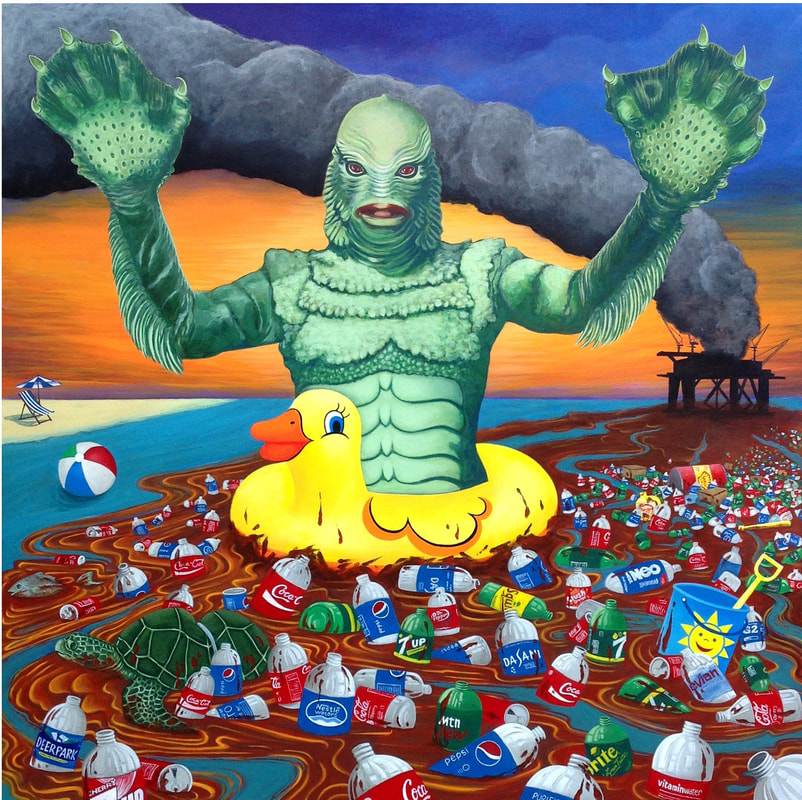
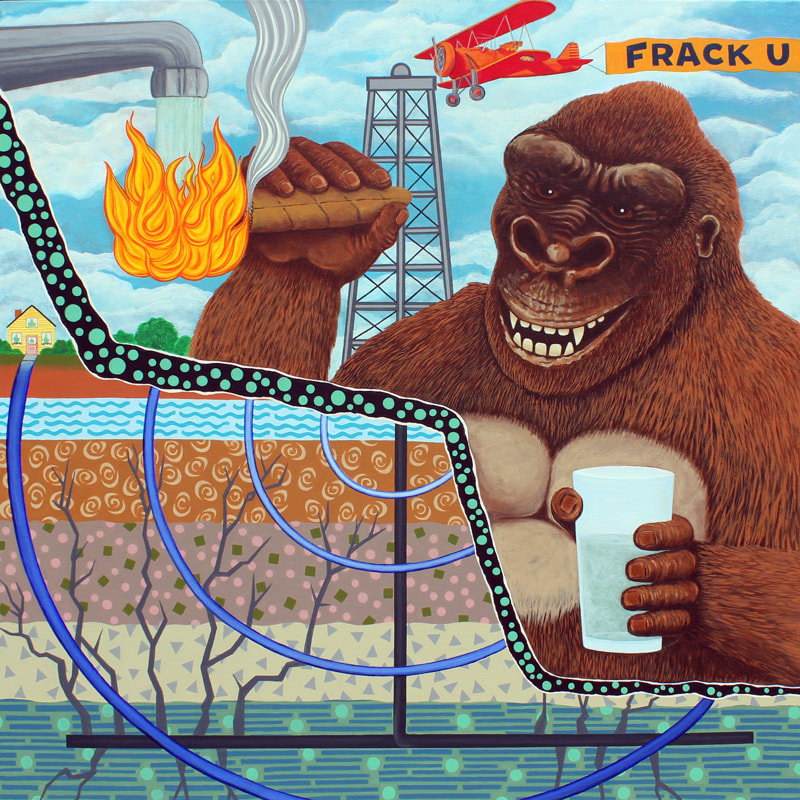
A series of paintings by artists Laura and Gary Dumm seeks to challenge viewers with images of pop-culture monsters facing ecological collapse. 
© Laura and Gary Dumm
Sometimes the latest bad environmental news makes us want to scream like someone in a horror movie who’s just come face to face with Frankenstein’s monster.
Frankenstein’s monster isn’t too happy about the news, either.
Neither are the Creature from the Black Lagoon, King Kong, Chucky or other horror-movie monsters who appear in a recent set of paintings by artists Gary and Laura Dumm of Cleveland, Ohio.

“Old King Coal” © Laura and Gary Dumm
The paintings — exhibited as the “Here There Be Monsters” series — depict the iconic characters surrounded by smog, pesticides, plastic pollution, oil, fracking flames and soon-to-be extinct species.
It’s a quirky, powerful series of paintings created by a duo with a long history of commenting on society through their work. Gary, 71, is a cartoonist and graphic novelist perhaps best known for his decades-long collaboration with “American Splendor” writer Harvey Pekar. Laura, 68, is a pop-art painter whose work often touches upon issues related to animals or social rights. Together they’ve worked together on numerous projects, with their environmental series being one of their most striking.

“Burning in Water, Drowning in Plastic” © Laura and Gary Dumm
We contacted the Dumms to talk about protest art and their look at the real-life monsters affecting the environment.

What inspired you to develop this monstrous series?
Gary: We were looking for a way to do some serious collaborative works about the environment, and Laura first suggested doing a series about bugs and how certain issues like pesticide overuse were affecting them and the environment. We tried our damnedest to come up with something viable, but nothing was working well enough…until I came up with the broader idea of using classic horror monsters from movies as the main characters. Thinking about the fact that most of the monsters were failed scientific experiments made them a good match as recognizable vehicles for expressing some complex ideas. We agreed that these icons could be the “hook” to draw in viewers and also be the messengers for things that we had to say about threats to our environment. And the addition of humorous touches, to leaven the serious subject matter, has proven to be both popular and thought provoking in peoples’ reactions to this series.

Did you have any challenges in completing the series?
Laura: The only challenge is the usual one: coming up with good ideas that resonate with both of us. There’s lots of research, thinking, discussion and sketching done to get each resulting piece to say what we want in a manner that simultaneously strong while not being a diatribe. We feel that we’ve come up with some wonderfully surrealistic and humorously bizarre paintings that hopefully resonate and stay with most viewers. Unfortunately, it appears that there are still too many dire subjects left for us to tackle about the future of our planet. We won’t be short of subject matter.

“The Four Horsemen of Extinction” © Laura and Gary Dumm
What do you hope viewers will learn or experience through this work? 
Gary: We hope to inform the public. When someone looks at any of the paintings they are first attracted by the monster or the color. After they stop, read the title, enjoy the monster, then they focus on the message and hopefully a conversation will follow. We had one person tell us he “doesn’t buy water in plastic anymore because of our painting.” One college-educated person had no idea what GMOs or Monsanto were. After talking about our “Scream of the Butterflies,” she did more research and became more informed.

“Scream of the Butterflies” © Laura and Gary Dumm
What comes next — for this series, or for you?
Laura: We do love collaborating for a cause, so when the right ideas hit us we will make time to continue this series.

Here There Be Monsters
DummArt
Click to enlarge image


Links

These Are The Cities Doing The Most To Combat Global Warming

Bloomberg -  | 

➤Group’s ‘A-list’ shows Boston, London and Sydney in the lead
➤Reykjavik says it already is running 100% on renewables

The U.K.'s Roadmap to Zero Carbon Emissions by 2050

Cities, which are home to more than half the world’s population, are stepping up efforts to slash pollution, often wresting the fight against climate change away from national governments.
That’s the conclusion of CDP, a non-profit group that pushes institutions to detail their greenhouse-gas emissions. Often able to move faster than their national counterparts, metropolitan authorities from London to Sydney and Boston are among a group of 15 setting out the most rigorous plans to achieve carbon or climate neutrality by 2050.

Pushing Green Ambition
Cities across the globe that are front-loading aggressive climate change goals
Note: Includes only cities with target of 50% or more cut in emissions from their respective baseline year
Sources: CDP Climate A List, Bloomberg
The moves are evidence of ambition by local authorities to do their part in reining in global warming, almost two-thirds of global emissions come from cities. CDP wants to draw attention to their actions to encourage others to make similar commitments.
“Cities are doing a lot of the work, but they can’t get there alone,” said Kyra Appleby, global director of cities, states and regions at CDP. “Businesses need to act, national governments need to act as well, people need to change their own behavior in order for us to limit carbon emissions.”

Source: CDP
A smaller group consisting of five cities including Paris and San Francisco have set themselves 100% renewable energy targets. Reykjavik, population 123,000, says it already uses 100% renewable power. How fast other cities get to that point is largely down to the policies they enact.
Paris gets 35% of its energy from clean sources, and San Francisco gets almost 60% of its power from renewables, CDP said.
Almost 7% of the 625 cities that took part in the report were given the highest rating -- joining the CDP “A-list.” Among the top scoring, only 28 have set goals for carbon neutrality (balancing emissions of greenhouse gases), climate neutrality (designing wider policies to reduce the overall impact of human activity to the environment) or cutting emissions by half or more.
More than 20 U.S. cities got the highest rating showing how mayors and city level lawmakers can take the initiative on climate change in spite of a president who has repeatedly played down the effects of global warming.
Since the 2015 Paris Agreement that committed the world to slowing down global warming, the narrative has shifted from a problem that the world faces in the future to an issue that exists today. That was sped up by a 2018 United Nations report that spelled out the need for rapid action to grapple with a warming planet -- and what would happen to ecosystems if temperatures increased another half degree Celsius.
Cities have formed alliances to share knowledge and push for change -- like the C40 initiative that has 94 cities committed to implementing ambitious climate goals. Protests over the global warming have become more urgent with activists calling for climate emergencies to be declared.
CDP gives an “A” rating to any city that reports publicly on its climate adaptation and action plans as well as reporting on emissions inventories and reduction targets. The worst performing cities are handed a “D” although CDP doesn’t make those public.
“Cities are real hot spots of innovation, business and human life on earth so it’s crucial that cities are acting in order for us to meet the targets,” Appleby said.

Links

19/05/2019

Why The Guardian Is Changing The Language It Uses About The Environment

The Guardian - 

From now, house style guide recommends terms such as ‘climate crisis’ and ‘global heating’
The destruction of Arctic ecosystems forces animals to search for food on land, such as these polar bears in northern Russia. Photograph: Alexander Grir/AFP/Getty Images
The Guardian has updated its style guide to introduce terms that more accurately describe the environmental crises facing the world.
Instead of “climate change” the preferred terms are “climate emergency, crisis or breakdown” and “global heating” is favoured over “global warming”, although the original terms are not banned.
“We want to ensure that we are being scientifically precise, while also communicating clearly with readers on this very important issue,” said the editor-in-chief, Katharine Viner. “The phrase ‘climate change’, for example, sounds rather passive and gentle when what scientists are talking about is a catastrophe for humanity.”
“Increasingly, climate scientists and organisations from the UN to the Met Office are changing their terminology, and using stronger language to describe the situation we’re in,” she said.
The United Nations secretary general, António Guterres, talked of the “climate crisis” in September, adding: “We face a direct existential threat.” The climate scientist Prof Hans Joachim Schellnhuber, a former adviser to Angela Merkel, the EU and the pope, also uses “climate crisis”.
In December, Prof Richard Betts, who leads the Met Office’s climate research, said “global heating” was a more accurate term than “global warming” to describe the changes taking place to the world’s climate. In the political world, UK MPs recently endorsed the Labour party’s declaration of a “climate emergency”.
The scale of the climate and wildlife crises has been laid bare by two landmark reports from the world’s scientists. In October, they said carbon emissions must halve by 2030 to avoid even greater risks of drought, floods, extreme heat and poverty for hundreds of millions of people. In May, global scientists said human society was in jeopardy from the accelerating annihilation of wildlife and destruction of the ecosystems that support all life on Earth.
Other terms that have been updated, including the use of “wildlife” rather than “biodiversity”, “fish populations” instead of “fish stocks” and “climate science denier” rather than “climate sceptic”. In September, the BBC accepted it gets coverage of climate change “wrong too often” and told staff: “You do not need a ‘denier’ to balance the debate.”
Earlier in May, Greta Thunberg, the Swedish teenager who has inspired school strikes for climate around the globe, said: “It’s 2019. Can we all now call it what it is: climate breakdown, climate crisis, climate emergency, ecological breakdown, ecological crisis and ecological emergency?”
The update to the Guardian’s style guide follows the addition of the global carbon dioxide level to the Guardian’s daily weather pages. “Levels of CO2 in the atmosphere have risen so dramatically – including a measure of that in our daily weather report is symbolic of what human activity is doing to our climate,” said Viner in April. “People need reminding that the climate crisis is no longer a future problem – we need to tackle it now, and every day matters.”

Links

Lethal Heating is a citizens' initiative