04/10/2021

(BBC) Climate Change: Stop Smoke And Mirrors, Rich Nations Told

BBCMatt McGrath

Young protesters in Milan argue that ministers aren't doing enough. EPA

Rich countries' plans to curb carbon are "smoke and mirrors" and must be urgently improved, say poorer nations.

Ministers meeting here in Milan at the final UN session before the Glasgow COP26 climate conference heard that some progress was being made.

But officials from developing countries demanded tougher targets for cutting carbon emissions and more cash to combat climate change.

One minister condemned "selfishness or lack of good faith" in the rich world.

US special envoy John Kerry said all major economies "must stretch" to do the maximum they can.

Around 50 ministers from a range of countries met here to try to overcome some significant hurdles before world leaders gather in Glasgow in November.

But for extremely vulnerable countries to a changing climate the priority is more ambitious carbon reductions from the rich, to preserve the 1.5C temperature target set by the 2015 Paris agreement.

Scientists have warned that allowing the world temperatures to rise more than 1.5C above pre-industrial levels is highly dangerous.

An assessment of the promises made so far to cut carbon suggests that the world is on track for around 2.7C.

Ministers from developing countries say this is just not acceptable - they are already experiencing significant impacts on their economies with warming currently just over 1C.

US special envoy John Kerry called on all richer countries to step up. Reuters

"We're already on hellish ground at 1.1C," said Simon Steill, Grenada's environment minister who argues that the plans in place just weren't good enough to prevent disaster for his island state.

"We're talking about lives, we're talking about livelihoods, they cannot apply smoke and mirrors to that."

"Every action that is taken, every decision that is taken, has to be aligned with 1.5C, we have no choice."

Some delegates felt that richer countries aren't sufficiently engaged on the issue of 1.5C, because they are wealthy enough to adapt to the changes.

"They don't care about 1.5C because if there's sea level rise, they have the means to build sea walls, and they are just remaining there in their high walls of comfort," said Tosi Mpanu Mpanu, from the Democratic Republic of Congo.

"Some countries are willing to do things but they don't have the means, some have the means but are not willing to do things. Now how do we find the right choreography?"

On this question of choreography, ministers were in agreement that the G20 group of countries should be leading the dance.

Alok Sharma is the UK minister in charge of COP26. Reuters

Mr Kerry called on India and China, who are part of the G20, to put new carbon plans on the table before leaders gather in Glasgow. "All G20 countries, all large economies, all need to try to stretch to do more," he told the gathering.

"I'm not singling out one nation over another. But I am encouraging all of us to try to do the maximum we can."

Analysis
Victoria Gill, science correspondent

The mood on the street in Milan could not have contrasted more sharply with the formal, political roundtable discussions inside the PreCOP26 conference.

On Friday, students and activists marched to the doors of the conference venue - banners waving and arms linked in a human wall to protect Greta Thunberg, who led the procession. There were cheers of: "We are unstoppable, another world is possible".

And just one day after sharing the stage with world leaders, and after meeting the Italian prime minister, 18-year-old Greta told a cheering crowd: "We are sick of their blah blah blah and sick of their lies."

Meanwhile, behind the concrete walls of the conference hall on Saturday, ministers were cautiously optimistic that their discussions had laid crucial foundations for the UN climate meeting in November.

As he brought the meeting to a close, Alok Sharma, president for the much-anticipated COP26 in Glasgow, assured me that there was now a tangible "sense of urgency".

"It's this set of world leaders that are deciding the future," he said. "We're going to respond to what we've heard here from young people."


One of the biggest remaining hurdles to progress remains the question of finance. The richer world promised to pay developing nations $100bn a year from 2020.

That figure hasn't yet been met and while ministers here were confident it would be achieved in Glasgow, the failure to land the money is eroding trust.

"Everything we need to do, we know what that is, and now it's just a question of who's going to be paying for it, who is going to be willing to share their technology," said Tosi Mpanu Mpanu.

"And that's where the problem is. So there seems to be at times selfishness or lack of good faith."


Despite these reservations, the UK minister tasked with delivering success in Glasgow was in positive mood after the meeting in Milan. "I think we go forward to Glasgow with a spirit of co-operation," said Alok Sharma.

"I do not want to underestimate the amount of work that is required but I think there is a renewed urgency in our discussions."

However there are significant hurdles to clear before leaders arrive in Glasgow and technical questions about carbon markets and transparency are still unresolved.

"We need to change. And we need to change radically, we need to change fast," said EU vice-president Frans Timmermans. "And that's going to be bloody hard."

Links

(AU The Guardian) NSW Environment Minister Urges Moderate Liberals To Push The Party Harder On Net Zero

The Guardian

Matt Kean says Matt Canavan and George Christensen ‘never worry about rocking the boat, so why should progressive, economically rational Liberals not do likewise?’

NSW minister for energy and the environment Matt Kean wants fellow moderate Liberals to pressure Scott Morrison to take action on climate. Photograph: Joel Carrett/AAP

The New South Wales environment minister Matt Kean has called on fellow Liberal moderates in Canberra to replicate the forceful lobbying of National MPs, and insist that Scott Morrison takes a net zero target to the Cop26 in Glasgow.

Kean has warned in an interview with Guardian Australia’s politics podcast that traditional Liberal voters are prepared to rise up against Liberal governments failing to take ambitious action to reduce emissions and transition to a sustainable economy.

The interview follows NSW this week unveiling a new pledge to halve emissions in the state by 2030. The previous state target was a 35% cut compared with 2005 levels.

The new commitment spearheaded by Kean was backed by Liberals and Nationals in cabinet – while their federal counterparts remain publicly split on climate policy in the lead up to the Glasgow conference.

With the Cop26 bearing down, the NSW minister and prominent Liberal moderate says colleagues in Canberra need to find their voice, and quickly.

“I think sensible Liberals need to make their position very clear to the prime minister just as Matt Canavan, George Christensen and other characters make abundantly clear their views on these issues.”

“They never worry about rocking the boat, so why should progressive, economically rational Liberals not do likewise? We should be standing up for our constituencies, we should be standing up for our country and we should be making our voice known in the Liberal party and in the public domain.”

Kean believes Scott Morrison should adopt the mid-century net zero target, and also commit to a more ambitious medium-term emissions reduction target.

Courtesy of the NSW commitment, and with other states contributing to the heavy lifting on emissions reduction, Morrison would now be in a position to unveil a 34% cut in national greenhouse gas emissions by 2030 based on existing pledges, rather than sticking to the current national 2030 target of a 26 to 28% cut.

There has been sustained speculation that Morrison could update the 2030 pledge as well as committing to net zero, assuming the Nationals can be persuaded. But the scenario considered more likely is Australia will predict overachievement on the existing target rather than adjust the current pledge.

The NSW environment and energy minister said the coming transition should be viewed through the lens of economic opportunity rather than cost. In electoral terms, he says the threat in the Liberal party’s electoral heartland is real, with groups like Climate 200 promoting independent candidates.

“The number one issue in my community is taking action on the environment that also helps our economy, and that should be completely in line with what conservatives, who are meant to be conserving things, should be about: conserving our planet, handing it to the next generation better than we found it, but also seizing the biggest economic opportunity that we will ever see,” Kean said.

“I don’t want to see strong, good Liberal moderates thrown out and replaced with independents.”

“Strong economically rational and socially progressive voices in the Liberal party can bring about change for the better and that’s what we are doing here in New South Wales”.

“I want those people to stand up in the Liberal party and be counted and then they won’t have an issue from independent voices looking to knock them off in a general election”.

The Morrison government is expected to unveil its commitments for Glasgow by mid-October. Some Queensland Nationals have signalled they are implacably opposed to net zero.

Federal Liberals in metropolitan seats have called publicly for Morrison to adopt the net zero commitment. A number of these MPs would also support a higher medium term emissions reduction target.

Given the opposition from some Nationals, government MPs say the federal minister for energy and emissions reduction Angus Taylor has privately floated the idea that the Coalition could adopt a plan to get to net zero without signing up to the target. But many Liberals regard this idea as completely suboptimal in a policy sense, and politically untenable.

Guardian Australia revealed earlier this week Morrison met on Tuesday with a deputation of Liberals in a teleconference – including Dave Sharma, Fiona Martin, Trent Zimmerman, Julian Leeser, John Alexander, Julian Simmons, Angie Bell, Paul Scarr, Andrew Bragg, Tim Wilson, Katie Allen, Dean Smith, Jason Falinski, Celia Hammond and Bridget Archer.

The prime minister is understood to have told the group it remained his preference to land a roadmap laying out the required technology, actions to get to net zero emissions by mid-century and the 2050 target.

Morrison also acknowledged that climate change was now a vote-changing issue in the Liberal party heartland.

Links

(The Independent, UK) Australian Government ‘Wilfully Negligent’ On Climate Crisis, Says Scientist Studying Impact On Bees

The Independent - Harry Cockburn

Scott Morrison’s administration ‘not taking the environment seriously’, says Dr James Dorey

Fire burns within sight of the suburban fringe of the city of Canberra on January 31, 2020. (Getty)

A scientist studying the impact of worsening wildfires in Australia on the country’s native bees has accused the government of acting in a “wilfully negligent way when it comes to climate”, failing to protect biodiversity, and not caring about the future.

Dr James Dorey, a postdoctoral researcher at Yale University, and the lead author of new research led by Flinders University, made the remarks following the publication of research revealing the number of threatened Australian native bee species is on course to increase by almost five times after the devastating “Black Summer” bushfires of 2019-2020.

The extensive fires burnt through 24 million hectares, destroying around 3,000 homes, and killed or displaced an estimated 3 billion animals.

The research team assessed 553 bee species – around one-third of Australia’s known bee species – and found marked population reductions among many.

Nine species were assessed as “vulnerable” and two more “endangered” as a direct result of the multiple fire fronts in the 2019-20 bushfires.

Describing the research as a “call to action”, Dr Dorey told The Independent that it was “no surprise”, the species were suffering due to the lack of ambition to tackle the climate crisis in Australia.

“The Australian government is acting in a wilfully negligent way when it comes to climate and I honestly think that we could be punching above our weight when it comes to climate action. Instead, Australia continues to invest public money into climate-wrecking fossil fuel industries,” he said.

“Of course, climate change is a global challenge and Australia is not alone in failing to act, but truly it feels like our federal and many state governments care not a smidge for the natural world of which we should be active and positive custodians.”

He added: “It is no surprise at all that there are species getting pushed towards extinction by climate change and massive disturbance events, like the Black Summer bushfires.”

The study also warned widespread wildfire and forest fire damage is being repeated all around the world, from North America and Europe to the Congo and Asia, causing catastrophic impacts on biodiversity and sudden and marked reduction in population sizes of many species.

Dr Dorey said it was “incredibly frustrating” that Australian prime minister Scott Morrison had suggested he may not attend the UN’s Cop26 climate summit in the UK – a meeting widely regarded as the last chance for governments to act on the runaway climate emergency.

He said: “It feels like an explicit admission that Scott Morrison, and the federal government, doesn’t care at all about our climate or our future.

“The government is not taking the environment seriously, which is terrible because the Australian environment is incredible and worth saving. As are the ecosystems found around the world. I think that our governments should be thinking ahead and for future generations. Not just their next election.”

Fellow author Dr Stefan Caddy-Retalic, from the University of Adelaide and University of Sydney said the research underlines the importance of studying impacts on less visible species.

“Climate change is increasing the frequency of natural disasters like wildfire, which impacts our wildlife.

“Listing severely-impacted species on the IUCN red list and under Australian law represents our best approach to lobby governments to act,” he said, adding that native bees are very important providers of ecosystem services including pollination, but most are poorly known.

Olivia Davies, a Flinders University researcher and also an author on the paper, said: “Most people aren’t aware of just how vulnerable our native bees are because they are not widely studied.

“The fact that no Australian bees are listed by the IUCN shows just how neglected these important species are.”

The research is published in the journal Global Change Biology.

Links

03/10/2021

(CNN) Australia's Climate Policy Is Being Dictated By A Former Accountant In A Cowboy Hat

CNNBen Westcott

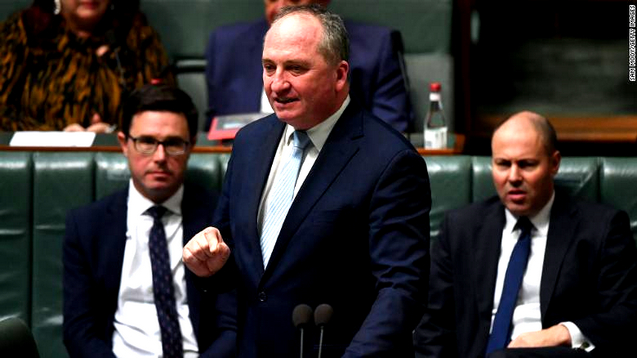
Barnaby Joyce leads Australia's National Party, which traditionally represents rural voters.

Australia's Prime Minister has all but confirmed he won't join global leaders at crucial climate talks in Glasgow.

Two more weeks of Covid-19 quarantine would be too much, Scott Morrison said on Friday, claiming that while there are "a lot of international interests," the most important audience for his yet-to-be-unveiled climate plan remains at home.

"My first and most important group that I need to talk to about our plan is not overseas. It's right here in Australia," he said. "It's talking to people in regional Australia, how the deputy prime minister and I believe our plan will help them in their communities, how our plan will help them realize their future."

With that remark, Morrison made it clear his loyalty lies with Deputy Prime Minister Barnaby Joyce, a cowboy hat-wearing, former accountant who leads the National Party, the Liberal government's coalition partner -- and not with international allies who are urging Australia to take greater action to cut emissions.

Australian Prime Minister says Australia will reach net zero "as soon as possible".

Joyce says he wants to see the numbers before he agrees to any new climate targets, as he struggles to unite a party riven with differences over Australia's future relationship with coal.

Morrison's refusal to commit to a target of net zero emissions by 2050 hasn't just isolated him on the international stage. Even within Australia's own borders -- aside from staunch pro-coal Nationals -- Morrison is looking more and more like he's being left behind.

On Friday, even the Minerals Council of Australia, the country's mining advocacy group, announced it supported net zero emissions by 2050. The country's largest states have already announced large emission reduction targets, and surveys also show most Australian people support tougher climate action.

Will Stefan, emeritus professor at the Australian National University's Fenner School of Environment and Society, said public opinion appeared to contradict the interests of Morrison's political allies and big business, who invest heavily in fossil fuels.

"I think there's a growing gulf between what the Australian public wants and how our Prime Minister is behaving," he said.

And that's a dangerous position for a Prime Minister to be in just months before a federal election.

Photovoltaic modules at a solar farm on the outskirts of Gunnedah, New South Wales, Australia.

Selling Kodak cameras

Part of the reason for Morrison's reluctance to take actions lies in the fact that he leads a coalition made up of the center-right, pro-business Liberal Party and the National Party, who traditionally advocate for regional workers and agricultural communities.

The National Party has long opposed any action on climate change, claiming it will hurt rural communities. Joyce wants assurances the party's traditional supporters won't lose out in any broader transition to renewable energy.

"It's the little old bush accountant saying that lots of clients have ideas, but (you need) to sit down with them and say, 'Okay, that's your idea, let's prudently go about this,'" Joyce told told the Australian Broadcasting Corporation (ABC). He said whole towns rely on Australia's coal industry, and they shouldn't be forgotten.

"It's not just those farms, not just the mines, it is the towns that are attached to the commerce of those industries," he said. "It is the hairdressers, the tire business. These people also rely on the Nationals to make sure that we don't pull the economic rug out from underneath them."

Deputy Prime Minister Barnaby Joyce during Question Time in the House of Representatives at Parliament House on June 23 in Canberra, Australia.

While some Nationals support a move to net zero, others seem unlikely to budge, much to the frustration of some of Morrison's Liberal Party colleagues who want greater climate action.

On Sunday, a coal-loving Nationals senator took to Twitter to say he was "deadset against net zero." A Liberal minister hit back, accusing him of "selling Kodak cameras ... when the iPhone is coming."

The divisions are making life difficult for Morrison, who said he's working on a plan to bring his government "together on this issue."

It's not clear when that plan will be released, but he has said it'll be ready before other leaders descend on Glasgow for the 2021 United Nations Climate Change Conference, also known as COP26 as it is the 26th UN conference on climate change.

Despite being one of the largest per capita emitters of carbon in the world, according to the World Bank, the Australian government has dragged its feet on climate change action for decades.

The steelworks and coal loading facility in Port Kembla in Wollongong, Australia.

Australia's pledge to reduce its carbon emissions by 26% to 28% from 2005 levels by 2030 is far below commitments from similar developed nations, including the United States. And Morrison has steadfastly refused to commit to net zero by 2050, saying only the country will reach the goal "as soon as possible."

Morrison's government has insisted that Australia is meeting its climate targets -- and even beating them -- but Stefan said the emission reduction target was "very weak."

Experts have previously said Australia would need to cut its emissions by twice the current commitment, up to 50% by 2050, to keep warming below 2 degrees Celsius worldwide. And even greater cuts are needed to keep warming below the international target of 1.5 degrees Celsius.

"They're talking about new technologies and so on, but they're avoiding, completely avoiding the way we can get our emissions down, rapidly at cost and with side benefits. And that's to go renewable," said Stefan.

Part of the trouble is Australia is heavily reliant on mining for its economic prosperity. The country is one of the world's biggest coal exporters, bringing in around 50 billion Australian dollars ($36 billion) and employing more than 50,000 people, according to the government.

Australia is one of the world's biggest coal exporters.

With coal prices surging, some Nationals see no reason to cut off a lucrative source of revenue.

But the rival argument is that Australia has an opportunity to generate masses of renewable energy and industries to replace jobs lost in fossil fuels.

On Wednesday, as he announced plans to halve the state's emissions by 2030, New South Wales Environment Minister Matt Kean said Australia should "lead the world" on climate change, describing it as the "biggest economic opportunity of our lifetime."

"The reality is that the world is changing rapidly ... We would be absolutely mad to miss it," he said.

What the Australian people want

Some politicians have pitched Australia's climate divide as a city versus country debate that will see the latter lose out.

In an opinion piece published Monday, Nationals Sen. Bridget McKenzie accused her Liberal Party colleagues of forgetting about rural Australians and miners whose jobs would be lost by tough action on climate change.

At a press conference with the Liberal Party's deputy leader, Treasurer Josh Frydenberg, on a separate issue Wednesday, the two traded jabs over the government's climate policies.

When Frydenberg said "climate change has no postcode," McKenzie responded by saying some Liberal Party politicians were trying to be "cool" by pushing for climate action. "Josh isn't one of them," she added.

While politicians argue over the best way forward, rural Australians are getting on with it. They say they have no choice.

Ellen Litchfield, a third-generation farmer, said rural and urban communities have more in common than some politicians seem to think.

With her family, third-generation farmer Ellen Litchfield operates Wilpoorinna, a sheep and cattle station 650 kilometers (400 miles) north of Adelaide in the Australian Outback, making her acutely aware of the threat of droughts to her and farmers like her.

She said the idea that there was a divide between rural and urban voters was mostly cooked up by politicians, capitalizing on a nostalgia for rural Australia, to argue for the status quo.

"I think that there's a lot more in common with the regional voter and the urban voter than they want us to believe," she said.

Litchfield, who advocates for Farmers for Climate Action, said many regional workers see "the benefits of changing."

"Mind the pun, but we're at the coalface of climate change every day. We're working out in the environment, we're seeing how things change," she said.

"And feeling supported and like we are all working together, all the industries are working together to secure the future, would be a huge benefit for us."

It isn't just Litchfield who supports climate change action in Australia.

Protesters take part in the School Strike 4 Climate rally on May 21 in Melbourne, Australia.

A poll by Essential Polling released on August 17 found more than 60% of respondents supported providing greater funding for solar power, introducing a carbon levy on polluters and putting in place a net zero carbon emissions target by 2030.

ANU professor Stefan said government efforts to reduce emissions in some jurisdictions, such as his home in the nation's capital, Canberra, had been popular with the electorate.

"This is a global problem, and we're all expected to do our fair share," he said. Whether Morrison can come up with a plan to balance the competing forces in his coalition remains to be seen.

But whatever compromise he can offer will be pored over at length by the international community -- and by all Australians with votes to cast the next election. 

Links

(AU SMH) While The 2050 Battle Rages In Australia, The World Is Talking 2030

Sydney Morning HeraldNick O'Malley | Mike Foley

This week’s brawl within the federal government over whether to commit to a target of net zero by 2050 must look to much of the rest of the world like a glimpse of the political past.

“I am deadset against net zero emissions,” outspoken Nationals MP Matt Canavan tweeted during the week, enthusiastically joining in the cut-and-thrust between Liberal moderates and Nationals hardliners over the 2050 target.

Barnaby Joyce has given the government hope he may agree to net zero emissions by 2050. Credit: Alex Ellinghausen

Yet elsewhere in the world, 2050 is a given and 2030 is the issue. At the United Nations climate summit in Glasgow next month, developed nations will be called upon to cut their emissions by at least 50 per cent by the end of the decade to make it possible to limit global warming to 1.5 degrees, identified as the point at which catastrophic climate change could spin out of control.

The host of the summit, British Prime Minister and Conservative Party leader Boris Johnson, has committed to reducing emissions by 68 per cent by 2030. Australia has not so far updated its existing commitment to cut emissions by 26-28 per cent from 2005 levels by the same date.

And Prime Minister Scott Morrison is not just under international pressure. Moderate Liberals have made it clear they want to move with the rest of the world.

The political cost of slow climate action is growing. Federal Liberal Party director Andrew Hirst emailed members last week calling for a fighting fund to protect MPs like Josh Frydenberg and Katie Allen in Melbourne and Dave Sharma, Jason Falinski and Trent Zimmerman in Sydney, who face challenges from pro-climate action conservative independents.

Nor are the Nationals in lockstep. Unlike Canavan and Resources Minister Keith Pitt, Nationals leader Barnaby Joyce has signalled his support can be bought with enough financial support for regional economies.

So out of step with global ambitions is the 2050 debate that it has prompted at least one international onlooker to ask if it is genuine.

“The cynic in me wonders if it is in some sense staged, a piece of performance art,” says the renowned climatologist and author Michael Mann, director of the Earth System Science Centre at Pennsylvania State University. “It allows the Prime Minister to appear to be taking a bold stance by pledging net zero emissions in 2050, when it is in fact an anaemic pledge that kicks the can down the road, decades too late.”

The black summer bushfires have given a horrifying new backdrop to the debate over emissions and what failing to cut them would mean. Credit: AP

Mann, who wrote much of his new book The New Climate War while living in Australia on sabbatical during the black summer bushfires, knows how bitterly climate is contested in Australian politics. “Australia is clearly the last holdout right now among major industrial nations when it comes to making serious climate commitments.”

Australia’s former top climate diplomat, Howard Bamsey, says net zero by 2050 is a “very low bar” and the bare minimum expected by our allies. “If you think you’re not going to get there, then you need some blood on the floor to show that you’ve tried,” he says.

Why 2030 matters

In the simplest terms 2030 is crucial to tackling climate change because it forces governments to take immediate action rather than delaying action until it becomes impossible to achieve the Paris Agreement goal of keeping warming to within 2 degrees - and as close to 1.5 as possible - by 2100.

According to the United Nations’ last major climate report in August, to have just a 67 per cent chance of holding warming to 1.5 degrees, starting from 2020 we could afford to emit just 400 billion tonnes more carbon dioxide into the atmosphere.

Coal stockpiles in Gladstone in June. “If G20 countries - including Australia - choose business-as-usual, climate change will soon send Australia’s high living standards up in flames,” says Selwin Hart, a top climate adviser to the UN. Credit: Peter Davis

Given that the world currently emits about 40 billion tonnes of greenhouse gases each year, by January 2021 that would have stood at 360 billion tonnes, and by 2030 our “allowance” would be exhausted.

“To have any chance of hitting [Paris goals] we need immediate steep cuts,” says Professor Will Steffen, former executive director of the Australian National University Climate Change Institute and a councillor with the Climate Council.

“Setting a 2030 target that allows for a gradual transition to net zero emissions helps avoid locking in carbon-intensive economic pathways and can avoid costly rates of change in later years,” says a new report on the gap between current targets and keeping global warming to 1.5 degrees by Climate Analytics, a global climate policy centre and think tank.

In climate negotiations, there is also a view that wealthy countries have a responsibility to cut faster than developing nations because they have already benefited from growing wealthy by exploiting fossil fuels, and because they have the financial resources to act.

The Prime Minister and the Treasurer are responding to the international pressure, albeit more slowly than many on the internationals stage would like. While Joe Biden announced a commitment to cut emissions by 50 per cent by 2030 as he assumed the US presidency, Morrison says he wants Australia to “preferably” reach net zero by 2050.

Johnson outlined the economic opportunities in a clean revolution when he said “in the years to come, the only great powers will be green powers”. Frydenberg echoed this message and warned that global investors mark Australia down as a risky backwater.

“We cannot run the risk that markets falsely assume we are not transitioning in line with the rest of the world,” Frydenberg said.

Coal
How Germany closed its coal industry without sacking a single miner
Like other G20 nations, Germany takes net zero by mid-century for granted, and it’s now tackling immediate domestic politics.

Germany has committed to cut emissions 65 per cent by 2030, and the government is battling bad press as reports show the country is on track to achieve only 50 per cent by the end of the decade.

But successive federal governments have been hamstrung for a decade by internal division over climate.

While a majority of MPs recognises there’s support for greater action among urban voters, they’ve been blocked by some of those representing rural electorates as well as blue-collar workers in coal mines and power plants.

Having identified climate policy as a prime ministerial graveyard, Morrison adopted a “technology not taxes” mantra. Cuts would be made to emissions only if they could be made without cost to industry. As a result, Australia has yet to update its 2030 target to reduce greenhouse gas emissions by at least 26 per cent based on 2005 levels, making it even more of an outlier among peer nations.

The government is working on an updated version of its technology roadmap which could offer a pathway to a net zero deadline. It will focus on expected greenhouse reductions from investing in low-emissions technology.

Can it be done?

According to scientists and engineers, deep and fast cuts can be made. The cost of renewable energy technology has fallen faster than expected and rates of adoption have exceeded even optimistic predictions.

Australian state and territory governments have all adopted targets of net zero by 2050 or earlier, while this week’s announcement by NSW that it would pursue a 50 per cent by 2030 target puts it into line with Victoria’s ambitions.

Australia is expected to increase its emissions reduction goals ahead of the Glasgow climate summit, but questions remain over whether it will be enough. Credit: PA

The NSW decision also suggests that there is a way through the political impasse within the Coalition as well.

Modelling relied upon by the NSW government in adopting the target suggests that it can be met through four main measures.

The first is the replacement of the coal-fired power fleet with renewables based in so-called Renewable Energy Zones across the state. In these zones the government agrees to streamline permits for renewables and foots the bill for transmission infrastructure.

Other policies include a raft of measures to make it cheaper and easier to own electric cars and a fund to help industry replace equipment.

Renewable Energy Zones have been key to winning the backing of NSW Nationals leader John Barilaro, with NSW forecasting its emissions reduction drive will attract about $12 billion of investment across the economy by 2030, with two-thirds of that expected to flow into regional communities.

The zone around Joyce’s federal seat is expected to drive $10 billion in investment into the region.

Similarly, Victoria’s plan includes pumping public money into programs to spur investments in renewables, private uptake of solar and industry innovation.

Emissions
Carbon capture and storage eligible for emissions reductions credits
Earlier this year the International Energy Agency recommended that in the near term government should consider “halting construction of new coal power plants and phasing out coal power by 2040 (or 2030 for developed nations), phasing out combustion engine cars by 2035, ending fossil fuel subsidies, and rapidly accelerating renewables deployment over the next decade to decarbonise the power system by 2050”.

The federal government’s “technology not taxes” policy embraces some of these measures - but it also maintains fossil fuel subsidies such as the $7.8 billion fuel tax rebate. It is also investing public money in large-scale carbon capture and storage in the hope of keeping some fossil fuels running in a net zero world.

Climate Action Tracker, an independent scientific analysis group, was scathing in its assessment: “The government appears intent on replacing fossil fuels with fossil fuels: the 2021-22 budget allocates large sums ($52.9 million) to gas infrastructure projects and a gas-fired power station ($30 million), with no new support for renewable energy nor electric vehicles.”

Their overall verdict on Australia’s performance so far? “Highly Insufficient”.

Given that COP26 starts in less than a month, the Morrison government does not have much time left to convince the world otherwise.

Links

(The Conversation) Social Media Is Reducing Climate Change Debates To Your Views On Veganism

The Conversation |  

Online debates over the environmental impact of eating meat are getting heated. Kaboompics/Pixabay

Authors
  •  is Associate Professor, School of Sociology; Geary Fellow, Geary Institute for Public Policy, University College Dublin
  •  is a PhD Candidate in Social Data Science, University of Oxford
Ten years ago, when we ranked the most controversial articles on Wikipedia, George W. Bush was at the top of the list with global warming at number five.

The article on global warming has now been re-titled as climate change, but this remains among the most polarising issues of our time – and one frequently debated on social media.

This might seem like it’s due to the way climate change is often presented primarily as a political issue: something you can choose whether or not to support.

But perhaps it’s as much a result of the way social media works. Our recent research shows that polarisation on social media is mathematically inevitable.

What’s more, this polarisation is allowing online discussions about climate change to be overridden by culturally-focused arguments about things like diet. This appears to be further cementing the idea that climate change is a matter of ideology, making it harder to convince people to support action to tackle it.

The fact that it’s so easy to unfriend or unfollow people you disagree with on social media has accelerated the formation of online echo chambers to the extent that even an algorithmic tool designed to break the bubbles won’t be able to help.

Don’t get us wrong: we’re big fans of social media and most likely have already tweeted this article by the time you read it. Social media can be seen as a marketplace of ideas, providing an open forum to exchange facts and opinions and, importantly for scientists, to inform the public about their research. But polarisation can ruin it for everyone. An example of this relates to the UK bakery chain Greggs’ vegan sausage roll, which ignited days of social media turmoil when it was introduced to the UK in January 2019 to coincide with Veganuary, a month-long UK-based charity campaign designed to encourage veganism.

Veganuary-oriented social media discussions that year were dominated by arguments over the sausage roll’s relative merits.

To understand the extent of this interference, we analysed about half a million tweets posted between 28 December 2018 and 28 January 2019 containing any of the hashtags “#vegan”, “#veganuary” and “#veganuary2019” to map out the prevalence of extreme opinions among the tweets. Around 30% of the tweets we analysed were firmly pro-vegan, while 20% of tweets used Veganuary-related hashtags to express their protest against veganism. More importantly, many Twitter users who tweeted about Veganuary explicitly said if it wasn’t for the Greggs story, they wouldn’t have gotten involved.

On one hand, bringing extra attention to the campaign might be considered a blessing. On the other, the polarised nature of online arguments disproportionately focused on the issue of the vegan sausage roll.

This shifted what could have been a fruitful and logical discussion around the pros and cons of veganism towards unproductive fights centred around perceived threats to people’s identities tied up with what they do or don’t eat and what that means.

Many quickly took sides, refusing to engage in conversation and instead attacking the personal qualities or intelligence of the “other side”. This conflict surfaced again on social media a few months later, when the Intergovernmental Panel on Climate Change (IPCC), a UN-endorsed organisation, published its Special Report on Climate Change and Land in August 2019.

In order to gauge the level of public engagement with the report, we collected all tweets sent in August 2019 which contained the phrase “IPCC”. We then used software to analyse the content of some 6,000 tweets in English in order to extract the main topics of discussion. We found that not only were a large portion of the tweets in response to the IPCC report specifically about diet, but these tweets contained the most toxic and polarised language in the sample.

This is even more surprising when considering that diet was only mentioned briefly in the original IPCC report, without any explicit recommendations about meat or dairy consumption.

Evidence like this suggests that diet and cooking are now forming the core of a new culture war around climate. This could be catastrophic for climate action. Politicians and policy makers traditionally tend to avoid issues that are culturally controversial, and polarisation of public opinion has been shown to weaken politicians’ accountability when it comes to making major decisions.

A map of Twitter users and those they retweet, from our Veganuary dataset. Author provided

Our work recently published in Climatic Change shows how tools such as computational topic modelling and sentiment analysis can be used to monitor public discourse about topics like climate events, diet and climate policies. This could help policymakers plan more engaging communication strategies: in other words, to help them read the room. Both scientists and science communicators who discuss reports like that produced by the IPCC must understand, and anticipate, the likelihood of emotionally charged, potentially negative responses to such polarising issues as climate change – as well as specific areas of polarisation, such as diet, that are currently more popular.

This way, they can work to communicate key information in ways that allow readers to focus on what really matters. 

Links

Lethal Heating is a citizens' initiative