30/01/2022

(AU The Guardian) Great Barrier Reef On Verge Of Another Mass Bleaching After Highest Temperatures On Record

The Guardian - 

Exclusive: ‘Shocked and concerned’ US government scientists say heat stress over Australia’s ocean jewel is unprecedented

File photo of coral bleaching. Scientists at the US National Oceanic and Atmospheric Administration say the Great Barrier Reef headed into the summer with more accumulated heat than ever before. Photograph: AFP/Getty Images

Temperatures over the Great Barrier Reef in December were the highest on record with “alarming” levels of heat that have put the ocean jewel on the verge of another mass bleaching of corals, according to analysis from US government scientists seen by Guardian Australia.

On Friday the Morrison government announced $1bn for reef conservation over the next nine years if it wins the next election – a pledge branded by some as a cynical attempt to stop the reef being placed on the world heritage “in danger” list at a meeting in July.

Conservationists and scientists mostly welcomed the pledge, but many said the government needed to greatly improve its greenhouse gas emissions targets and stop supporting fossil fuel projects.

In the three months leading up to 14 December, an analysis from scientists at the National Oceanic and Atmospheric Administration (Noaa) says heat stress over the corals reached a level “unprecedented in the satellite record” for that time of year.

According to the analysis, temperatures were so hot that between mid-November and mid-December, the minimum temperatures over more than 80% of the reef were higher for that period than previous maximums.

Dr William Skirving, of Noaa’s Coral Reef Watch, said his team “were surprised, shocked and concerned” when the analysis, covering each year from 1985, was completed.

“There’s never been heat stress like that in our records. It’s completely out of character and speaks to the fact that the minimum temperatures were higher than the previous maximums. This is almost certainly a climate change signal.

“Being a scientist in this field in this day and age is sometimes a bit nightmarish. Sometimes I wish I knew a little bit less.”

As greenhouse gas emissions accumulate in the atmosphere, the world’s oceans are getting hotter, and scientists say coral bleaching will become more frequent in the short term, whatever happens to emissions.

The 2,300km reef has seen five mass bleaching events – in 1998, 2002, 2016, 2017 and 2020 – all caused by rising ocean temperatures driven by global heating.

According to the Noaa analysis, which has not been peer reviewed but has been accepted to a scientific journal, the reef headed into the summer with “more accumulated heat than ever before”.

Average water temperatures in mid-December were at least 0.5C hotter than the corresponding period for any previous summer when the reef bleached.

The peak period for heat stress tends to be in late February and March.

Corals get most of their food and colour from the algae that live within them. But if temperatures get too high, the algae separates and leaves the animal bleached white.

Corals can recover from mild bleaching but are weaker, more susceptible to disease and reproduce less in the following years.

Dr Mark Read, the assistant director of reef protection at the Great Barrier Reef Marine Park Authority, said: “The impact is considered minor at this point, however we are watching conditions closely, recognising the heat accumulation in the system.”

There were reports of heat-stressed corals and some bleaching from offshore reefs between Cooktown and Mackay and inshore reefs near Townsville.

“The risk of broad-scale coral bleaching in the Great Barrier Reef is reliant on weather conditions over the next couple of weeks,” he said.

Extended periods of cloud cover, rainfall and wind could all help reduce temperatures, he said.

The Bureau of Meteorology meteorologist Shane Kennedy said monsoonal conditions could deliver cloud and rain in the coming week, but this could clear south of Cairns in the coming days.

Associate Prof Tracy Ainsworth, a coral biologist at the University of New South Wales, said cloud cover could reduce the extra stress on corals from sunlight.

“It’s sad we’re in a position where we’re hoping for conditions that minimise coral mortality.”

Prof Jodie Rummer, a Townsville-based marine biologist, said some corals were bleaching at Magnetic Island, near Townsville.

“I’m concerned for the reef and this funding pledge feels a bit like a last-ditch effort [to stop the reef being listed as in danger],” she said.

Scott Morrison views the reef from a glass bottom boat during a visit to the Great Barrier Reef. Photograph: Brian Cassey/AAP

On Friday the prime minister, Scott Morrison, was in Cairns to announce the funding which, if his government was re-elected, would target projects across water quality, pollution, illegal fishing and outbreaks of coral-eating starfish.

Reef health monitoring, habitat restoration and scientific research into making corals and habitats more resilient would also be funded.

The world heritage committee is due to decide in July whether to place the reef on its “in danger” list.

Australian government’s plan to protect Great Barrier Reef falls short, environment groups say. Read more
Unesco science advisers recommended the listing last year, and the $1bn pledge comes just days before a 1 February deadline for the government to send a progress report to Unesco.

Associate professor Mike Van Keulen, the chair of marine science at Murdoch University, described the Coalition’s pledge as “a cynical token action”.

Conservation groups have long called for extra funding to improve water conditions over the reef, which experts say can improve the health of corals and give them a better chance of surviving as temperatures rise.

Richard Leck, the head of oceans at WWF-Australia, said the pledge was “positive news for our national icon” and would keep funding at broadly their current levels.

“Progress on reducing water pollution has fallen behind the government’s targets to protect the reef, so it’s vital that this investment is applied in a way that markedly improves water quality.”

But he said it “needs to be complimented by real action on climate to drive down emissions this decade”.

Dr Anita Cosgrove, a Queensland campaigner with the Wilderness Society, said the package was “insufficient to overcome the breadth of challenges”.

The Australian Academy of Science president, John Shine, said global heating threatened the reef’s “extraordinary variety of habitats and species”.

The Australian Marine Conservation Society water quality expert, Jaimi Webster, said funding to address water pollution and illegal fishing was welcome, but insufficient.

Gavan McFadzean, of the Australian Conservation Foundation, said: “A government that is fair dinkum about protecting the Great Barrier Reef would urgently phase out coal, oil and gas – and would not continue to subsidise the growth of fossil fuel industries – to give the reef a chance to survive.”

‘Dancing through the water’: rare sighting of blanket octopus in Great Barrier Reef. Read more
The Queensland Conservation Council director, Dave Copeman, also said the government’s support for fossil fuel projects was putting the reef under threat. 

Labor’s deputy leader, Richard Marles, questioned whether the Morrison government would follow through on its $1bn pledge.

“This is a prime minister who throughout his time in office has completely failed to take any meaningful action on climate change,” he said, adding “you cannot take action on the reef without being serious on climate change, and Scott Morrison is not”.

The Greens senator for Queensland, Larissa Waters, said: “A belated cash splash on the Great Barrier Reef is a joke from a government that has turbo-charged the climate crisis imperilling the reef by giving billions to fossil fuels and backing new coal and gas.”

Morrison’s pledge was also criticised by one of his own backbenchers. The Queensland Liberal National party senator Gerard Rennick told the ABC it was “unnecessary funding” that was only aimed at “appeasing the United Nations”.

Links

(AU ABC) $1b Plan To Save Great Barrier Reef Will Fail Without Climate Change Action, Expert Says

ABC North Qld | Zilla Gordon

The Great Barrier Reef as seen from above on a stunning day.
Reactions to the government's funding announcement have been mixed.(Facebook: Great Barrier Reef Legacy)

Key Points
  • Labor says the government has had 10 years to try and restore the health of the Great Barrier Reef
  • A marine biologist says the funding won't help much without broader action on climate change
  • A dive business operator says the reef can be nursed back to health and has welcomed the announcement
The Morrison government's billion-dollar plan to save the Great Barrier Reef has been criticised by a scientist who says it will mean nothing if global carbon emissions are not reduced.

The nine-year plan announced today in Cairns is the biggest single investment ever made in the reef and will support the development of technology and water management practices.

It comes after the 344,400-square-kilometre ecosystem narrowly avoided being listed as "in danger" by UNESCO last year.

James Cook University marine biology associate professor Jodie Rummer said she felt underwhelmed by the commitment.

"Without a mention of climate change in this announcement … it's not looking great," she said.
"We need to be putting resources and money – $1 billion – towards net zero by 2035 and to reducing our emissions by 75 per cent in this decade."
A woman stands in an aquarium building with her arms crossed.
Jodie Rummer says the reef will be doomed without more action on climate change.(ABC News: Travis Mead)

Dr Rummer said Australia was not doing enough to address climate change.

"We're barrelling towards two-degree warming," she said.

"What we've already seen with one and 1.2 degrees of global warming is three million heat waves within five years resulting in 98 per cent bleaching on reefs worldwide.

"This is isn't just isolated to Australia — it's a problem worldwide."

Bleached coral next to healthy coral, with fish swimming by.
Coral bleaching at Magnetic Island. (Supplied: Victor Huertas)

'Better late than never'

Paul Crocombe runs a dive business in Townsville and has been working on the reef for more than 40 years.

He welcomed today's announcement, saying it was "better late than never".

Mr Crocombe's biggest concern was water quality.

"We get drought, we get a lot of exposed soil, and they we'll get a cyclone and a flood and that soil will wash down into the ocean," he said.

Mr Crocombe hoped people would become more aware that what they washed down their drains ultimately affected the reef.

He also felt many believed the reef was beyond repair, but he said the reef had the potential to be "very good for a long time" provided it was properly cared for.

"I don't think it's too late," he said.

Terri Butler says the reef wouldn't be in such bad shape if "real action" had been taken earlier. (News Video)

Labor lashes government's timing 

Opposition Environment spokeswoman Terri Butler said she viewed today's announcement as an admission of failure from the government.

"Their only policy to date has been giving half a billion dollars to a tiny charity behind closed doors in a backroom deal and clearly they're admitting that hasn't been enough," she said.

Ms Butler said if the government had taken "real action" on climate change the reef's health would not be in such steep decline.

"This is a government that is desperately trying to scrabble in relation to the reef after a decade of mismanagement," she said.
"This is a government that turned up to Glasgow this year with nothing more than a pamphlet."
Australia avoids Great Barrier Reef
global embarrassment
Let's strip away the politics and look at the facts — the things that actually matter to the reef. Read more
Ms Butler said Labor supported immediate action, but would not comment on whether the party would match the $1b commitment.

"The government's announcement is for funding over 10 years,'" she said.

"We don't even know how much of this money is suppose to be spent immediately and how much is spent in year seven, eight, or nine."

Labor has pledged to spend $163 million, including an additional $63m to the Reef 2050 program.

At the moment the plan is only funded until 2023/24.

Shadow Treasurer Jim Chalmers said the Prime Minster had turned an environmental issue into a political one and that Australians would see through the timing of the announcement.

"We know that Scott Morrison doesn't care about the reef — if he did he would have done something about it over the last decade the Liberals and Nationals have been in office," he said.

Scott Morrison stands in a courtyard with a wry smile on his face.
Scott Morrison says the funding comes in addition to billions already spent on the reef.(ABC News: David Sciasci)

PM reaffirms climate commitments

When asked if the funding adequate and whether the government should have focused on reaching net zero by 2030, Mr Morrison said the reef had always been a priority.

"We've committed to net zero by 2050 and we've reduced emissions by over 20 per cent," he said.
"We're so proud of our reef and we can be proud that Australia leads the world in reef management."
 Youtube Great Barrier Reef dodges 'danger' status

Mr Morrison said the funding came on top of $2b already invested in its sustainability plan.

"We are backing the health of the reef and the economic future of tourism operators, hospitality providers and Queensland communities [who] are at the heart of the reef economy," he said.

Links

(USA NYT) Judges Increasingly Demand Climate Analysis In Drilling Decisions

New York Times - Lisa Friedman

A federal judge this week required the government take climate change into account before approving offshore oil drilling leases. That’s becoming more common.

A federal judge ruled on Thursday that the Biden administration had acted “arbitrarily and capriciously” when it conducted an auction of offshore leases. Credit...Education Images/Universal Images Group, via Getty Images

WASHINGTON — A judge’s decision this week to invalidate the largest offshore oil and gas lease sale in the nation’s history, on grounds that the government had failed to take climate change into consideration, shows that regulatory decisions that disregard global warming are increasingly vulnerable to legal challenges, analysts said Friday.

Judge Rudolph Contreras of the United States District Court for the District of Columbia ruled on Thursday that the Biden administration had acted “arbitrarily and capriciously” when it conducted an auction of more than 80 million acres in the Gulf of Mexico.

The Interior Department failed to fully analyze the climate effects of the burning of the oil and gas that would be developed from the leases, the judge said.

The ruling is one of a handful over the past year in which a court has required the government to conduct a more robust study of climate change effects before approving fossil fuel development. Analysts said that, cumulatively, the decisions would ensure that future administrations are no longer able to disregard or downplay global warming.

“This would not have been true 10 years ago for climate analysis,” said Richard Lazarus, a professor of environmental law at Harvard University.

He said it is “a big win” that courts are forcing government agencies to include “a very robust and holistic analysis of climate” as part of the decision-making when it comes to whether or not to drill on public lands and waters.

Emissions from fossil fuel extraction on public lands and in federal waters account for about 25 percent of the country’s greenhouse gases.

Shell, BP, Chevron and Exxon Mobil offered $192 million for the rights to drill in about 1.7 million acres in the area offered by the government in the Nov. 17 lease sale. The leases have not yet been issued.

Judge Contreras said the government had relied upon an outdated and flawed analysis from the Trump administration, which argued that not holding the lease sale would result in higher greenhouse gas emissions because oil companies overseas would increase their production to fill a vacuum in the market.

He called reliance on that analysis a “serious failing” and ordered a new study under the National Environmental Policy Act, or NEPA, which says the government must consider ecological damage when deciding whether to permit drilling and construction projects.

The judge reached the same conclusion as judges for both the United States Court of Appeals for the 9th Circuit and the District Court for the District of Alaska in cases within the past two years concerning lease sales based on a similar analysis.

“This is continuing to set an established precedent that NEPA requires a greenhouse gas analysis,” said Collin O’Mara, the president of the National Wildlife Foundation. “This just continues to show the damage that we’re doing by allowing federal leasing to go on.”

Keith Hall, director of the energy law center at Louisiana State University, cautioned that having to show the impacts of climate change does not necessarily mean fossil fuel development will come to a standstill.

A future administration could show the full impacts of climate change in a lease sale decision and still legally decide that economic benefits outweigh the climate dangers.

“An administration more friendly to the fossil fuel industry could still go forward,” Mr. Hall said. “Weighing the pros and cons is ultimately a policy decision.”

The Biden administration is now in an awkward position of deciding whether to appeal the ruling.

As a candidate, Mr. Biden promised to stop issuing new leases for drilling on public lands and in federal waters. Shortly after taking office, he signed an executive order to pause the issuing of new leases.

But after Republican attorneys general from 13 states sued, a federal judge in Louisiana blocked that order, and also ruled that the administration must hold lease sales in the Gulf that had already been scheduled by the Trump administration.

The Biden administration went forward with the sale in November, despite arguments by environmental activists that the Interior Department could have done more to prevent or reduce the size of the lease sale.

In a statement Melissa Schwartz, a spokeswoman for the Interior Department, said the agency was reviewing the decision.

“We have documented serious deficiencies in the federal oil and gas program,” Ms. Schwartz said. “Especially in the face of the climate crisis, we need to take the time to make significant and long overdue programmatic reforms.”

Analysts said they expected the Biden administration to let the ruling stand.

“They’re not spilling a lot of tears over this one, since it’s a big lease sale done by Trump that they obviously wanted to pause,” Mr. Lazarus said.

That opens up a question of whether the oil companies that purchased leases, the trade groups representing them, or the Republican states suing the Biden administration’s effort to block new leases, could appeal.

Mr. Hall said he believed they could.

“The defendants are impacted enough that they would have standing to appeal,” he said.

In a statement, the Louisiana solicitor general, Elizabeth Murrill, said the state was “exploring potential legal remedies” to the court decision.

Links

29/01/2022

(AU AIIA) The Language Of Diplomats In Times Of Climate Change And Populism

Australian Institute of International Affairs - Mirjam Gruber

The power of language has long been recognised — while populists often employ radical and emotionally driven language, diplomats must be thoughtful and cautious in their communication. Is this compatible in times of climate change?

Author
Mirjam Gruber is a political scientist at the Center for Advanced Studies of Eurac Research, a private research center based in Bolzano, Italy.
While the United Nations Climate Change conference in Glasgow and its results were criticised by environmental activists and also by scientists as damaging for climate protection, some participants of the conference seemed satisfied that a common agreement was found at all.

For example, the global coal “phase-out” was modified to a “phase-down” due to pressure from China and India, which many described as too vague and too unspecific.

However, looking at other international papers, many agreements between different international actors seem to fit this description of vague and unspecific.

In fact, a well-known feature of diplomatic semantics is that many issues are not addressed at all, and others are not clearly stated. Reasons for this vary, but one primary goal is to maintain international relations peacefully and prevent escalations of conflict.

Sometimes, therefore, adjectives or articles are deliberately omitted from conversations or documents, general paraphrases are used instead of concrete ones, or specifics are left unspecified. In principle — when in doubt — diplomats formulate sensitive issues too cautiously rather than too aggressively. This is also called the jargon of diplomats, because it helps to communicate in difficult situations and can help to find solutions to pressing issues.

Indeed, leading negotiations and engaging in persuasion are essential abilities that diplomats must master. In this respect, language is a major tool for diplomats. But of course, it is not just diplomats that know and use the power of language.

Understanding language as a social, cultural, or psychological phenomenon is one of the main research fields of linguistics scholars. The study of linguistic aspects of social phenomena or issues has now become a part of many disciplines, such as political science, sociology, or psychology.

The role of language and how it is framed has an influence on the perception of social phenomena, and thus it can shape the representation of these phenomena. Especially nowadays, when people receive an incredible amount of information through digitalisation and more concretely social media and so are exposed to fake news, misinformation, and disinformation, the linguistic dimension can be a central aspect in the studies of social and individual behaviour.

Many examples can be found in the scientific literature that examine the influence of language on the behaviour of individuals, on the polarisation of society, or on the perception of social issues. However, just as diplomats use language selectively to achieve their goals, so do other actors.

For example, in migration studies, the role of far-right and right-wing populist actors came into focus as they have strongly influenced the migration discourse in many countries. For instance, scholars claimed that the, “strong anti-immigration and anti-refugee rhetoric orchestrated by the Law and Justice Party (PiS) across the Polish public sphere has also played a pivotal role in increasing levels of xenophobic, as well as outright racist sentiments, in wider Polish public discourse and society.”

Similar developments have been observed in many other countries, such as the USA, UK, and Australia.

Furthermore, right-wing populist actors are also increasingly shaping public discourse on other issues, such as climate change. This is exacerbated by the spread of fake news, such as the denial of anthropogenic climate change, which has even been fuelled by former US President Donald Trump.

In the current discourse on the COVID-19 pandemic, fake news as well as conspiracy theories are a major problem — which can also contribute to the polarisation of society. Even though rising populist movements in industrialised Western nations often do not have a great deal of formal power, they have the potential to substantially impact policies through influencing political and public discourse.

Due to the rising populist influence in many regions of the world, as well as the fast dissemination of fake news and the global challenge of the climate crisis, language and its power must become the centre of attention not only in research, but also in public discourse.

While political parties, social movements, think tanks, and the media are already the subject of environmental and climate research, the role of diplomats and diplomatic jargon should become more central.

This is where so-called climate diplomacy comes in. The current climate crisis requires the international community to tackle this problem via the implementation of climate change policies — and not only on a global level, but also a national and local level.

To do so, a common and conscious language is an important ingredient. Indeed, thoughtfulness and sensitivity in communication is essential to define common goals.

On the other hand, regarding climate change, the international community has already agreed to implement the goals of the Paris Agreement. In this phase, it is particularly important to rely on science and to generate strong implementation measures that are based on scientific evidence and research.

At this point, it should also be mentioned that climate change itself is already a term that has been politically framed.

In fact, some media outlets have decided to speak of the “climate crisis” or “climate emergency” to better reflect the scale of the issue.

Such framing in the sense of promoting unified and strong communication based on scientific evidence is especially important in times when fake news or, more specifically, the denial of climate change, is actively and strongly fuelled by some actors, such as far right political parties such as the Alternative for Germany, fossil fuel and coal industries, or media outlets.

In diplomacy, however, things often go in a different direction. When diplomats or ambassadors shift from using terms such as “climate change” or “climate crisis” to “promoting biodiversity” when communicating with policy makers, the urgency of the climate crisis suddenly sounds less critical and does not directly imply a serious threat.

So, what is the goal behind changing such terms?

Maintaining a dialogue with all possible actors is, of course, very important. However, in the case of an issue where science is very strong and individual nations — as well as the international community — have promised to act and to comply with agreements, concise and assertive use of language might help to implement policies which are urgently needed in the fight against climate change.

Diplomacy is certainly a difficult area in international relations, and it requires extreme sensitivity and empathy — and often uses language as one of its key tools.

These linguistic evasions from the concrete to the non-concrete offer advantages, but can also have disadvantages.

In today’s world, we can and should discuss the impact of diplomatic jargon in relatively new areas of international cooperation — the fight against climate change — and the direction in which the further development of diplomatic language should go, taking into particular consideration the potential rising populist influence in public discourses.

Links - Australian Institute of International Affairs Climate Change Articles

(AU SMH) ‘Living In Swelter Boxes’: January 27 The Deadliest Day For Heatwave Deaths

Sydney Morning Herald - Miki Perkins

January 27 is the deadliest day in Australia for heat-related deaths, with heatwaves posing a greater threat to life than any other natural hazard including bushfires and floods.

Heatwaves cause more deaths than any other weather event. Credit: Glenn Campbell

There have been more than 4500 deaths caused by periods of extreme heat since 1900, more than the total of other natural disasters combined, according to new statistical findings from risk industry analysts Risk Frontiers. These numbers will grow as climate change fuels more frequent and intense heatwaves.

The people most at risk of dying due to extreme heat are the elderly and those from a lower socioeconomic background.

For reasons that are not yet fully understood, most deaths have occurred on January 27, the day after Australia’s national public holiday, Risk Frontiers general manager Andrew Gissing said.

“One hypothesis could be that people are active and out and about on the 26th and suffered heat-related illness on the 27th,” Mr Gissing said.

“Another interesting finding is that people weren’t really doing much shortly before they died. They might be sitting on their couch or sleeping: business as usual,” he said.


Heatwave incident locations in Australia between 2001 and 2018.


New analysis of Australian coronial records relating to heatwave deaths between 2000 and 2018 found there were 473 deaths reported that were explicitly heat-related, of which 354 occurred during heatwave conditions. This research was published in the International Journal of Disaster Risk Reduction this month.

Almost all the 354 deaths occurred during two occasions: the 2009 heatwave that preceded the Black Saturday bushfires and an extreme heatwave in Victoria and South Australia in 2014.

The Bureau of Meteorology defines a heatwave as three or more days in a row when both daytime and night-time temperatures are unusually high.
Extreme weather

Mr Gissing said the real figure was likely to be much higher than coronial records show, with people dying of heart attack or stroke, for example, that had been related to stress caused by high temperatures.

Men have a higher mortality rate during heatwaves than women. And those most at risk include the elderly – particularly those over 70 – and people who are socioeconomically disadvantaged, unable to easily access health services, have a physical or mental disability, are socially isolated or don’t have access to air conditioning.

Most of the fatalities that occurred indoors happened in older houses, highlighting the need for governments to find inexpensive ways to support people living in public housing or renting to adapt their homes to extreme heat.

Perth and parts of Western Australia have sweltered through a recent heatwave, with six consecutive days over 40 degrees, while this week Victoria has experienced a low-intensity heatwave, with a sustained period of above-average temperatures and warm nights.

If you live in low income in public housing, or have a disability, it’s more difficult to escape the heat, said head of the Victorian Council of Social Services Emma King.

Low cost heat adaption tips

  • Water your garden: trees and plants cool the air when watered well
  • Seal any gaps: Stop hot air getting into your home
  • Turn off appliances: electrical appliances can generate heat
  • Create a cool room. Focus on keeping one room cool to save money
  • Cover your windows. Protect from sun inside and out.

“Extreme heat is particularly dangerous for people living in antiquated public housing units that act like ‘swelter boxes’,” Ms King said.

Installing rooftop solar on all suitable public housing properties would be a good first step, allowing tenants to use their air conditioning for longer periods, she said.

Recent recording-breaking hot days were a clear health hazard, said board of member of Doctors for the Environment Australia Dr John Iser. “Some of these hot days are unlivable days, we have temperatures in central and north-western Australia that are over 50 degrees.”

Earlier this month, data found the past seven years had been the seven warmest on record despite the La Nina weather pattern. The report showed the world has already warmed between 1.1 and 1.3 degrees above pre-industrial levels.

The world’s oceans also recorded their hottest year in more than 60 years with greenhouse gases driving increasing temperatures.

Mr Gissing urged people to check on older or isolated people in their community during a heatwave, and invite them to spend time in a cooler house.

“Heatwaves are as much of a social hazard as anything else,” he said. “These deaths are highly preventable if we all look out for each other”.

Links

(The Conversation) How To Teach Children About Climate Change, Inspire Hope And Take Action To Change The Future

The Conversation - |

Children need information that both acknowledges the troubling realities we’re facing and that also equips them to take action. (Roy/Flickr), CC BY-NC

Children need information that both acknowledges the troubling realities we’re facing and that also equips them to take action. (Roy/Flickr), CC BY-NC


Listen To The Article
8min 35sec

Author
  •  is Assistant Professor, Faculty of Health Sciences, Simon Fraser University, Burnaby, B.C.
  •  is a PhD Student, Faculty of Health Sciences, Simon Fraser University, Burnaby, B.C.
Children and youth know that climate change is altering lives, environmental patterns and futures.

Human-caused climate change is altering the intensity of the likelihood of extreme weather, and has contributed to an abrupt rise in disasters over the past 20 years, creating significant personal and economic costs.

In 2021, many people across Canada experienced the impacts of weather-related events linked to climate change, including devastating flooding, landslides, heat domes, wildfires, thawing permafrost and hurricanes.

We have examined existing research about understanding climate change related to youth and children and their mental health. Our focus is learning how to best equip young people to navigate climate change and to envision their futures amid multiple social challenges.

While the effects of climate change are undeniable across global communities, these effects also disproportionately impact people who experience social, structural and systemic inequities and marginalization.

Our early research findings have identified the importance of moving beyond traditional curricular approaches in schools.

We hope to help develop innovative ways to teach children and youth about climate change in a way that is trauma-informed and seeks to build resilience in children and youth. This includes linking scientific approaches with arts-based methods.

We have also begun a process of interviewing British Columbia educators and reviewing the province’s curriculum to assess how B.C. is doing with regards to best practices in climate change education, and what might be improved.

Intergenerational justice issue

Climate change is a social and intergenerational justice issue that disproportionately impacts children and youth, who have have inherited the problem.

Youth and children also have unique needs in climate adaptation, mitigation and recovery processes, given the effects climate disasters can have on their lives. Children also want to be actively and meaningfully engaged in responses to climate change, but are often not given the opportunity — and when they do act, their efforts can go unnoticed.

When young people perceive that adults are not taking substantial action on climate change and when their voices go unheard, these experiences can contribute to youth losing hope for their futures. This is particularly the case in a media-saturated world where reminders of climate disasters, as well as misinformation, are permeating the news, social media and the social environment around them.

The impacts of climate change, as well as youth and children’s reaction to them, serve as continuous reminders for educators, parents or guardians, regional planners and health providers that climate change is an urgent issue requiring immediate attention. How we communicate about climate change and imagine possible social responses to this shared crisis has a lasting effect on children and youth today.

People taking part in an Extinction Rebellion protest against old-growth logging lie on the street, in Vancouver, B.C., in March 2021. THE CANADIAN PRESS/Darryl Dyck

Need for ‘grounded hope’

 For their development and well-being, children need information that both acknowledges the very troubling realities we are facing but also equips them to take action to change that future.

Building on the thinking of psychologist Lee Daniel Kravetz, we think this could be called offering “grounded hope” — a way of seeing based in a realistic understanding of circumstances, while cultivating hope by building confidence in our ability to have a role in shaping outcomes. With respect to climate change, this approach would encourage young people to learn how to identify and connect with the strengths and assets of their communities and to develop tools for envisioning and building sustainable solutions.

This agency can counter the despair that comes from the climate crisis. An important way to foster this agency is through linking scientific approaches with arts-based methods. For children and youth, art is not only a powerful and accessible way to communicate about how climate change is affecting their lives and sense of future, but also a creative way to develop new metaphors, narratives and design principles for building a more hopeful future.

Responses to climate change

Youth have varied reactions to the effects of the climate crisis on their future. These reactions include having stress or anxiety-related responses that negatively affect sleep, ability to focus and relationships; feeling like the future is out of their hands, leading to reduced priority of planning for the future (such as considering further education) or expressing commitments to taking action to address climate change.

Educators play an important role in helping youth and children manage their stress about the future and stay connected to each other in a kind and compassionate way. Paying attention to both is critical when the going gets tough.

Learning to stay connected through relationships in a compassionate way is critical in navigating climate change. (AP Photo/David Cliff)

Trauma-informed approaches

 Beyond stress, some children and youth find the effects of climate change are traumatic. The Manitoba Trauma Information Centre defines trauma as “a single experience, or enduring repeated or multiple experiences, that completely overwhelm the individual’s ability to cope or integrate the ideas and emotions involved in that experience.” Research shows that when talking to young people about climate change, a trauma-informed practice that builds resilience is helpful.

A B.C. Ministry of Education document offering key principles and strategies promoting mental health in schools notes that taking a trauma-informed lens means “integrating an understanding of past and current experiences of trauma into all aspects of school life.”

From curriculum guidelines to teaching approaches, schools must seek to operate out of an awareness of the historically and culturally specific ways that students are vulnerable to both climate trauma and other forms of trauma resulting from intersecting forms of injustice and marginalization.

Life chances

 The COVID-19 pandemic has highlighted the ways in which severe and sustained changes to children’s social world via, prolonged periods of social distancing and school closures, for example, may alter children’s development, prospects for educational attainment and life chances — chances people have for “sharing in the socially created economic or cultural ‘goods’ … in any given society,” as explained by sociologist Anthony Giddens.

Extreme-weather events create the possibility for similar personal and social upheaval, along with significant impacts to the natural environment, communities and built infrastructure. However, involving children meaningfully (in age- and stage-appropriate ways) in making change can promote feelings of agency and resilience in the age of the climate crisis.

We look forward to continuing to understand specific ways educators, parents and role models are teaching about climate change in resilience-building ways, and what insights this may yield for future directions for climate change education.

Links

28/01/2022

(Vice) How To Sue A Government Over Climate Change

Vice - Helen Meriel Thomas

Gluing yourself to the road is one way to protest environmental collapse. Suing fossil fuel companies is another.

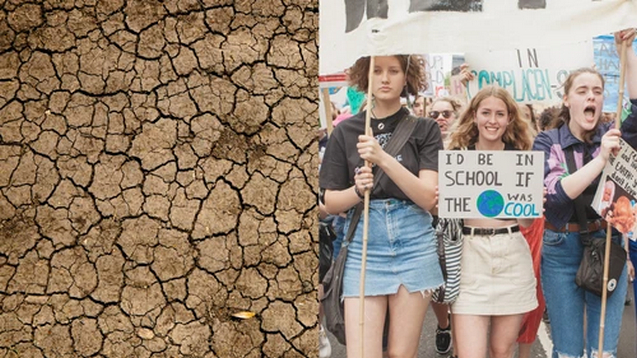
Drought-ridden land next to a group of young activists

So you want to do something about climate change, but you’re not sure where to start. Sharing an Instagram infographic about the impact of shopping from Shein, despite what the slacktivist critics might say, can still have an impact. But what are your options if you want to take things to the next level? Do you have to glue yourself to the road?

The short answer is: no. 

If you’re someone who prefers pen and paper, using the law is a great way to get your point across. An increasing number of successes involve using litigation to hold companies and governments to account over their climate pledges.

In 2021, a court case against Shell brought by 17,000 Dutch citizens and seven organisations, including Friends of the Earth International, successfully ruled that the company must reduce its emissions.

ClientEarth is an environmental law charity that uses treaties like the Paris Agreement to bring climate criminals to justice. VICE spoke to one of their lawyers, April Williamson, to find out how you, a lowly individual, can hack the law to fight climate change. 

VICE: So what actually is the Paris Agreement, and is it legally binding? 

April Williamson:
The Paris Agreement is an international agreement, which has been signed by almost every country in the world, concerning climate change. All signatories have agreed to limit global warming to well below two degrees Celsius, and are pursuing efforts to limit warming to below 1.5 degrees Celsius. The Paris Agreement is binding on all of its signatories. However, that doesn't mean that an individual or an organisation can directly sue a government for failing to uphold its obligations.


These Kids Are Suing European Governments Because of the Climate Crisis. Tristan Kennedy
So what happens if countries don’t stick to it?

April Williamson: Typically, the Paris Agreement will be implemented at the national level through national laws. And so for example, in the UK, you have the Climate Change Act, which has legally binding targets to reduce carbon dioxide emissions in the UK by 100% (net zero) by 2050*. It's national laws like that which people can use to hold the government accountable. 

Corporations are some of the biggest offenders when it comes to emissions. Are they part of the Paris Agreement?

April Williamson: Companies are not a party to the Paris Agreement, so they can't be held directly responsible. However, the agreement has been used to inform cases against companies – for example, there was a recent case in the Netherlands against Shell, where the courts found that it wasn't managing climate change risk appropriately and ordered it to reduce its emissions by 45 percent by 2030. That's a really important figure, because the scientific consensus is that that's what's required in order to meet the temperature targets.

Police clearing Extinction Rebellion tents in London. Photo: ZENO MORINO / ALAMY STOCK PHOTO

Could the British government theoretically be sued for, for example, reducing tax on domestic flights, which directly goes against their commitment to reduce carbon emissions?

April Williamson: That's quite a complicated question. As you can imagine, cases like that require quite a lot of factual analysis. I think that the problem is that the way that many national laws have been set up dictates that emissions need to be reduced within a certain timeframe. But the way that the government decides to meet those emissions reduction targets and meet their ultimate goal is within their discretion. They can choose exactly how they plan to do that, as long as they meet those targets… Policies like reduced tax for domestic flights could mean that they're not meeting their targets, but that would require quite a lot of analysis to be able to see whether or not there's a strong case.
.

The Activist Who Keeps Exposing Environmental Racism in the U.S. Geoff Dembicki
Is the UK currently meeting its emissions targets?

April Williamson:
Through the passing of the Climate Change Act, we established the Climate Change Committee, which is an independent committee that reviews the government's performance against its targets. The government did meet its first two emissions reductions targets, which are set out over a five year timeframe, but it's estimated that it's going to be missing its future targets. So the government is in danger of not complying with UK legislation.

What will happen if it doesn't comply?

April Williamson: The government could be in danger of facing a judicial review, which is where somebody, an individual or an organisation, or a group of people, could bring the government to court to try and push it to comply with its obligations. A good example would be another case in the Netherlands, for example, which was brought by a charity called Urgenda. They essentially said that the government hadn't set adequate policy and wasn't doing enough to meet their target, and the court ordered them to have a certain amount of emissions reduced by a certain time. We're expecting to see more cases like that around the world.


Meet the Young Activist Suing the UK Government Over Climate Change. Molly Lipson
What’s the connection between human rights law and climate change?

April Williamson: You will have seen in the news that there are more and more natural disasters and extreme weather events affecting people. So sea level rise, flooding, wildfires, landslides; many of those things could affect people's right to life. People have died in some of these disasters, it affects their health, it could affect their property if their homes or anything else that they own is lost. Almost every government in the world, in addition to having signed the Paris Agreement, is also a party to various human rights treaties. Amongst those, you have the right to life and the right to property, which could be impacted by climate change. Last year, the UN Human Rights Council also adopted a resolution which recognises the right to a clean and healthy environment, and we're expecting that to be used in different litigation cases and human rights cases that might be related to climate change.

Extinction Rebellion protesters in London. Photo: Chris Bethell

What other legal structures are there in place to protect the environment?

April Williamson: In addition to climate specific laws, there are also quite a number of different laws that can be used to protect the environment more generally, like planning. For example when major infrastructure is built, there might be requirements on the emissions it can make. And this goes all the way down to quite small things like home insulation.

At an individual level, there are also quite a few existing laws, which are not necessarily designed to protect the environment, but which can be used to do so. There are corporate laws, where, for example, directors could potentially be held to account if they fail to identify and manage risks appropriately. You could also use consumer laws to make sure that people are aware of the impacts of the products they’re using, or that they’re being advertised to accurately in “green” marketing.

If you suspect a company is misleading the public with greenwashing – i.e., portraying themselves or their product as sustainable and climate-conscious when they are not – can you complain to the Advertising Standards Agency?

April Williamson: Yes, you certainly can. It's actually quite easy to complain. You don't need a lawyer, you don't need anyone to advise you. It's a simple form. And that could potentially trigger an investigation to see whether or not the advert is misleading, or shouldn't be run the same way again. You can also email ClientEarth for our ongoing investigations into greenwashing.

Is it actually worth emailing your MP to urge them on climate action?

April Williamson: Yes, it is definitely worth emailing your MP. An MP is there to represent their constituents, and will often have a good idea of what's important to people who are living in a constituency. By writing to your MP with a clear and concise summary of why you think climate change is important and what the issues are, it can be escalated as an issue for them so they can go on to take action.

What are the most powerful tools individuals have at their disposal to hold governments and companies to account for climate change?

April Williamson: It's definitely not outside of an individual's power to be able to bring a legal case. But litigation isn't the be all and end all. It's also really important to do things like activism, advocate for policy changes, and engage with the science to make sure that people like your MP are aware of the problem, understand all of the findings and can escalate it to try and get stronger laws and enforcement.

Links

Lethal Heating is a citizens' initiative