02/02/2016

Who Politicized The Environment And Climate Change?

The Conversation - Brian C. Black

Protector in chief: Theodore Roosevelt with conservationist John Muir at Yosemite in 1906. U.S. Library of Congress

An environmental activist friend of mine recently shook her head and marveled at the extraordinary accomplishments of the last several months. "Still lots of work to be done," she said. "But wow! This has been an epic period for environmentalists!"
From the rejection of the Keystone pipeline to the Paris Agreement on Climate Change (COP21), "epic" may be an apt descriptor for someone who is an environmentalist.
However, nothing galvanizes opposing forces to action better than significant wins by their foes. And 2016 appears to promise that environmental issues – particularly climate change – will be more politicized than ever before.
It wasn't always this way.
By and large, environmental action since the 1960s proceeded in the U.S. in a bipartisan fashion, emphasizing issues of human health and resource conservation. That's no longer true: almost by default, the Democratic Party stands largely alone, rather than together with the Republican Party, to uphold the ethic that environmental protection is a united, American common interest.
How have we gotten to a point where the environment has become such a partisan issue?

From Teddy R. to Reagan
The intellectual roots of American environmentalism are most often traced back to the 19th-century ideas of Romanticism and Transcendentalism from thinkers such as Henry David Thoreau. These philosophical and aesthetic ideas grew into initiatives for preserving the first national parks and monuments, an effort closely associated with Theodore Roosevelt. By the close of the 19th century, a combination of resource exploitation and increasing leisure led to a series of conservation efforts, such as protection of birds from feather hunters, which were often led by wealthy women.
Today's environmentalism clearly harks back to these origins with aspects of being a social movement that seeks clear political outcomes, including regulation and government action. But much of what became known as the "modern environmental movement" originally coalesced around groups that formed under the influence of 1960s radicalism.
The large oil spill in Santa Barbara, California in 1969 provided some of the impetus for landmark environmental laws signed by Nixon, including the Clean Air Act, which he signed December 31, 1970. National Archives


The biggest impact of these organizations, though, came during the later 1960s and 1970s, when their membership skyrocketed with large numbers of the concerned, but not-so-radical, middle class. Through the formation of "nongovernment organizations" (NGOs), ranging widely from the Audubon Society to the Sierra Club, Americans found a mechanism through which they could demand a political response to environmental problems from lawmakers.
During the 1970s and 1980s, NGOs often initiated the call for specific policies and then lobbied members of Congress to create legislation. Such bipartisan action included clean water laws that restored Lake Erie and Ohio's Cuyahoga River or responded to dramatic events such as the Santa Barbara Oil Spill in 1969.
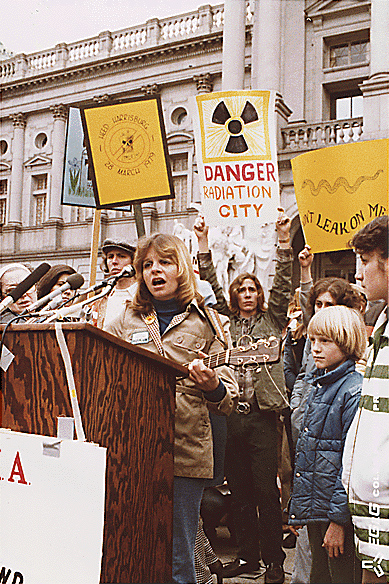
The nuclear power accident at Three Mile Island in 1979 fueled an antinuclear protest, a major concern of many environmentalists. National Archives and Records Administration (NARA)
Republican and Democratic presidents of this era signed laws that had begun with grassroots demands for environmental action. Environmental issues, whether they were the effects of acid rain or the ozone hole, had become a prime concern in the political arena. Indeed, by the 1980s, NGOs had created a new political and legal battlefield as each side of environmental arguments sought to lobby lawmakers.
These gains by environmentalists had a ripple effect politically. In "A Climate of Crisis," historian Patrick Allitt describes the opposition to environmentalism that emerged as a result of the bipartisan action on environment in the 1970s.
In particular, he describes the "anti-environmental" response manifested in policies of President Ronald Reagan, who slowed efforts to limit private development on public lands and set out to shrink the responsibilities of the federal government.

Antiregulation
Today, portions of this backlash appear to inform the views of candidates in the 2016 Republican presidential primary who reiterate the libertarian belief that it's best to severely limit government regulation of the environment.
And compared to the cooperative vision of past leaders including President Teddy Roosevelt and Congressman John Saylor, who fought in the 1960s for wilderness and scenic river legislation, the Republican environmental mandate of the past appears today to be stymied.
Climate change and environmental issues have barely come up in presidential debates, with candidates typically complaining that environment regulations will harm the economy. Mario Anzuoni/Reuters


Republican presidential candidate Senator Ted Cruz, for example, tapped into this spirit when in December 2015 he held a three-hour "hearing" titled "Data or Dogma? Promoting Open Inquiry in the Debate over the Magnitude of Human Impact on Climate Change" (which technically was convened by the science panel of the Committee on Commerce, Science, and Transportation that he chairs).
Prior to his hearing on the topic, climate change had been little discussed at the party's presidential debates; however, Cruz proclaimed that the "accepted science" proving climate change was actually a "religion" being forced on the American public by "monied interests."
By contrast, Democrats stress the term "common sense" and appear more than content to allow their party to become the primary bastion for environmental concern. Hillary Clinton, as the likely Democratic presidential candidate, has often been publicly ahead of the Obama administration on environmental issues.
For instance, when in early 2015 Obama approved the expansion of Arctic drilling, Clinton openly opposed it. Also, Clinton was openly against the Keystone pipeline project long before Obama definitively rejected it.
In both Keystone and Arctic drilling, Obama allowed the issues a long and very public vetting process that has revealed a powerful, broad-based environmental lobby. NGOs such as 350.org and others have demonstrated a willingness for activist demonstrations, particularly due to a deep base of support for issues such as climate change and sustainable energy.
Republican candidates seem prepared to relent possible compromise on environmental questions in order to appeal to a special interest faction of their party. Overall, though, Gallup polling demonstrates broad-based support for environmental issues, including a solid 46 percent favoring protecting the environment over economic development.

Climate change worsens the political divide
Going forward, the most revealing flashpoint on issues related to the environment is likely to be climate change, particularly after the historic Paris Agreement of December 2015.
Global warming first made front page news in the 1980s when NASA scientist James Hansen testified to the Senate. Then in 2007, the International Panel on Climate Change (IPCC) made history by specifying the connection between temperature rise and human activity with "very high confidence."
An emerging political force: activists for action on climate change and sustainable energy. Steve Rhodes/flickr, CC BY-NC-ND


In its relation to environmentalism, climate change represents a clear expansion of thinking. While local issues such as oil spills and toxic waste remain concerns, climate change clarified the possible planet-changing extent of the human impact. As a concept, it has had time to percolate through human culture so that today we are most concerned with issues of "mitigation" and "adaptation" – managing or dealing with implications.
In each case, these responses to climate change involve plans for regulations to, for example, limit carbon emissions. In response to the increasing call for structural changes to our economy and society, contrary voices (such as that of Cruz) have found traction by saying mitigation efforts will undercut economic development and, in general, disrupt our everyday lives.
Not surprisingly, concrete mitigation efforts, such as discussions of "cap and trade" legislation to curb greenhouse gas emissions and international pacts such as COP21, have also spurred panicked responses among those destined to be impacted by the new thinking. For instance, coal companies and a number of states openly fight efforts by the EPA to monitor and regulate CO2 as a pollutant.
So who politicized the environment? Ultimately, voters have.
By tying environmental issues such as climate change to our system of laws and regulations at the end of the 1960s, Americans permanently chained these concerns to political vagaries in the future. Politics is now an integral part of the process of regulating the nation's environment and health.
Therefore, a better question might be: "Who exploits the issue of environmental protection for political gain?" That answer, it appears, unfolds today for American voters.

Links

01/02/2016

Asia-Pacific Analysis: Climate Change And Agriculture

SciDev.Net - Crispin Maslog

Asia-Pacific Analysis: Climate change and agriculture
Copyright: Andrew McConnell / Panos

Summary
  • Changed weather patterns make farmers confused when to plant or harvest
  • Farmers urged to 'adjust, get wiser and practise climate-smart agriculture'
  • Projects demonstrate ecosystem interaction with farms and communities
The older folks among us have noticed that typhoons and hurricanes have come more frequently, are more destructive and no longer follow the seasons.
In the old days, for example, the typhoon season in South-East Asia usually started in July and ended in September. Nowadays, the most powerful ones are in the last two months of the year and they come even in the first half of the year.
Why? Scientists say that this is because of climate change. Climate change affects rainfall patterns, storms and droughts, growing seasons, humidity and sea level.
Farmers who depend on the rains to water their crops are not sure now when to plant or harvest. The winds and rains have become more severe. A few areas might even get cooler than warmer and vice versa.

Agriculture link to climate change
"Agriculture and climate change are closely linked," agriculture scientist Julian Gonsalves tells SciDev.Net. "Agriculture is part of the climate change problem. However, it is also part of the solution, offering many opportunities for mitigating GHG (greenhouse gas) emissions."
Gonsalves, senior advisor at the International Institute of Rural Reconstruction (IIRR), adds: "The "agriculture sector is expected to suffer the most serious impacts of climate change, and food security, nutrition and livelihoods will be affected if we don't act soon."
It is time, therefore, that farmers adjust, get wiser and practise climate-smart agriculture (CSA). Climate-smart agriculture, Gonsalves says, can be simply understood as environment-friendly and sustainable agriculture that takes into consideration climate variability and change factors.
Gonsalves heads an international research action project in the Philippines and Vietnam on scaling up community adaptation and CSA. The project site in the Philippines is in Guinayangan, Quezon, a seacoast and farming community of 40,000 where the local government is involved.

Thrusts of climate-smart agriculture
The main thrusts of CSA are to increase agriculture productivity and income in a sustainable and environmentally-sound manner; to build capacity of households and food systems to adapt to climate change; and to reduce emissions of GHGs and increase carbon sequestration.
Gonsalves adds that CSA also involves protecting ecosystems, such as conserving soils, rainwater and genetic resources, and protecting mangroves, and forest and water resources.
In the CSA project, Gonsalves hopes to demonstrate that ecosystem elements interact with farms and local communities and that natural resource boundaries are important because the ecosystem influences climate adaptation and resilience building.
CSA is usually best undertaken by taking landscapes into consideration because ecosystems are interconnected. Forest and water resources can be conserved. Improvements can help regenerate farms.
However, a degraded natural resource base increases the vulnerability of local communities to the impacts of drought, extreme rain, floods and other natural disasters.
Regenerative agriculture provides many choices for a new focus on climate-smart agriculture. CSA approaches address food and income security while helping reduce the carbon footprint of small farms.
CSA practices include soil, water and nutrient management along with agro-forestry, livestock and forest management techniques.
CSA technologies are already available, just waiting for widespread adoption by smallholder farmers. The adoption needs only to be coordinated and implemented at the local level, where decisions concerning public and private investments are made.

Lessons from CSA project
This is the strategic approach of the three-year CSA project in 2015-2018, funded by the Consultative Group for International Agricultural Research (CGIAR) programme on climate change, agriculture and food security and managed by the IIRR and World Agroforestry Centre in Vietnam.
So far the project implementers have learned a number of lessons.
First, farmers have basic understanding of climate change and its impacts due to abundance of information (TV, radio and other multimedia sources) but are capable only of translating impacts to their lives based on actual experiences with typhoons and prolonged dry seasons.
Second, the local government partner as well as national government agencies have the same agenda for climate change adaptation and mitigation. The challenge for the project team is how to incorporate the action research agenda into these initiatives.
Third, experiential learning — field-based observation and discussions — has been observed to be the most effective strategy for facilitating learning.
If only South-East Asian governments and international agriculture organisations can speed up the adoption of climate-smart agriculture and stamp out the climate-stupid oil palm plantation agriculture in Indonesia that fuels those everlasting Indonesian fires, we might have a cleaner environment in the Asia-Pacific region.

Links

Europe Watch Out The Climate Change Refugee Crisis Is Only Just Beginning

Quartz - Peter Schwartzstein

Drought is ravaging Ethiopia's Somali region. (Reuters/Tiksa Negeri)


The Amhara Plateau is no one's idea of a gloomy landscape. Rich fields blossom as far as the eye can see; bountiful rivers zigzag through the region's rolling hills. It isn't hard to see why local Orthodox Christians believe the Ark of the Covenant was floated down the Nile from Egypt and ended up here. Nor why desert raiders continually stormed in off the nearby Sahara for hundreds of years.
But to those who farm the fertile reaches of Western Ethiopia, their home environment is growing a good deal less enticing by the day.
Erratic temperatures and rains, which culminated last year in the total failure of the belg, the short rainy season, have struck locals hard. In a country still scarred by the deadly famines of the 1980s and 90s, reduced crop yields are panicking villagers, almost all of whom rely on agriculture for their livelihoods.
There's plenty of evidence that migration in sub-Saharan Africa is partly due to extreme weather. 
"The rains are very weak and in winter the cold is like nothing I've seen before," said Barakat Daniel, gesturing at a mostly empty trench he uses to irrigate his teff crop on a muddy hillock just outside Bahir Dar. "It's a hard life."
For some ambitious young men, conditions have long since crumbled to intolerable levels. They've tired of tilling land that's become harder to farm as older farmers sub-divide their already small holdings into miniature plots for their many children. With population growth overwhelming meager services at the same time as intense weather plagues farmland, more and more people from the region appear to be following the example of refugees from violence-afflicted parts of Africa, and making a break for Europe.
Droughts have caused conflict between communities fighting over food and resources around Ethiopia's Lake Turkana. (Reuters/Siegfried Modola)


Last July in Metema, an Ethiopian border town, where Sudanese flout their country's prohibition on alcohol by darting across the frontier to patronize streetside bars, I met a 22-year-old man who gave his name only as Gebremichael. He was waiting to cross into Sudan. "Why am I going?" he said. "Because I'm trying to improve myself and that's just not possible when your land gets worse and worse." He had toted a moth-eaten German language dictionary around for over a year, working to absorb new words at every available opportunity.
These days, climate change is in vogue. Everything from the war in Syria to unrest in West Africa has been laid at the feet of the weather gods. Some of the claims have been dismissed as spurious. But there's plenty of evidence that migration in sub-Saharan Africa is indeed partly due to extreme weather.
70% of the continent's migrants have left their homes because of poverty or a lack of work, according to research provided by the UN Environment Program (UNEP).  An estimated 64% of Africans—and close to 90% of Ethiopians—earn their living from agriculture.
The authorities estimate the number of migrants by counting the bodies of those who've succumbed to the heat. 
"Considering the very low baseline, where 25% of the continent go to bed hungry, where over 50% live on less than $1.25 per day, and where youth unemployment is at 60%, climate induced declines in productivity in the agricultural sector indirectly drive migration," said Richard Munang, who heads UNEP's African Regional Climate Change Program from Nairobi.
Skeptics may wonder why it's only now that East Africans are making their way north; after all, Ethiopia and its neighbors have seen plenty of deadly natural disasters in the past.
But the routes forged by largely Syrian, Iraqi, and Afghan refugees of war have opened up new possibilities. The demand has led smugglers to lower their prices and expand their knowhow. And for some East Africans, the sense that the sparse rains and unpredictable temperature shifts are both worse than before and here to stay has tipped the scales.
In Metema, where I met Gebremichael, immigration officials say they're seeing more travelers, most of whom hail from the desperately poor, drought-ridden Somali region of Ethiopia.
At Delgo, about 1,000 km (620 miles) north and in the heart of ancient Nubia, a Sudanese policeman said more and more migrants were following the abandoned British-era rail track north—even at the height of summer. The authorities estimate the total by counting the bodies of those who've succumbed to the heat.
Ethiopian dam projects have taken water from the Nile in Egypt, forcing farmers who relied on it for irrigation to turn to wells. (Reuters/Mohamed Abd El Ghany)


And in Cairo, where many Ethiopians, Eritreans, and Sudanese congregate before attempting the dangerous maritime hop, refugee activists say new arrivals from Sub-Saharan Africa may have as much as doubled over the past year, as higher food prices and tougher climes bite further south.
A 2015 World Bank study suggested climate change will pitch at least 100 million people back into poverty, mostly in Africa, by 2030.
Many African migrants are particularly likely to chance the illegal sea passage, campaigners say. "Most of them can't speak Arabic so can't work, and they experience bad racism because they're black," said one social worker, who asked not to be named. Hard though it is for climate migrants to get refugee status and resettlement in the West, many are resolved to risk the journey.
In 1990, the UN's Intergovernmental Panel on Climate Change (IPCC) projected that shoreline erosion, coastal flooding, and agricultural disruption would displace up to 200 million migrants by 2050. And last year a World Bank study suggested that climate change will pitch at least 100 million people back into poverty, mostly in Africa, by 2030.
A few Western governments have mooted plans to help struggling African countries counter the consequences of a changing climate. The UK's Department for International Development, for one, gave £10 million (then about $15 million) in December to help Sudanese farmers boost their "resilience" and combat desertification. But with Europe already struggling to cope with the relatively small numbers of war refugees, it seems unlikely that current immigration policies will do much to dissuade climate migrants, many of whom feel they have nothing to lose. On my journey I often heard variations on a common refrain: "I'm dead if I stay, so it doesn't matter if I die on the way."

Australian Emissions Rising Towards Historical Highs And Will Not Peak Before 2030, Analysis Finds

Fairfax - Tom Arup

Australia will likely meet its decade-end target even as national emissions rise and may continue to do so for years.
Australia will likely meet its decade-end target even as national emissions rise and may continue to do so for years. Photo: Glen McCurtayne

Australia's national greenhouse gas emissions are set to keep rising well beyond 2020 on current trends, with the projected growth rate one of the worst in the developed world, a new analysis has found.
An assessment of recent government emissions data, carried out by the carbon consultancy firm RepuTex, says that in the 2014-15 financial year Australia's carbon pollution rose for the first time in almost a decade when compared to the previous year.
From there they say separate government forecasts, also released late last year, show Australia's emissions are on track for a further 6 per cent increase to 2020.
RepuTex's own projections find that on these trends Australian emissions would still not reach a peak before 2030, taking pollution beyond the historical high set almost a decade ago.
Australia's emissions bound Photo: RepuTex, Department of Environment


RepuTex said this trajectory would put Australia's absolute emissions growth among the highest for developed nations. Only Finland, Sweden and Estonia are forecast to do worse between 2000 and 2020, with emissions falling in countries such as the United States, Germany and Britain.
Source: UNFCCC, RepuTex Photo: RepuTex

The latest government emissions data – released in late December – recorded a 1.3 per cent increase in emissions across 2014-15, largely due to increased land clearing and a surge of brown coal power generation. The national carbon price was repealed in July 2014, and replaced by the direct action plan, which aims to buy emissions cuts from businesses and farmers and set limits on industrial emissions.
While emissions were forecast to rise by the government out to 2020, it is a significantly lower increase than had been previously projected.
RepuTex argues these lower projections for 2020 are predominantly due to a reassessment of future economic growth rates. A spokesman for Environment Minister Greg Hunt said it was due to a more efficient economy, greater take up of renewable energy and lower land sector emissions.
More broadly Mr Hunt's spokesman hit out at RepuTex's track record, saying it had previously mis-forecast the results of auctions under direct action and whether Australia would meet its 2020 goal.
Although national emissions are rising, Australia will still almost certainly achieve its 2020 emissions reduction target of 5 per cent from 2000 levels. At the Paris climate summit last year Prime Minister Malcolm Turnbull said Australia would, "meet and beat our 2020 emissions reduction target".
RepuTex executive director Hugh Grossman said the government would largely meet its 2020 goal by relying on "carry over" carbon credits it had received for bettering an earlier target under the Kyoto Protocol.
At the Paris climate conference five countries – including Germany, Britain and Denmark – announced they would cancel out their carryover credits rather than use them to meet future targets.
"Meeting Australia's abatement task is largely just a victory in accounting terms," Mr Grossman said.
"We have met our target, but we used a credit to get there, so it's not a sign of any progress to reduce emissions."
Under the new climate agreement struck at the Paris conference, Australia has also pledged a goal to cut emissions by 26 to 28 per cent by 2030 from 2005 levels. Mr Hunt's spokesman said the government had laid out policies that would meet that goal.
The government has said it will review climate policy in 2017, including the potential use of international carbon permits to meet climate goals.
Mr Hunt's spokesman added the government expected the future emissions projections would again be revised down following the success at the Paris climate conference, changes in commodity demand and the outcomes of consultation on new government programs under development, including car emissions standards and a national energy productivity plan.
He said Australia's 2014-15 absolute emissions were the second lowest in the past 15 years. He also pointed to falling emissions when accounted for per person and by economic production.

Links

31/01/2016

Here Is The Weather Forecast For The Next Five Years: Even Hotter

The Guardian - 

Long-range forecast predicts generally upward temperature trend, possibly interrupted by La Niña event in 2017

A sunny January day at Mudeford Sandbanks in Dorset. Photograph: Geoffrey Swaine/Rex/Shutterstock


Global temperatures will continue to soar over the next 12 months as rising levels of greenhouse gas emissions and El Niño combine to bring more record-breaking warmth to the planet.
 According to the Met Office's forecast for the next five years, 2016 is likely to be the warmest since records began. Then in 2017 there will be a dip as the effects of El Niño dissipate and there is some planet-wide cooling.
But after that, and for the remaining three years of the decade, the world will continue to experience even more warming. The forecast, which will be released this week, is the first such report that the Met Office has issued since it overhauled its near-term climate prediction system last year.
"We cannot say exactly how warm it will get but there is no doubt the overall upward trend of temperatures will continue," said Doug Smith, a Met Office expert on long-term forecasting. "We cannot say exactly how hot 2018, 2019 or 2020 will be. That will depend on other variables. But the general trend is going to be upwards."
The current El Niño – a meteorological event in which a band of warm water develops in the Pacific Ocean around the equator – is about to peak. However, global warming associated with the event normally lags several months behind that peak and as a result, 2016 could be even hotter that 2015, the warmest year on record.
Some global warming deniers have claimed that the current El Niño alone was responsible for making last year a record one, with the effects of carbon emissions being irrelevant. But Smith rejects these claims.
"We have had El Niños before," he said. "The one in 1997-98 was particularly intense. Nevertheless, global temperatures were less then than they were in 2015 – and that is because background heating caused by increasing carbon dioxide levels in the atmosphere are higher today than they were in 1997-98."
However, the end of the current El Niño and the possible triggering of a La Niña event – an extensive cooling of the central and eastern tropical Pacific Ocean – is likely to bring a temporary halt to rising global temperatures, according to the Met Office.
As a result, 2017 is likely to see a dip in global temperatures. "We can be pretty sure there will be a drop that year," added Smith.
After that, temperatures could start to rise again over the rest of the decade. "Whether one of these years – 2018, 2019, 2020 – overtakes 2016 in terms of temperature is very hard to predict at this stage," said Smith. "We are looking quite far into the future, after all."
One reason for such uncertainties is a lack of precise knowledge about the heating of the oceans. "If you want to measure climate change you need to have precise information about the total energy of the planet and most of that is stored in the ocean," said Smith. "Recently temperature rises on the land slowed and people said global warming had stopped. That was never true. The ocean heat content went up all the time."
In a bid to improve information about ocean warming trends, scientists have deployed robot floats – part of the international Argo measuring system – that record temperatures and salinity to depths of 2,000 metres. Now a new generation of Argo devices is to be deployed and will reach depths of 5,000 metres. "That should provide crucial data that will help us make more accurate forecasts," added Smith.
The release of the Met Office study comes as another group of scientists revealed research that shows the last 30 years were probably the warmest Europe has experienced in more than two millennia. An international team used tree ring records and historical documents to reconstruct yearly temperatures going back 2,100 years and discovered there was no period as warm as the last 30 years.

Links

The State of Climate Change Litigation: Can Canada and the U.S. follow Urgenda?

Work and Climate Change Report - elizabethperry493


The landmark Urgenda decision in the Netherlands in June 2015 has ignited and re-ignited activity around the world, around the prospect of using litigation to fight climate change. "Unlawful or Above the Law? " in the CCPA Monitor (Nov/Dec. 2015) reviews the Urgenda decision in detail, and puts it in the context of Canadian policy and historical legal cases which have challenged Canada's withdrawal from the Kyoto Protocol. A fuller treatment of the article, titled Canada's Failure to Reduce Greenhouse Gas Emissions (October 31, 2015) appears on the Lawyers' Rights Watch Canada website. The authors advocate a legal challenge to Canada's GHG emissions reduction policies. Much of the legal argument is based on the concept of environmental rights as human rights; a Canadian pioneer on this issue is David R. Boyd, whose article " The Constitutional Right to a Healthy Environment" appeared in Environment Magazine in 2012. (a fuller treatment appears in his book The Environmental Rights Revolution: A Global Study of Constitutions, Human Rights and the Environment (2012)). A more recent publication by Ecojustice, The Right to a Healthy Environment: Canada's Time to Act (2015), acknowledges a large debt to Boyd's work, and the BlueDot movement of the David Suzuki Foundation works in practical ways towards the goal. In December 2015, Toronto became the 100th municipality in Canada to pass a declaration supporting its residents' right to a healthy environment. Climate Change: Tackling the Greatest Human Rights Challenge of our Time (Feb. 2015) by the Center for International Environmental Law and CARE considers how to address the issue within the UNFCCC process.

Liability
Regarding liability for climate change damages, West Coast Environmental Law in B.C. and the Vanuatu Environmental Law Association released Taking Climate Justice into our own Hands on December 8, 2015 "which explains the legal basis for climate-impacted countries to set the rules for climate damages lawsuits and how those rules can be enforced against international fossil fuel polluters." Further, the authors propose language for a Climate Compensation Act, based on common law and thus adaptable to in any country in the world. (Vanuatu released a Statement for Climate Justice in June 2015 ). A newly-launched blog series by the Alberta Environmental Law Centre promises "to provide updates on climate change law developments and include insights from our related law reform research."

Sabin Center
The Sabin Center for Climate Change Law at the Columbia Law School, New York, publishes compendium of cases in the U.S. and non-U.S., and maintains a database called Climate Change Laws of the World. In 2015, the Center published Climate Change in the Courts: An Assesment of non-U.S. climate litigation, as well as Climate Change and Human Rights 2015 (in cooperation with UNEP). The introduction states: "The question is no longer whether human rights law has anything to say about climate change, but rather what it says and how it can best be brought to bear. This report is the most detailed and comprehensive study yet undertaken of those questions".
In a November 2015 blog, "Failure to take climate action is not only morally wrong, it's illegal" Michael Burger discusses the Urgenda and Ashgar Legari case in Pakistan, and links them to current climate change cases in the United States. Most high profile of these have been led by Our Children's Trust, arguing for the right of children to live in a healthy environment. In November in Washington State, Judge Hollis Hill ruled in favour of youth, stating that "[t]he state has a constitutional obligation to protect the public's interest in natural resources held in trust for the common benefit of the people." Other cases are being pursued by Our Children's Trust in Massachusetts, North Carolina, Pennsylvania, and Colorado. In August 2015, Our Children's Trust filed a landmark constitutional climate change lawsuit against the federal government in the U.S. District Court of Oregon; plaintiffs include 21 young people and climate scientist Dr. James E. Hansen, serving as guardian for his granddaughter and for future generations. The complaint document is here; the plaintiffs request a court order requiring the President to implement a national plan to decrease CO2 to a safe level, defined as 350 ppm by the year 2100. In January 2016, a judge granted intervenor status in the case to the National Association of Manufacturers, the American Fuel & Petrochemical Manufacturers,the American Petroleum Institute, and other energy industry groups.
Internationally, cases claiming damages from climate changes are underway in the Philippines and Peru. To keep up to date internationally, follow eLaws News by the Environmental Law Alliance Worldwide (ELAW), who have also published Holding Corporations Accountable for Damaging the Climate (2014). The Center for International Environmental Law also focuses on climate liability and climate justice.

The Digital Divide: A Challenge To Overcome In Tackling Climate Change

World Bank - John Roome

Students from Tonga's Tailulu College making the most of new high-speed broadband services at 2013 World Telecommunication and Information Society Day celebrations in the the Tongan capital, Nuku'alofa. Nukua'lofa, Tonga. Photo: Tom Perry / World Bank

Try to imagine a world without the Internet.
Impossible, isn't it?
Over the past 25 years, the Internet has become the nervous system of our society, interconnecting all the different parts of our everyday lives. Our social interactions, ways of doing business, traveling and countless other activities are supported and governed by this technology.
At this very moment, just over three billion people are connected to the Internet, 105 billion emails are being sent, two million blog posts have just been written (including this one) and YouTube has collected four billion views. These numbers give you a glimpse of the extent to which humanity is intimately and deeply dependent on this technology.
The digital revolution has changed the daily lives of billions of people. But what about the billions who have been left out of this technological revolution?
This and many other questions have been addressed in the just released 2016 World Development Report 2016: Digital Dividends, which examines how the Internet can be a force for development, especially for poor people in developing countries.

A striking contradiction
In many developing countries, more families now own a mobile phone than have access to electricity or clean water. No major technology has reached more people in such a short time but, unfortunately, there's still a significant digital divide between the poor and the wealthy parts of the global population when it comes to Internet access. Perhaps not surprising that the same digital divide has an impact on the ability of developing countries to deal with the impact of climate change.
According to our recently released Report, Shock Waves: Managing the Impacts of Climate Change on Poverty, climate risk management requires data and knowledge. Connectivity is therefore a fundamental part of the equation for protecting poor people from climate change.

Making the difference on the ground
We already know that greater connectivity in vulnerable countries is crucial for ensuring access to information before, during and after a disaster. The Global Facility for Disaster Reduction and Recovery has developed a wide array of tools for disaster risk management (DRM), and they rely heavily on the Internet's infinite capabilities.
The GFDRR's Open Data for Resilience Initiative (OpenDRI) is helping countries to set up open disaster information platforms. Through the GFDRR's risk identification efforts, like OpenDRI, over 160 million people in 60 countries have gained improved access to risk information, and 1300 new datasets are now freely available to the public. Digital technologies also allow us to use innovative approaches to disaster risk management such as crowdsourcing and social data mining, which can expand the information base rapidly and cheaply. These digital approaches can also facilitate closer collaboration between all parts of the government, enable fuller integration of public and private services, and allow greater involvement on the part of the public.
The Flood Tags project, for example, is developing a tool to harness data collected via Twitter for on-the-ground flood observations. Such mining of social data can give us a constant and up-to-the-minute understanding of the situation during a disaster, in a way that could not be done before. Connected open-source mobile weather stations can help reduce flood damage and increase community preparedness by collecting crucial weather data and broadcasting SMS-based communications to early warning systems.
As outlined in the Shock Waves Report, another great example of how connectivity can help poor people is financial inclusion. In most developing countries, poor people have less access to financial tools than the rest of the population, often forcing them to save "in kind." Thanks to mobile banking, it is now possible to provide convenient and affordable financial services to those living in rural areas, reducing the vulnerability of poor families. And that matters. For instance, changes in rainfall patterns can mean farmers may have to adjust their practices or  need to invest in new machinery and seeds, or possibly learn new techniques. Without access to credit, these measures may be unaffordable, and they could become locked into activities with declining productivity and income.

Moving ahead  
As underlined in the World Development Report 2016: Digital Dividends, more investments are needed if we are to boost our efforts to close the digital divide and make the Internet universal, affordable, open, and safe. Equally we know solving the "climate puzzle" will take a vast array of resources and forward-thinking solutions. The Internet is, without any doubt, the tool that will best allow us to connect, share information and gather collective intelligence in the years to come.

Links

Lethal Heating is a citizens' initiative