17/02/2025

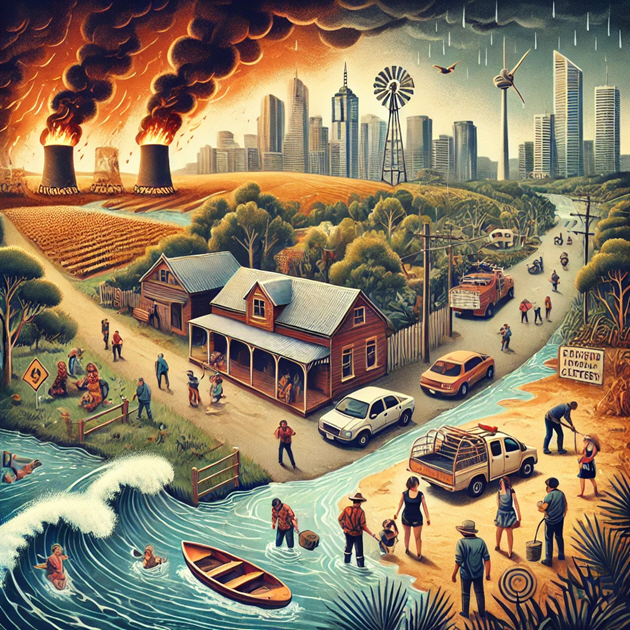
AUSTRALIA: Climate Change Economic Overview - Lethal Heating Editor BDA

This Economic Overview of Climate Change in Australia is part of a series examining the impact of Lethal Heating in key areas, including:

Climate change poses significant challenges to Australia’s economy, affecting multiple sectors—from agriculture and mining to tourism and insurance. 

Extreme weather events, shifting resource availability, and the global transition to low-carbon energy sources all have far-reaching consequences for economic stability, employment, and growth. 

Below is an overview of key economic impacts:

1. Agriculture and Food Production

  • Droughts and Water Scarcity: Prolonged drought conditions reduce crop yields, affect livestock, and increase water costs, leading to higher food prices and lower export volumes.
  • Extreme Weather Damage: Floods, cyclones, and bushfires can devastate farmland and infrastructure, causing immediate losses and long-term soil degradation.
  • Supply Chain Disruptions: Transport and logistics can be hindered by damaged roads or rail lines, increasing costs for producers and consumers.
  • Adaptation Costs: Farmers invest in water-saving technology, more resilient crop varieties, and insurance to mitigate risks, raising production costs.

2. Mining, Energy, and Resources

  • Fossil Fuel Transition: Australia’s significant coal and gas exports face growing international pressure as trading partners shift to cleaner energy sources, potentially reducing demand and revenue.
  • Renewable Energy Growth: Investments in solar, wind, and other renewables create new economic opportunities and jobs, particularly in regional areas. However, the transition can be disruptive for communities reliant on fossil fuel industries.
  • Infrastructure Vulnerabilities: Extreme weather events can damage extraction sites, pipelines, and ports, leading to costly downtime and repairs.

3. Tourism and Hospitality

  • Great Barrier Reef Bleaching: Coral bleaching events deter international visitors, reducing tourism income and impacting local businesses such as dive operators, hotels, and tour companies.
  • Extreme Weather Deterrents: Severe heatwaves, bushfires, and floods can discourage travel, leading to short-term and seasonal dips in tourism revenue.
  • Shifts in Seasonal Patterns: Changing weather patterns may alter peak tourist seasons, forcing businesses to adapt operational and marketing strategies.

4. Infrastructure and Property

  • Damage to Infrastructure: Roads, bridges, and public facilities suffer from storms, floods, and bushfires, leading to significant repair and maintenance costs for governments and private entities.
  • Property Values: Homes in bushfire-prone or low-lying coastal areas risk devaluation as insurance premiums rise and the likelihood of climate-related damage increases.
  • Urban Heat Impacts: Cities face increased costs to maintain livable conditions (e.g., cooling systems, green infrastructure), particularly during heatwaves.

5. Insurance and Financial Services

  • Rising Premiums: More frequent and severe natural disasters push up insurance costs, making coverage unaffordable for some households and businesses.
  • Banking Sector Risks: Mortgage lending can be exposed to climate risks if properties become uninsurable or devalued. Regulatory bodies increasingly require financial institutions to account for climate-related risks.
  • Public Liability: Governments may need to step in with disaster relief or insurance guarantees, straining public finances.

6. Government Expenditures and Policy

  • Disaster Relief and Recovery: Frequent extreme events lead to higher government spending on emergency responses, reconstruction, and social support programs.
  • Climate Adaptation and Mitigation: Investments in infrastructure resilience (e.g., flood defences, fire management) and emissions reduction (e.g., renewable energy incentives) require substantial public funding.
  • Regulatory Frameworks: Carbon pricing, emissions trading schemes, and other policies can drive innovation but also create short-term costs for certain industries.

7. Employment and Workforce Shifts

  • Fossil Fuel Employment: Communities reliant on coal or gas extraction face job losses if global demand declines. Economic diversification and reskilling programs become crucial for transitioning workers.
  • Green Jobs: Growth in renewable energy, sustainable agriculture, and climate adaptation projects can generate new employment opportunities, especially in regional areas.
  • Climate-Related Migration: Some regions may experience population decline due to resource scarcity or disaster risks, while others may see inflows of workers seeking new opportunities in climate-resilient sectors.

8. Opportunities for Growth and Innovation

  • Clean Technology Development: Australia’s strong research sector and abundant natural resources (sun, wind, minerals for batteries) can position the country as a leader in clean tech and sustainable innovation.
  • Sustainable Agriculture: Advancements in drought-resistant crops, precision farming, and regenerative agriculture can help maintain global competitiveness.
  • Circular Economy Models: Emphasizing recycling, waste reduction, and resource efficiency can reduce environmental impacts and create new business models.

Conclusion

Climate change has wide-ranging economic implications for Australia, affecting everything from primary industries to urban infrastructure. 

While the challenges—rising costs, potential job losses, and damage to vital resources—are substantial, there are also opportunities for innovation, diversification, and leadership in emerging green industries. 

Strategic policy decisions, public-private collaborations, and proactive adaptation measures will be essential to safeguarding Australia’s economic future in a changing climate.

Links

AUSTRALIA: Climate Change Social Overview - Lethal Heating Editor BDA

This Social Overview of Climate Change in Australia is part of a series examining the impact of Lethal Heating in key areas, including:

Australia is on the frontline of climate change, facing increasing extreme weather events, rising temperatures, and shifting ecosystems.

The social consequences of these changes are significant, affecting communities, livelihoods, health, and Indigenous cultures.

1. Community Displacement &
    Infrastructure Damage

  • Natural Disasters: Australia has seen more frequent and intense bushfires, floods, and heatwaves. Events like the 2019–2020 Black Summer bushfires and the devastating 2022 floods have displaced thousands and caused billions in damages.
  • Rural & Coastal Communities: Rising sea levels threaten low-lying coastal towns, while prolonged droughts make inland farming areas less habitable, forcing people to migrate to cities.

2. Economic & Employment Challenges

  • Agriculture & Tourism: Prolonged droughts and extreme heat reduce crop yields and threaten the agricultural sector, impacting farmers' livelihoods. The Great Barrier Reef, a major tourism attraction, suffers from coral bleaching, affecting jobs in reef-dependent industries.
  • Energy Transition: The push to phase out coal and gas impacts workers in fossil fuel industries, raising concerns about job losses and the need for reskilling programs.

3. Health & Wellbeing Impacts

  • Heat-Related Illnesses: Rising temperatures increase heatstroke cases, particularly among the elderly, outdoor workers, and low-income populations.
  • Mental Health Crisis: Climate anxiety, PTSD from disasters, and financial stress contribute to worsening mental health, particularly in rural and Indigenous communities.

4. Indigenous Cultural Disruptions

  • Land & Heritage Loss: Many Aboriginal and Torres Strait Islander communities are closely connected to the land and rely on it for cultural practices. Rising sea levels in places like the Torres Strait Islands threaten sacred sites and traditional ways of life.
  • Traditional Knowledge in Conservation: Indigenous knowledge is increasingly recognised for its role in fire management (e.g., cultural burning) and ecosystem protection, but stronger integration into climate policies is needed.

5. Social Inequality & Climate Justice

  • Vulnerable Populations: Lower-income groups, Indigenous Australians, and remote communities face the greatest risks from climate change but often have fewer resources to adapt.
  • Housing & Insurance Issues: The rising cost of home insurance due to frequent disasters makes it difficult for low-income Australians to afford protection, increasing homelessness risks.

6. Political & Public Response

  • Climate Activism: Youth-led movements like School Strike 4 Climate and organizations like the Australian Conservation Foundation push for stronger climate policies.
  • Government Actions: While Australia has committed to net-zero emissions by 2050, critics argue that policies still favour fossil fuel industries, delaying meaningful climate action.

Conclusion

The social impacts of climate change in Australia are profound, affecting communities, health, jobs, and Indigenous cultures. 

Addressing these challenges requires urgent action, stronger government policies, community resilience programs, and a just transition to renewable energy.

Links

16/02/2025

Massive methane leaks detected in Antarctica, posing potential risks for global warming

Manuel Ansede Antarctica Base Gabriel de Castilla
 
A Spanish scientific expedition has discovered columns of gas emerging from the seabed. Geologists also warn about the possibility of huge landslides that could generate tsunami

The research vessel 'Sarmiento de Gamboa' next to Spain's Antarctica base Gabriel de Castilla, on February 9. Luis Manuel Rivas


A team of Spanish scientists exploring the Antarctic seabed has detected “massive emissions” of methane, a gas with a capacity to warm the planet around 30 times greater than carbon dioxide (CO₂).
 
The researchers, on board the ship Sarmiento de Gamboa, have observed columns of methane in the ocean up to 700 meters long and 70 meters wide, according to the geologists Ricardo León and Roger Urgeles, leaders of the expedition, in statements to EL PAÍS. 
 
These previously unknown emissions could potentially represent an environmental bomb for the planet’s climate.

What they have discovered is exactly what they feared. Scientists set sail on January 12 in search of these massive but at that point still hypothetical leaks. The compound accumulated on the seabed about 20,000 years ago through the decomposition of organic matter in the form of methane hydrates, a crystalline solid. 

“It is like ice that you could set on fire and it would burn,” explains Urgeles, of the Institute of Marine Sciences, based in Barcelona. 

The theory was that the thinning of the enormous Antarctic ice sheet, which began at the end of the last ice age, is causing a decrease in the weight on the land and a rise of the continent’s land mass; this phenomenon, known as post-glacial rebound, favours leaks of frozen methane hidden for millennia in the seabed.

Researchers looked for leaks on the edges of Antarctica, one of the regions of the planet hardest hit by global warming, with a rise in temperature of more than three degrees in just half a century. 

“We have estimated that in this area there are some 24 gigatons of carbon accumulated in methane hydrates, an amount equivalent to what all of humanity emits in two years,” warns Urgeles.

Two members of the research vessel 'Sarmiento de Gamboa.'CSIC
Frozen, solid methane is turning into methane gas. 

“These phenomena have already been recorded in the Arctic, but this is the first time they have been detected in Antarctica,” says León, from the Geological and Mining Institute of Spain. 

His team met two EL PAÍS journalists on Antarctica’s King George Island on February 8, the day they ended their expedition. Their results, still very preliminary, suggest that the gas is bubbling up from the subsoil along faults, often through mud volcanoes hundreds of meters above the seabed.

The Sarmiento de Gamboa research vessel, part of the Spanish National Research Council (CSIC), has been cruising the dangerous Antarctic seas for almost a month, taking water and sediment samples and performing X-rays of the subsoil. 

Methane hydrates, similar to ice, are stable at low temperatures and high pressures, but with the warming of the oceans and the decrease in the weight of the sea - due to the uplift of the Antarctic land mass - they become destabilized and the gas erupts. 

The methane columns observed by the researchers dissolve at about 150 meters from the ocean surface. Future analysis of the samples will reveal to what extent the gas is released into the atmosphere.

Geologists Ricardo León and Roger Urgeles warn of another threat. The instability of marine sediments can cause huge landslides on the continental slope, with the potential to generate tsunamis

“When methane hydrates turn into gas, they occupy a volume 160 times greater. If they do not dissipate quickly, they can cause huge landslides, such as the Storegga landslide in the Arctic,” stresses Urgeles, alluding to the largest known submarine landslide, which caused a tsunami that devastated the coasts of northern Europe some 8,150 years ago.

Wave heights reached 20 meters on the Shetland Islands in present-day Scotland, but the geological traces of the natural disaster can still be found all along the Norwegian coast, in Denmark and even in Greenland

“The Storegga landslide was of similar dimensions to the whole of Andalusia (in southern Spain) and coincided with periods of major climate change on Earth. Given the time of the landslide, one of the reasons could be that these changes caused a dissociation of methane hydrates and triggered the huge landslide,” warns León.

Links

14/02/2025

GLOBAL: Climate Change Cultural Overview - Lethal Heating Editor BDA

The cultural impact of climate change: a flooded traditional village, people evacuating, an elder passing down stories, and environmental devastation.

This Global Climate Change Cultural Overview is part of a series examining the impact of Lethal Heating in key areas, including:

The cultural impact of climate change is profound and far-reaching, affecting traditions, identities, and ways of life across the world.

Here are some key areas where climate change is reshaping culture:

1. Loss of Traditional Knowledge & Practices

  • Indigenous and rural communities that rely on seasonal patterns for agriculture, fishing, and ceremonies are struggling as climate change disrupts weather cycles.
  • In the Arctic, the melting ice threatens Inuit hunting traditions, which are deeply tied to their cultural identity.

2. Climate Migration & Displacement

  • Rising sea levels and extreme weather are forcing communities—especially in low-lying island nations like Tuvalu and Kiribati—to relocate, leading to loss of homeland and cultural heritage.
  • Displaced communities face challenges in preserving language, traditions, and social structures in new environments.

3. Changes in Art, Literature & Storytelling

  • Climate anxiety and ecological grief are emerging themes in contemporary art, literature, and music.
  • Indigenous storytelling traditions are evolving to reflect environmental changes and the struggle to preserve cultural wisdom.
  • Climate fiction ("cli-fi") is becoming a popular genre, addressing the human experience of climate change.

4. Festivals & Religious Practices

  • Many religious and cultural festivals are tied to seasonal cycles, such as harvest festivals in Asia and Africa, which are being disrupted by shifting climates.
  • Some religious leaders are incorporating climate activism into faith-based teachings, emphasizing stewardship of the Earth.

5. Impact on Food & Cuisine

  • Traditional diets are changing as staple crops like coffee, rice, and maize are affected by changing climates.
  • Communities reliant on fishing are struggling as fish stocks decline due to warming oceans and acidification.

6. Language & Climate Terminology

  • New words and concepts are emerging to describe climate-related experiences, such as "solastalgia" (grief over environmental loss).
  • Some Indigenous languages contain precise terms for environmental phenomena that are disappearing along with the ecosystems they describe.

7. Political & Social Movements

  • Climate change is fuelling youth-led activism, with figures like Greta Thunberg and movements like Fridays for Future inspiring cultural shifts toward environmental responsibility.
  • Social justice issues, such as climate colonialism and environmental racism, are gaining attention, highlighting the disproportionate impact of climate change on marginalized communities.

Links

AUSTRALIA: Climate Change Political Overview - Lethal Heating Editor BDA

This Overview of Australia's Climate Change Politics is part of a series examining the impact of Lethal Heating in key areas, including:

Australia’s climate change politics are highly contentious, shaped by economic dependence on fossil fuels, extreme climate impacts, and political divisions. 

The country is both a major contributor to climate change—being one of the world’s largest coal and gas exporters—and one of the most vulnerable to its effects, experiencing worsening bushfires, heatwaves, and coral bleaching.

1. Government Policies & Commitments

a. International Commitments

  • Paris Agreement (2015): Australia committed to reducing emissions by 43% below 2005 levels by 2030 and achieving net zero by 2050.
  • COP Conferences: Australia has historically been seen as a laggard in climate negotiations, resisting stronger emissions reductions and fossil fuel phase-outs.
  • Pacific Climate Diplomacy: Australia faces pressure from Pacific Island nations, which are highly vulnerable to rising sea levels. The Albanese government has promised stronger engagement, but its continued fossil fuel exports undermine its credibility.

b. Domestic Climate Policies

  • Safeguard Mechanism (2023): A reform under the Albanese government requiring major polluters to reduce emissions.
  • Renewable Energy Targets: The government aims for 82% renewable electricity by 2030, expanding solar, wind, and battery storage.
  • Gas & Coal Expansion: Despite green commitments, Australia continues approving new coal and gas projects, sparking criticism from climate advocates.

2. Political Divides on Climate Action

Climate change has been a divisive issue in Australian politics, often determining elections and leadership changes.

a. Labor Party (ALP)

  • Historically cautious on climate due to electoral fears, but has strengthened policies under Prime Minister Anthony Albanese.
  • Supports renewable energy investment but avoids direct confrontation with fossil fuel industries.
  • Pledged net zero by 2050 and 43% emissions reduction by 2030, but critics say it’s not enough.

b. Liberal-National Coalition (LNP)

  • Traditionally sceptical of strong climate action, favouring coal and gas industries.
  • Former Prime Minister Scott Morrison (2019–2022) was criticised for weak climate policies, symbolised by his infamous "I brought a lump of coal to Parliament" moment.
  • The Coalition now debates whether to embrace stronger climate policies or maintain fossil fuel support.

c. The Greens

  • Strongest climate action advocates, pushing for 75% emissions reduction by 2030 and an end to new coal and gas projects.
  • Key players in negotiating climate legislation, sometimes blocking bills they see as too weak.

d. Independents & "Teal" Candidates

  • In the 2022 federal election, a wave of "Teal Independents" (centrist, pro-climate action candidates) defeated Liberal MPs in wealthy urban electorates.
  • This shift forced the major parties to take climate action more seriously.

3. Fossil Fuel Industry & Lobbying

  • Australia is the world’s second-largest coal exporter and a major LNG (liquefied natural gas) producer.
  • The fossil fuel industry has strong political influence, with heavy donations to major parties.
  • New gas projects, such as Scarborough, Beetaloo Basin, and Narrabri, continue despite warnings from scientists.
  • The Australian government provides billions in subsidies to fossil fuel companies, even as it promotes renewables.

4. Climate Impacts & Public Opinion

a. Extreme Weather Events

  • Bushfires (Black Summer 2019–20): Destroyed over 18 million hectares, killed 33 people, and burned 3 billion animals.
  • Heatwaves & Droughts: Increasingly frequent and severe, affecting agriculture and water supply.
  • Flooding: Major disasters in Queensland and New South Wales in 2022 caused billions in damages.
  • Great Barrier Reef Bleaching: Multiple mass bleaching events threaten the reef’s survival.

b. Public Attitudes

  • Polls show Australians increasingly support stronger climate action, especially after extreme weather events.
  • However, climate action remains polarizing in regional areas dependent on coal and gas jobs.

5. Future Outlook & Challenges

  • Economic Transition: Australia must balance phasing out fossil fuels with creating new clean energy jobs, particularly in coal-dependent communities.
  • Pacific Relations: Australia’s credibility in the Pacific hinges on stronger climate action, as island nations demand an end to fossil fuel expansion.
  • Political Shifts: Future elections could see further climate-driven changes, especially if the public demands stronger policies.
  • Global Pressure: Trading partners like the EU may impose carbon tariffs on Australian exports, forcing stricter policies.

Conclusion

Australia is at a crossroads. While its government is making progress on climate policy, continued fossil fuel expansion undermines its commitments. The country faces mounting pressure—both domestically and internationally—to act faster and more decisively. 

Links

GLOBAL: Climate Change Political Overview - Lethal Heating Editor BDA

This Global Climate Change Political Overview is part of a series examining the impact of Lethal Heating in key areas, including:

1. Global Political Landscape

Climate change is one of the most politically charged issues of the 21st century. 

Governments, international organisations, corporations, and civil society all play roles in shaping policies and actions. 

While there is broad scientific consensus on the causes and consequences of climate change, political responses vary widely based on national interests, economic concerns, and ideological positions. 

2. International Agreements & Frameworks

  • Paris Agreement (2015):
    A landmark treaty under the UNFCCC where countries committed to limiting global warming to well below 2°C, ideally 1.5°C, above pre-industrial levels. However, enforcement mechanisms are weak, and many countries are failing to meet their commitments. 
  • COP (Conference of the Parties):
    The annual UN climate conference where nations negotiate climate action. COP28 (2023) in Dubai led to the first-ever agreement to "transition away from fossil fuels," but critics argue it lacks binding commitments.
  • Kyoto Protocol (1997):
    Preceding the Paris Agreement, it set legally binding emission reduction targets for developed nations but was largely ineffective due to lack of participation from major polluters like the U.S. 

3. National Politics & Divides

  • United States:
    Highly polarised.
    Democrats typically advocate for stronger climate action, supporting renewable energy and regulations.
    Republicans often push back due to economic concerns, favouring fossil fuel industries.
    The U.S. oscillates between ambitious climate policies (under Obama and Biden) and rollbacks (under Trump). 
  • European Union:
    Generally progressive, with ambitious climate policies like the European Green Deal and strict emissions regulations.
    However, internal divisions exist, especially with fossil fuel-dependent nations like Poland. 
  • China:
    The world’s largest emitter, but also the biggest investor in renewable energy.
    It has pledged carbon neutrality by 2060 but remains reliant on coal. 
  • Developing Nations:
    Countries in Africa, Asia, and Latin America argue that historical polluters (developed nations) should bear more responsibility.
    They seek climate financing to adapt to climate impacts without sacrificing economic growth. 

4. Fossil Fuel Politics & Corporate Influence  

The fossil fuel industry remains a powerful political force. 

Lobbying efforts often delay or weaken climate policies. 

Countries like Saudi Arabia, Russia, and the U.S. continue to defend fossil fuel interests, while oil and gas companies invest in greenwashing campaigns to appear environmentally responsible without making significant changes. 

5. Climate Activism & Public Pressure  

Movements like Fridays for Future, Extinction Rebellion, and Just Stop Oil have pushed climate change to the forefront of political debates. 

Activists demand systemic change, often clashing with governments and corporations. 

Laws criminalising protests have increased in some countries, highlighting tensions between climate activism and political power. 

6. Geopolitics & Climate Refugees  

  • Climate change is exacerbating global instability, fuelling conflicts over water, food, and habitable land. 
  • Nations facing severe climate threats (e.g., island states like Tuvalu) demand urgent action, while high-emission nations resist drastic economic shifts. 
  • Climate-induced migration is emerging as a major political issue, with millions expected to be displaced due to extreme weather and rising sea levels. 

7. Future Trends & Political Challenges 

  • The transition to clean energy is inevitable but politically fraught.
    Green technologies are disrupting traditional industries, creating economic winners and losers. 
  • Right-wing populist movements often oppose climate action, framing it as an elitist agenda that harms working-class jobs. 
  • Climate lawsuits against governments and corporations are rising, with courts increasingly recognising climate inaction as a violation of human rights. 
  • The success of climate action depends on sustained political will, public pressure, and international cooperation—none of which are guaranteed.

Links 

12/02/2025

GLOBAL: Climate Change Economic Overview - Lethal Heating Editor BDA

A prosperous green economy versus the devastation caused by climate inaction.


This Global Climate Change Economic Overview is part of a series examining the impact of Lethal Heating in key areas, including:

Climate change is an economic crisis. 

Rising temperatures, extreme weather events, and resource scarcity are reshaping global markets, threatening economic stability, and deepening financial inequality. 

The costs of inaction are far greater than the costs of mitigation, yet political and corporate interests often delay necessary reforms.

1. The Cost of Climate Disasters

  • Rising Damages: Hurricanes, wildfires, floods, and droughts are causing billions in losses annually.
  • Insurance Crisis: Insurance companies are raising premiums or pulling out of high-risk areas, making coverage unaffordable.
  • Infrastructure Damage: Roads, bridges, power grids, and water systems are vulnerable to climate-related disasters, requiring expensive upgrades.

Key Examples:

  • The U.S. alone suffered $165 billion in climate-related damages in 2022.
  • Hurricane Katrina (2005) cost over $125 billion in damages, a figure that would be higher today.
  • California’s wildfires have cost tens of billions, with some insurers refusing to cover properties in fire-prone areas.

2. Climate Change & Global GDP Loss

  • Declining Productivity: Rising temperatures reduce agricultural output, labour efficiency, and economic growth.
  • Developing Nations Hit Hardest: Countries in the Global South face the worst economic impacts despite contributing the least to emissions.
  • Financial Market Instability: Climate risks threaten long-term investments, with potential for major economic downturns.

Key Projections:

  • Climate change could shrink the global economy by 18% by 2050 if no action is taken.
  • By 2030, climate-related water shortages could cost some regions up to 6% of their GDP annually.
  • The U.S. alone could lose 10% of GDP by the end of the century if warming continues unchecked.

3. Divisional Impacts: Winners & Losers

  • Agriculture: Crop yields are declining due to extreme heat, droughts, and changing rainfall patterns, leading to food shortages and price spikes.
  • Energy: Fossil fuel industries are facing increasing regulations, while renewable energy investments are booming.
  • Tourism: Coastal and ski tourism are being disrupted by rising sea levels and declining snowfall.

Winners:

Renewable Energy: Solar, wind, and battery storage industries are experiencing record growth.
Climate Tech & Green Innovation: Carbon capture, plant-based food, and water conservation tech are attracting major investments.
Sustainable Finance: ESG (Environmental, Social, and Governance) funds are becoming a major force in investment markets.

Losers:

Fossil Fuel Industry: Governments are phasing out coal, oil, and gas subsidies, though many resist change.
Real Estate: Properties in flood zones and wildfire-prone areas are losing value.
Insurance Companies: Increasing climate-related claims are making it harder to remain profitable.

4. Climate Migration & Economic Displacement

  • Rising Migration Costs: Millions are being forced to flee due to extreme weather, causing economic strain on host countries.
  • Job Losses: Entire industries, like coal mining and fisheries, are disappearing or relocating due to climate impacts.
  • Urban Stress: Climate migrants are flocking to cities, increasing housing demand, unemployment, and economic inequality.

Key Facts:

  • The World Bank predicts that over 200 million people could be displaced by climate change by 2050.
  • Rising sea levels could submerge $1 trillion worth of real estate assets by 2100.

5. The Cost of Climate Action vs. Inaction

  • Investing in Climate Solutions: Transitioning to a green economy will require trillions, but it will save far more in the long run.
  • Carbon Pricing & Green Policies: Governments are adopting carbon taxes and subsidies to shift toward clean energy.
  • The Green Economy Boom: Renewable energy, electric vehicles, and sustainable tech are creating millions of new jobs.

Comparing Costs:

💰 Estimated cost of limiting global warming to 1.5°C: $50 trillion over the next three decades.
💰 Estimated cost of doing nothing: $178 trillion in economic losses by 2070.

Final Thought

Climate change is the ultimate economic disrupter. 

Every delay in action increases future costs, yet political and corporate inertia slow progress. 

While some industries resist change, others see enormous opportunities in a green transition. 

The question is not whether we can afford climate action—it’s whether we can afford not to act.

Links

Lethal Heating is a citizens' initiative