25/02/2017

50 Reefs: World-First Global Plan Says Only 10 Pc Of Coral Reefs Can Be Saved From Extinction

ABC News - Greg Hassall | Rebecca Latham

A before and after image of coral bleaching in March 2016 (left) and later dying in May 2016 (right) at Lizard Island. (Supplied: The Ocean Agency/XL Catlin Seaview Survey)
 Key points:
  • New focus on reefs that are least vulnerable to climate change and have best chance of survival once global temperatures have stabilised
  • List of 50 reefs to be finalised by end of the year
  • Uncertainty whether entire Great Barrier Reef will make list of reefs to be protected
A new global plan aims to save the meagre 10 per cent of the world's coral reefs predicted to survive beyond 2050.
It is the first worldwide initiative aimed at protecting reefs from extinction and to date funding is coming from philanthropic organisations, not governments.
Scientists estimate 90 per cent of the world's coral reefs will disappear in the next 35 years due to coral bleaching induced by global warming, pollution and over-development.
The grim outlook accounts for the targets set by the Paris Agreement on climate action being met and ocean temperatures stabilising.
The 50 Reefs initiative, launched today at the World Ocean Summit in Bali, is an ambitious plan to identify and protect the world's most critical reefs.
Built on the work of a team led by University of Queensland Professor Ove Hoegh-Guldberg and the Ocean Agency's Richard Vevers, it brings together a coalition of scientific experts and philanthropic innovators from around the world to fund and implement the plan.
Professor Hoegh-Guldberg insisted their approach was realistic, not pessimistic.
"It's based on the best science. It's saying we will only have 10 per cent left but let's make sure those 10 per cent have the best chance of survival."
Coral bleaching is a highly visual direct impact of the ocean absorbing 93 per cent of climate change heat, The Ocean Agency says.
"There's no global plan at the moment to save coral reefs.
"This is the first of its kind. It's a massive plan."
The 50 Reefs initiative is radical in both its scope and approach. Importantly, it shifts the focus from the most critically endangered reefs to those that have the best chance of survival once global temperatures have stabilised.
Professor Hoegh-Guldberg referred to the process as one of "triage".
"We're only going to have 10 per cent of today's reefs there so, knowing that, how can we best provide support for those reefs so they do survive?"
Mr Vevers said the plan was about scientifically identifying the reefs least vulnerable to climate change and also the ones most important as seed centres to allow reefs to repopulate over time.
He said the predictions were a real wake up call that the planet was potentially losing its most biodiverse ecosystems.
"It's not about losing a tiger or a single species; it's an ecosystem of up to a million species. We're not just talking about corals; we're talking about all the species that are dependent on those corals — that's what's so shocking about what's happening right now," he said.

Global plan paints bleak picture for reefs (Image: The Ocean Agency / XL Catlin Seaview Survey) (ABC News)

Which reefs will make the list?
Ground-breaking technology, involving 360-degree virtual reality images, have helped document the state of reefs across the globe and will be used in the 50 Reefs program.
"No-one had ever tried to take 360-degree imagery underwater while motoring along a reef environment," Mr Vevers said.
So far, thousands of images have been taken across 22 countries.
Given the various criteria involved, the job of selecting the 50 reefs will fall to a team of international experts, who are expected to finalise their list by the end of this year.
Whether the Great Barrier Reef is included remains to be seen, although given its size and diversity there is an expectation parts of it would meet the criteria.
"We're going to leave the decision about how we select those 50 sites to the expert group but it's entirely possible that there might be part of the Great Barrier Reef that might be of special importance," Professor Hoegh-Guldberg said.
"Certainly the Great Barrier Reef is an important part of the mix," Mr Vevers said.
"So we're expecting the science to show the areas most vulnerable to bleaching and global impacts and the areas which are least vulnerable and hopefully that will help with the management."
Thousands of 360-degree virtual reality images will form part of the research into which reefs will be chosen for the 50 Reefs project. (Supplied: The Ocean Agency / XL Catlin Seaview Survey)
International non-government funding behind plan
Professor Hoegh-Guldberg says it's worth pouring effort into protecting the remaining 10 per cent of reefs expected to survive past 2050. (Australian Story: Rebecca Latham)
"The first phase — to identify those 50 reef systems and to begin to engage with business and governments and so on — is going to cost about a million dollars," Professor Hoegh-Guldberg said.
"The second phase, where we intervene and start to make changes on the ground, we're really talking about a much larger project — we're probably taking about $100 million at the very least."
Frustrated by a lack of political leadership with the management of climate change, the team has secured initial funding for the project from a range of non-government organisations including Bloomberg Philanthropies, The Tiffany and Co Foundation and the family foundation of Microsoft co-founder Paul G. Allen.
It comes after research found the temperatures that caused last year's devastating coral bleaching on the Great Barrier Reef will occur almost every year by 2050 unless greenhouse gas emissions are curbed quickly.

Links

Fish Under Threat From Ocean Oxygen Depletion, Finds Study

The Guardian - 

Oxygen levels in oceans have fallen 2% in 50 years due to climate change, affecting marine habitat and large fish such as tuna and sharks
Large fish like marlin will be driven into ever narrower bands of oxygen-rich water near the surface, leading to more competition for food sources. Photograph: Bill Boyce/Geomar
The depletion of oxygen in our oceans threatens future fish stocks and risks altering the habitat and behaviour of marine life, scientists have warned, after a new study found oceanic oxygen levels had fallen by 2% in 50 years.
The study, carried out at Geomar Helmholtz Centre for Ocean Research in Germany, was the most comprehensive of the subject to date. The fall in oxygen levels has been attributed to global warming and the authors warn that if it continues unchecked, the amount of oxygen lost could reach up to 7% by 2100. Very few marine organisms are able to adapt to low levels of oxygen.
The paper contains analysis of wide-ranging data from 1960 to 2010, documenting changes in oxygen distribution in the entire ocean for the first time. “Since large fish in particular avoid or do not survive in areas with low oxygen content, these changes can have far-reaching biological consequences,” said Dr Sunke Schmidtko, the report’s lead author.
Some areas have seen a greater drop than others. The Pacific – the planet’s largest ocean – has suffered the greatest volume of oxygen loss, while the Arctic witnessed the sharpest decline by percentage. “While the slight decrease of oxygen in the atmosphere is currently considered non-critical, the oxygen losses in the ocean can have far-reaching consequences because of the uneven distribution,” added another of the report’s authors, Lothar Stramma.
It is increasingly clear that the heaviest burden of climate change is falling on the planet’s oceans, which absorb more than 30% of the carbon produced on land. Rising sea levels are taking their toll on many of the world’s poorest places. Warming waters have devastated corals – including the Great Barrier Reef – in bleaching events.
Acidic oceans, caused by a drop in PH levels as carbon is absorbed, threaten creatures’ ability to build their calcium-based shells and other structures. Warming waters have also caused reproductive problems in species such as cod, and triggered their migration to colder climates. Lower oxygen levels in larger parts of the ocean are expected to force animals to seek out ever shrinking patches of habitable water, with significant impacts on the ecosystem and food web.
Callum Roberts, the author of Ocean of Life and a marine conservation biologist at the University of York, is unsurprised by the latest findings. “What we’re seeing is fallout from global warming,” he says. “It’s straightforward physics and chemistry playing out in front of our eyes, entirely in keeping with what we’d expect and yet another nail in coffin of climate change denial.”
Scientists have long predicted ocean deoxygenation due to climate change, but confirmation on this global scale, and at deep sea level, is concerning them. Last year, Matthew Long, an oceanographer at the National Center for Atmospheric Research in Colorado, predicted that oxygen loss would become evident “across large regions of the oceans” between 2030 and 2040. Reacting to the German findings, Long said it was “alarming to see this signal begin to emerge clearly in the observational data”, while Roberts said, “We now have a measurable change which is attributable to global warming.”
The report explains that the ocean’s oxygen supply is threatened by global warming in two ways. Warmer water is less able to contain oxygen than cold, so as the oceans warm, oxygen is reduced. Warmer water is also less dense, so the oxygen-rich surface layer cannot easily sink and circulate.
“As the world warms up, the thickness and temperature of the surface layers are increasing,” said Roberts. “This acts like a stronger lid on the world’s oceans, so there’s less oxygen transported down below.”
“Unless we address greenhouse gas emissions urgently we’ll see more and more of this,” said Roberts. “Life will become harder for creatures that live in the sea and for those that depend on them – ie us.”
A CTD-rosette is lowered into the ocean to analyse conductivity, temperature and depth and measure dissolved oxygen. Photograph: Geomar
Fish that rely on dissolved oxygen will grow more slowly, peak at a smaller body size, and produce fewer offspring. And, Roberts pointed out, larger fish such as tuna, swordfish and sharks will be badly affected given their greater dependence on larger amounts of oxygen – they will be driven into ever narrower bands of oxygen-rich water near the surface, as will much of their prey, leading to more competition for food sources and other changed behaviour.
One knock-on effect is likely to be an increase to overfishing: “The eastern Pacific has huge tuna fisheries already,” he pointed out. “If the tuna can’t dive down where it is uninhabitable, as oxygen deficient areas expand, they have less space at the surface, they’re squeezed into ever tighter spaces and they’re more vulnerable to being caught.”

Links

Climate Change Threatens Ecosystem Collapses In Ocean Hot Spots: Study

Fairfax

Six ocean hot spots that teem with the biggest mix of species are getting hit hardest by global warming and industrial fishing, an international study co-authored by an Australian scientist has found.
The study published in the journal Science Advances looked at 2100 species of fish, seabirds, marine mammals and even plankton to calculate Earth's hot spots of marine biodiversity.
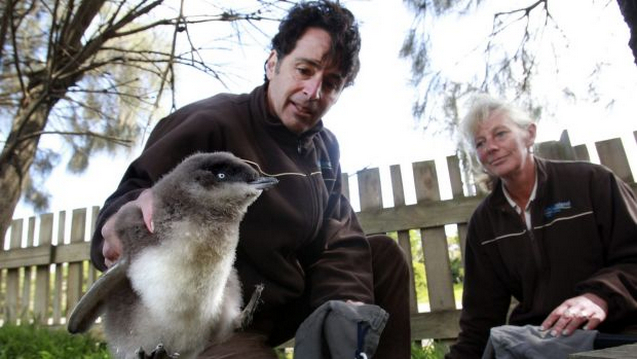
Research scientist Andre Chiaradia and research technical officer Leanne Renwick at the Penguin Parade Reserve on Phillip Island. Photo: Rebecca Hallas
It found overfishing and warming temperatures were hurting the lush life in these areas.
"Human activities drive environmental changes at scales that could potentially cause ecosystem collapses in the marine environment," the study says.
Co-author Andre Chiaradia, a senior scientist and penguin expert at the Phillip Island Nature Parks in Australia, said: "In those hot spots, the changes are already happening.
"They are the most at risk."
Researchers found the liveliest ocean hot spot also happens to be where the science of evolution sprouted: the Pacific Ocean off the central South American coast.
Other hot spots include the the south-western Pacific off Australia's southern and eastern coast, south-western Atlantic Ocean off Argentina; the western Indian Ocean off the African coast; the central western Pacific Ocean surrounding Malaysia, Indonesia and the Philippines and the Oceania region of the Pacific around the international date line.
Four of the six hot spots are in the Pacific; all are either in the southern hemisphere or just north of the equator.
"What makes this biodiversity? It's the isolation," Dr Chiaradia said.
"On land, we have kangaroos and weird animals like the platypus. And in the ocean it's not different."
Penguins, which are near the top of the food chain, were a good example of the impact of changing water temperatures and currents, Dr Chiaradia said.
Warm El Nino waters have decimated Galapagos penguins and the population of southern African penguins had dropped by about 90 per cent in just 20 years.

Links

24/02/2017

Tackling Climate Change Conservatively: How A Republican Calls For Action In The Trump Era

ABC News - Patrick Wood

Bob Inglis is on a mission in Australia to convince conservatives to combat climate change. (Supplied: RepublicEn.org)
Bob Inglis was a Republican Congressman, which to him meant one thing: "Climate change was nonsense."
It was the mid '90s and the representative from South Carolina says he didn't know anything about climate change except that it was something for the other side of politics to fuss over.
"I was just from the reddest district in the reddest state in the nation and it seemed that that was the business of the other tribe," he said.
Fast forward to 2004 and Mr Inglis was preparing for yet another run at office when his eldest son, who was about to vote in his first election, approached him.
"He said to me, 'Dad I'll vote for ya, but you're gonna clean up your act on the environment'."
"It was the first of a three-step metamorphosis for me."
The next two steps in Mr Inglis's transition from critic to climate action champion were visits to Antarctica and Australia's Great Barrier Reef.
These trips, and discussions with scientists along the way, convinced him there was a serious problem with the environment that had to be fixed.
Opinion: Climate change isn't just a Leftist cause
I'm a Liberal voter and I'm passionate about action on climate change. Did that sentence seem strange, asks Dale Hughes
He rushed back to the US and promptly introduced a bill to put a tax on combustible fossil fuels.
It promptly fell flat and he promptly lost his seat in Congress.
That was 2010.
Since then Mr Inglis has become a fierce advocate of action on climate change, but with a very specific focus: to tackle the problem with policies that are true to conservative principles, and in so doing convince his fellow Republicans they should get on board.
And he's brought that message to Australia, where he is currently touring the country to speak at public forums as well as with political and business leaders.
"I'm trying to help conservatives to overcome their inferiority complex," he said.
"We apparently think we're no good when it comes to energy and climate."
Mr Inglis tracks the split between the left and right on climate change in the US back to the global financial crisis, which broke in 2008.
He said prior to that former US Republican president Ronald Reagan had success with the Montreal Protocol to address the hole in the ozone layer, and George HW Bush introduced a cap-and-trade program to address acid rain.
"But then came the great recession, and some people with some vested interests created a wave of publicity that built on to the very high tide of distrust and discontent in America, particularly in the right, and that wave came over the sea wall and shorted out all of the climate change equipment," he said.
"So really we've been bailing ever since and trying to rewire."

What are the conservative answers?
Mr Inglis is certain conservatives can take the lead on addressing climate change, and that the answer is policies based around ideas of free enterprise, limited government and accountability.
He has established a group, RepublicEn.org, which proposes environmental tax reform in the US.
Specifically, the group wants to eliminate all subsidies for all fuels and "make all fuels fully accountable for all of the costs they bring upon society."
This would mean taking into account the health costs and any damage to the environment.
"So if you made it so the incumbent fuels could no longer subsidise their soot by spreading it all across society and made them accountable for that, well yes the price of their electricity would go up, but not artificially, it would go up to its actual cost," he said.
"So if you put all of the costs in on all of the fuels … then consumers, in the liberty of enlightened self-interest, would seek cleaner, better fuels.
"Then in the free enterprise system, on a level playing field, innovation will happen."
Mr Inglis is not alone in his mission to spread a conservative case for climate action.
Another conservative lobby group, the Climate Leadership Council, has recently formed and includes veteran Republicans who propose a four-point plan to reduce carbon dioxide emissions, including the introduction of a carbon tax.
The council met with White House officials earlier this month to propose replacing nearly all of Barack Obama's climate policies with a carbon tax starting at $40 a tonne. It's something Mr Inglis is keen to follow.


Bob Inglis on Radio National

What hope do these ideas have under President Trump?
President Donald Trump's recent moves on environmental policies, as well as his previous comments on climate change, suggest a shift away from regulations and a renewed focus on fossil fuels.
The man he chose to head the Environmental Protection Agency, Scott Pruitt, is a known critic of the agency's regulations, having filed 14 lawsuits against the EPA during his time as Oklahoma attorney-general. One of them was over the EPA's attempt to limit carbon emissions from coal-fired power plants.
And the White House website's current statement on energy policies says "the Trump Administration is also committed to clean coal technology, and to reviving America's coal industry, which has been hurting for too long."

Scott Pruitt questioned on climate change in confirmation hearing (ABC News)

Nevertheless, Mr Inglis said he remained hopeful President Trump would be open to his ideas.
"I don't for a minute think that Donald Trump actually believes that it's a Chinese hoax and conspiracy, he's clearly playing to the crowd," he said.
"Admittedly it's a 'bank shot', but there's a chance that he might decide to complete the sentence this way: 'Richard Nixon went to China; Bill Clinton did welfare reform; Donald Trump did climate change'."
For now, Mr Inglis takes heart seeing young conservatives joining the environmental cause and embracing principles that speak to their beliefs.
For him, it's a sign the right is ready to rejoin the discussion.
"I see it on talk radio in America, where on first hearing they're sceptical, but then they hear it in their own language," he said.
"They don't hear a progressive talking, they hear a conservative using conservative language, and that moves them."

Links

SA Electricity Problems Solved With Solar Battery Storage

Eco News - David Twomey


The company behind a $100-million solar plant with battery storage has said its project could solve South Australia’s energy woes as Australia’s conservative Liberal-Nation government announces a $445,000 investment into a pumped hydro-station for the state.
South Australia’s power supply has been scrutinised since the state was plunged into darkness last September, and was recently forced to “load shed” during a recent heatwave.
South Australian-based renewable energy company Zen Energy is working to build a $100-million solar power plant with 100 megawatt (MW) of battery storage in the region.
Chairman Professor Ross Garnaut said the battery would “solve most” of the state’s energy problems and if increased by a further 50MW it would solve “all” energy issues.
“The blackouts of the past year would not have happened if this was in place,” he said.
We think that it can make a major contribution both to grid stability and also to provide a buffer for when peak demand for power exceeds supply from other sources.”
However, Professor Garnaut said “arcane” rules and pricing in the national electricity market needed reform in order for the project to be viable.
He met with South Australian Labor Premier Jay Weatherill today to discuss the regulatory hurdles that he hoped could be removed by the Council of Australian Governments (COAG).
He said they already had financial backing for the project, which meant it could be in operation by next summer if restrictions were loosened.
“Our biggest hope is for reform of the arcane rules of the national electricity market which are standing in the way of a secure energy future; it’s one of the most regulated sectors in the Australian economy,” Professor Garnaut said.
“All electricity generators and users bid every five minutes for the price but then they average the price over half an hour.
“It makes life very difficult for a battery that can respond very quickly and it takes away some of the advantages of the battery.”
Energy Australia also received $450,000 from the Australian Renewable Energy Agency (ARENA) today to develop a pumped hydro-power station in the Upper Spencer Gulf.
Pumped hydro generates power by releasing water from a dam through turbines to a lower dam when there is high demand and pumping it back to the top at off-peak times.
The Liberal-National government said the project would store power and help stabilise the grid.
Mr Weatherill has previously touted the idea of breaking away from the national electricity market.
However, Professor Garnaut said reforming the national system would be a better option for South Australia.
Mr Weatherill said work was progressing on the state government’s energy plan which would recommit to a 50 per cent renewable energy target.
“We’ve got people beating down our doors promoting renewable energy projects which includes storage,” he said.
“The long-term future is renewable energy associated with storage which will secure the future of our energy sector here in this stage and also the nation.”
Mr Weatherill said the government would release its energy plan “soon” but the Liberal-National state opposition has accused the government of not having a plan.

Links

State Of Solar 2016: Globally And In Australia

Climate Council - Andrew Stock | Greg Bourne

Solar power is surging in Australia and around the world, on the back of scaled-up production and continually falling costs.
Our new report finds that the solar rollout will continue to go gangbusters this year, with more than 20 industrial-scale installations set to go ahead across the country, and another 3700 megawatts in the pipeline.

KEY FINDINGS

1. Globally, solar photovoltaic (PV) power is surging on the back of scaled-up production and continually falling costs.
  • 70GW (projected) of new solar power capacity was added globally in 2016, breaking last years’ (2015) record of 50GW capacity added.
  • China (34.2GW), the United States (13GW) and Japan (10.5GW) continued to lead with the most solar PV capacity added.
  • The solar sector employs 2.8 million people globally, outnumbering coal jobs. In the United States, solar now provides twice as many jobs as coal.
2. Solar costs are now so low that large, industrial-scale solar plants are providing cheaper power than new fossil and nuclear power.
  • Solar costs have dropped 58% in five years and are expected to continue to fall by a further 40-70% by 2040.
  • Electricity prices from new coal power stations could rise to A$160 per megawatt hour, while solar parks are around $110 per megawatt hour and are expected to come down significantly in price over time.
3. Australia remains a world leader in household solar
  • The cost of solar power is now well below the retail power prices in Australian capital cities, and continues to fall. The exception is the ACT which has the lowest retail prices in Australia.
  • Australia adds more solar power every year than the combined capacity of South Australia’s (recently closed) Northern and Playford coal-fired power stations.
  • Over 8000 Australians are now employed in solar and solar has the potential to create thousands more jobs as it grows.
4. 2017 will be a huge year for large-scale solar in Australia.
  • Larger solar PV installations are already taking off in Australia – on airports, mines, healthcare facilities and businesses.
  • In 2017 over 20 new large-scale solar projects will come online. A further 3,700 MW of large-scale solar is in the development pipeline (roughly equivalent to three coal fire power stations).
  • Australia is expected to reach over 20GW of solar PV in the next 20 years, equivalent to about a third of Australia’s current total power generation capacity.
5. A range of energy storage technologies will complement the growth of solar power providing secure, flexible power.
  • Solar and battery storage for households and businesses is already gaining traction in Australia – with more than 6,500 households installing the technology. Uptake is expected to triple in 2017.
  • Large-scale developments such the Lakeland solar and battery storage project and the Kidston solar and pumped hydro project (both in North Queensland) are demonstrating the potential of combining large-scale solar and energy storage technologies.
  • The Victorian Government is seeking expressions of interest to build a large scale battery storage facility in western Victoria to improve grid stability.

Links

23/02/2017

The Age Of The Giant Battery Is Almost Upon Us

Bloomberg - Joe Ryan | Brian Eckhouse

Photographer: Chris Ratcliffe/Bloomberg
  • Prudential, Investec among lenders financing storage projects
  • Falling prices and long-term contracts making storage bankable
The idea that giant batteries may someday revolutionize electrical grids has long enthralled clean-power advocates and environmentalists. Now it's attracting bankers with the money to make it happen.
Lenders including Investec Plc, Mitsubishi UFJ Financial Group Inc. and Prudential Financial Inc. are looking to finance large-scale energy-storage projects from California to Germany, marking a coming-of-age moment for the fledgling industry. The systems help utilities solve a longstanding clean-power conundrum: managing the unpredictable output from wind and solar farms, and retaining electricity until it's needed.
Battery costs have declined 40 percent since 2014 and regulators are mandating storage technology be added to the grid. That's encouraging utilities to offer longer contracts and developers are expected build $2.5 billion in systems globally this year. These trends are changing the risk profile, giving lenders confidence in batteries in much the same way that power-purchase agreements opened banks' doors years ago for wind and solar power.
"Having big money come in is the first step to widespread deployment," Brad Meikle, a San Francisco-based analyst for Craig-Hallum Capital Group LLC, said in an interview.
That's a shift from many of the storage projects we've seen to date as expensive components and unproven revenue potential made commercial lenders leery. Developers typically have financed systems from their own balance sheets, cobbling together revenue from short-term utility contracts or wholesale electricity markets.
"We see an opportunity in the space," Ralph Cho, Investec's co-head of power for North America in New York, said in an interview. "We're attempting to be a first mover."
Storage contracts to date in the U.S. and Canada rarely exceeded three years, said Bryan Urban, head of North American operations for the Yverdon-les-Bains, Switzerland-based storage developer Leclanche SA. Now utilities are signing agreements for three to seven years, and sometimes as long at 10 years, he said. And in the U.K., National Grid Plc is signing four-year contracts for storage services.

'Uncertain Revenue'
"Instead of these short uncertain revenue streams, you now have longer-term contracts that investors can get behind," said Logan Goldie-Scot, head of energy storage analysis at Bloomberg New Energy Finance in London.
The industry still faces significant hurdles. While costs have fallen, batteries are still an expensive way to manage electricity. Developers have little data to demonstrate how their systems will perform over time. Also, existing rules for wholesale power markets were mostly written for traditional equipment that generates and delivers electricity, and the industry is still developing market mechanisms to determine how to value and pay for storage systems that offer different functions.
The market is fragmented with a variety of different technologies, including lithium-ion batteries, flow batteries and flywheels. They have different capabilities and developers offer different types of services. They can smooth the flow of power on the grid, absorbing power when there's too much and delivering needed jolts when demand spikes.
That means the industry is still figuring out the best uses for storage systems, and banks don't want to wind up backing the Betamax of storage. Plus, several one-time high flyers ended up filing for bankruptcy in recent years -- remember A123 Systems Inc., Xtreme Power Inc. and Beacon Power Corp. -- leaving lenders gun shy.
The most important business stories of the day. Utilities have been experimenting with energy storage for decades, and while momentum has been slow, it's starting to take off. It took 30 years to install enough systems to add up to a gigawatt, and Sekine expects 1.7 gigawatts expected to go into service in 2017 alone. State regulators are a key driver, with California ordering utilities to install at least 1.3 gigawatts of storage by 2020, and Massachusetts on track to set its own targets by July.

Lethal Heating is a citizens' initiative