16/02/2018

U.S. Climate Change Litigation In The Age Of Trump: Year One

 - Dena Adler

Donald Trump claims to have delivered on deregulation in his first year as President.
While independent reporting questions the veracity of his assertions, climate change is one arena where the Trump Administration’s regulatory rollbacks have been both visible and real.
The Administration has delayed and initiated the reversal of rules that:
  • reduce greenhouse gas emissions from stationary and mobile sources;
  • sought to expedite fossil fuel development, including in previously protected areas;
  • delayed or reversed energy efficiency standards;
  • undermined consideration of climate change in environmental review, and
  • hindered adaptation to the impacts of climate change.
In total, the Sabin Center’s U.S. Climate Deregulation Tracker identifies a total of 64 actions taken by the executive branch in 2017 to deregulate climate change.
These actions correspond to at least two dozen climate-related protections.
However, the Trump Administration’s efforts have met with constant resistance, with those committed to climate protections bringing legal challenges to many, if not most, of the rollbacks.
U.S. Climate Change Litigation in the Age of Trump, a new working paper from Columbia University’s Sabin Center for Climate Change Law, seeks to give shape to the current moment in climate change litigation.
It categorizes and reviews dozens of climate change cases filed during 2017 to understand how litigation countered—and at times courted—the influx of climate change deregulation during the first year of the Trump Administration.
The analysis focuses specifically on 82 “climate change cases,” defined as cases that raise climate change as an issue of fact or law.
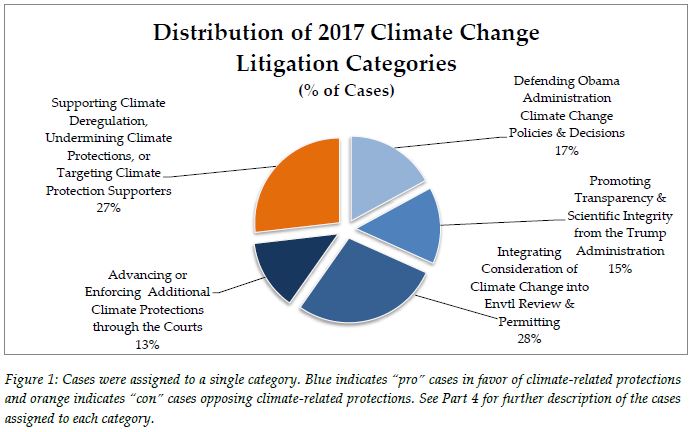
To explain the effects of climate change litigation in 2017, this paper sorted cases into five categories:
  1. Defending Obama Administration Climate Change Policies & Decisions;
  2. Demanding Transparency & Scientific Integrity from the Trump Administration;
  3. Integrating Consideration of Climate Change into Environmental Review & Permitting;
  4. Advancing or Enforcing Additional Climate Protections through the Courts; and
  5. Deregulating Climate Change, Undermining Climate Protections, or Targeting Climate Protection Supporters.
The working paper sorts 2017’s climate change cases into five categories. LARGE IMAGE

The first four categories are “pro” climate protection cases, where, if their plaintiffs or petitioners are successful, they will uphold or advance climate change protections.
The fifth category contains “con” cases—if their filing party or parties are successful, these cases will undermine climate protection or support climate policy deregulation.
Sixty of the reviewed cases were pro climate protection and twenty-two were con.
The pro cases outweigh the con cases roughly 3:1 (73 percent to 27 percent).
To understand how federal climate change litigation is shaping national climate policy in the absence of federal leadership, U.S. Climate Change Litigation in the Age of Trump looks across and within these litigation categories to further examine:
  1. who are the litigants; 
  2. what laws are they utilizing; and 
  3. how far have these cases progressed in year one of the Trump Administration.
See the Executive Summary and Full Report for the results.

Links

Trump’s Top Spy Just Contradicted The White House’s Line On Climate Change

VoxUmair Irfan

The director of national intelligence warned Congress that climate change could cause “upheaval” this year.
Director of National Intelligence Dan Coats testifies before the Senate Intelligence Committee on February 13 Chip Somodevilla/Getty Images 
The top US intelligence official warned Congress this week about the threat of “abrupt” climate change, contradicting the Trump administration’s efforts to drive climate out of national security discussions.
Director of National Intelligence Dan Coats, whose office oversees 17 intelligence agencies including the CIA and the NSA, submitted written testimony this week to the Senate Intelligence Committee. In addition to warnings about Russian interference in the upcoming midterm election and the militarization of space, he identified climate change as a significant concern.
“The impacts of the long-term trends toward a warming climate, more air pollution, biodiversity loss, and water scarcity are likely to fuel economic and social discontent — and possibly upheaval — through 2018,” Coats wrote.
He noted that the past 115 years were the warmest in modern civilization and that the past few years were the warmest on record. And there’s a possibility of a sudden shift in the global climate once it reaches a tipping point, he said.
Coats also observed that worsening air pollution is causing unrest in countries like India, water scarcity is driving tensions between nations, and ecosystems threatened by rising temperatures could jeopardize “critical human systems.”
This assessment follows testimony from Defense Secretary James Mattis, who earlier this month told lawmakers that climate change is an integral part of military planning.
“This is a normal part of what the military does, and under any strategy, it is part and parcel,” he told the House Armed Services Committee.
Over at the White House, well, it’s a different story. Trump himself mocked global warming on Twitter in December. And his administration officials regularly dismiss well-established climate science and are removing climate change from policy discussions, particularly around national security.
In an interview on February 6 with a Las Vegas television station, Environmental Protection Agency Administrator Scott Pruitt said that rising global temperatures are “not necessarily a bad thing” and that “humans have flourished’’ as the planet has warmed.
And the White House completely omitted climate change as a security concern from the National Security Strategy report released last December, bringing it up only to note that climate change policies in other countries could hurt the fossil fuel industry.
However, Coats’s remarks show that the practical realities of climate change are impossible to ignore for those who have to contend with its real-world consequences. And as temperatures rise, Trump, his Cabinet, and the entire national security apparatus will increasingly have to contend with rising seas, more intense weather, and the devastation that ensues.

Links

Scientists Just Issued a Grim New Warning on Climate Change: 'We Are Not Prepared'

TimeJustin Worland


The Legal Reasons Why President Trump Won't Take A Stand On Climate Change

New research shows that countries around the world are falling short of greenhouse gas goals in the Paris climate deal, and the consequences will likely be unprecedented extreme weather.
Published in the journal Science Advances this week, the study found that the likelihood of extreme heat, dryness and precipitation will increase across as much of 90% of North America, Europe and East Asia if countries do not accelerate their efforts to reduce greenhouse gas emissions.
“We are not prepared for today’s climate, let alone for another degree of global warming,” says study author Noah Diffenbaugh, a Stanford University professor of earth system science.
The 2015 Paris Agreement, which President Donald Trump has promised to exit when the U.S. is eligible to do so, aims to keep temperature rise below 3.6°Fahrenheit by 2100 with an ideal target of 2.7° Fahrenheit. Though the differences seem minor, the study shows the difference between those targets would lead to dramatic increases in the likelihood of record warm or wet days, according to the study.
Under the agreement, countries from across the globe offered their own individually determined pledges to reduce their greenhouse gas emissions, but those collective commitments still allow temperatures to rise 5.8° Fahrenheit, according to data from the United Nations Environment Program. Some countries do not seem eager to meet their commitments at all.
Scientists say the clock is ticking if countries aim to actually reduce emissions in a way that’s consistent with the Paris Agreement’s targets. In some cases, greenhouse gases emitted today will stay in the atmosphere decades.

Links

15/02/2018

International Court Ruling: A Safe Climate Is A Human Right

Climate Liability News - Ucilia Wang

Opposition to a trans-oceanic canal in Nicaragua has resulted in an international court ruling that environmental protection is a human right. Photo credit: Jorge Mejia Peralta via Flickr
The Inter-American Court of Human Rights has issued a landmark opinion that equates environmental protection with human rights, a conclusion that could force countries in Latin American and beyond to tackle climate change more aggressively.
The advisory opinion represents the first time the Inter-American Court has recognized a fundamental right to a healthy environment, a concept that may seem abstract but could impact interpretations of existing laws and improve environmental protection.
That concept isn’t new, but it hasn’t been widely applied by courts. The opinion comes at a time when a number of climate lawsuits have been filed around the world to try to establish the same or similar legal principles and pressure fossil fuel companies and governments to cut emissions.
“We think this decision will be used as a tool to strengthen ongoing litigation on human rights and the impact of climate change nationally and internationally,” said Astrid Puentes, co-director of AIDA, an advocacy group that filed an amicus curiae brief in this case.
The court was created in 1979 to enforce the American Convention on Human Rights, which has been ratified by most of the countries in Central and South America. The court hears cases brought by those governments or the Inter-American Commission on Human Rights.
Its decision has immediate implications for a recent case in Colombia. A lower court on Monday ruled against a group of 25 youths who petitioned last month to require the government to stop deforestation. The plaintiffs cited their constitutional rights to life and a healthy environment in their filing.
The youths planned to appeal, said Camila Bustos, a researcher with Dejusticia, the nonprofit advocacy group that filed the petition.
“We were glad that the (Inter-American) Court has set such an important precedent on environmental rights. It strengthens our arguments, and we will definitely cite it in the next step of the lawsuit,” Bustos said.
While the court’s opinions have legal impact, they can also influence decisions made elsewhere, especially given that human rights protection is considered a global issue that’s addressed through a number of international agreements and legal systems, such as the International Court of Justice in the Hague, said Carroll Muffett, president of the Center for International Environmental Law, a public interest law firm in Washington, D.C. that also filed an amicus curiae brief.
The seven judges of the Inter-American court took particular care to mention climate change in their opinion. They cited the Paris Climate Agreement, in which nearly 200 countries committed to cutting emissions and capping global warming to within 2 degrees Celsius above the pre-industrial levels.
The opinion is considered advisory because it isn’t a ruling about a legal dispute. It’s an answer to a question from Colombia, which wanted to know how human rights law applies to large-scale infrastructure projects in the Caribbean. The court reached its conclusion last November but didn’t publish it until last week.
Colombia posed the question after it was upset with decisions by the International Court of Justice over an ongoing territorial dispute with Nicaragua. Nicaragua plans to boost oil drilling off its coast and build a $50 billion canal that aims to rival the Panama Canal to increase maritime trade and generate revenue for the country.
Colombia did not mention Nicaragua in their petition and asked instead that the review cover the Caribbean. But the judges went far beyond that and came up with a list of do’s and dont’s about the role of the governments in protecting the environment and human rights.
One of the findings in particular surprised and delighted environmental advocates: it says a government is responsible for addressing the impact of an environmental disaster even if it stretches beyond the borders. The court also said governments need to be transparent and share information with each other and the public.
“The court recognizes that the obligations to protect human rights don’t stop at a country’s borders,” Muffett said. “This opinion demonstrates the deep integration between environmental protection and the responsibility of the government to protect human rights.”
Courts in a handful of countries, such as Ireland,  the Netherlands and Pakistan, have acknowledged that connection. More climate lawsuits are underway in other countries, including Norway and the United States, to try to push for that recognition as a human or constitutional right.
The 9th Circuit Court of Appeals in San Francisco is set to decide whether to allow  Juliana v. United States to proceed to trial. The case, filed by 21 people in their teens and early 20s, contends that the U.S. government is failing to protect their constitutional rights to life, liberty and property because it continues to champion energy policies that subsidize and promote fossil fuels.
Colombia’s Constitutional Court gave its take in 2016 when it struck down provisions of federal laws that allowed exemptions for mining and oil and gas drilling in high-altitude areas with fragile ecosystems. The court ruled that the provisions violated the public’s right to clean water because these areas provided as much as 70 percent of the country’s drinking water and were capable of capturing more carbon dioxide emissions from the atmosphere than a rainforest of comparable size.

Links

Ominous Warning For Sydney In Cape Town Water Crisis

Fairfax - Eamon Waterford*

Within months, a city sitting on the same line of latitude as Sydney could become the first major metropolis in modern history to run out of water.
When Cape Town hits its projected "Day Zero", millions of taps will suddenly run dry. Schools, hospitals and other institutions will retain access to some water but households will be cut off completely.


Fears that tourism could dry up amid Cape Town water crisis
As Cape Town's residents are forced into stricter measures to preserve water, there are fears that the flow of tourists, a vital part of the city's economy, could also dry up. 

Obviously Sydney enjoys a range of advantages over Cape Town.
But the factors that have led to the South African city's impending crisis should ring familiar: harsher droughts driven by a changing climate, an infrastructure backlog and rapidly growing demand from a booming population. All apply to Sydney.
Yet despite this you're more likely to hear Sydneysiders talking about traffic or property prices than water.
Water policy seems to have slipped from our civic discourse. Memories of the millennial drought have faded as our reservoirs have filled with years of above-average rainfall.
But this period of water wealth should not delude us. We will enter a period of sustained water shortage at some point in the not-too-distant future.
Which is why we should start talking about how we deal with water now, in the relative calm before the inevitable crisis.
Warragamba Dam in Sydney during the 2005 drought. Photo: Steve Christo
We tend to take for granted our access to safe water and sanitation. Each household has high quality water to every tap and a sewerage system that protects public health.
And perhaps in a city as relatively privileged as Sydney, things will never get "Day Zero" bad. But consider that during the last Sydney drought, dam levels approached 30 per cent.
Below this and we would have been talking about upgrading water restrictions to complete bans on watering any grass – from front lawns to sports grounds. Fountains and water features would have been turned off.
Fifteen per cent is the mark at which it becomes difficult to extract drinking water.
And while it is worth noting that the energy-intensive Kurnell Desalination Plan adds extra capacity to the region, Sydney's relationship with water nevertheless needs to extend beyond pipes, dams and treatment plants. Water can and should be at the centre of our urban landscape discussion.
Our city is suffering from a rapidly growing heat island effect, as the hard roofing and paving of urbanisation engulfs the Sydney basin. This extra heat is not only uncomfortable, it’s often lethal. The acute heatwave that hit in 2009 will forever be associated with the Victorian Black Saturday bushfires, which claimed 173 lives. But it is also estimated that during January and February of that year, 374 people – mainly the young and the old – died in south-eastern Australia from heat-related causes not associated with bushfires.
The danger and unpleasantness of heat was not taken into consideration during Sydney's previous attempts to control and regulate water. Natural rivulets and streams were covered over; historic water courses diverted.
Our native habitats, all of which rely on access to surface water, are now endangered. Once babbling brooks and streams are now stagnant and weed infested. The city is crisscrossed with open drainage canals and swales.
We have become estranged from our local environments. But it need not be this way. We can restore waterways and turn them from fenced-off eyesores into linear urban parks, providing a sequence of accessible paths for pedestrians and cyclists.
We can build on the government's efforts to create a network of parks and green space, by adding a "blue grid" of waterways and streams. This would be expensive. But it would be worth it. It would significantly reduce ambient heat in our urban environments, reduce stress and improve our mental health. Water and vegetation in urban environments creates cooling through shading, evaporation and evapotranspiration from plants. As climate change continues to heat our planet this will become ever increasingly important.
It would also provide a social licence for population density done well, by offering quality open space to people living without backyards of their own.
And if making our city happier and healthier isn't reward enough, consider the more instantly quantifiable benefits.
Following the restoration of a wetland in the Perth suburb of Lynwood, median home values within 200 metres increased by between $17,000 and $26,000 above the trend increase for the area. In Sydney, restoring the natural banks of Cooks River raised nearby property values by up to 9 per cent above trend.
Meanwhile the cost of inaction was recently highlighted by Infrastructure Australia, who predicted annual water bills of $2500 by 2040.
The incredible urban value of water has been powerfully driven home to me over the past three months after taking leave to stay home with my one-year-old.
Steel Park, near my inner west home, has a waterplay area for the kids under big trees adjacent to the Cooks River. As the temperature rose to 40 degrees and beyond this summer, this swiftly became our go-to place. Between the water and the trees, the temperature in this park was 10 degrees cooler than the rest of our neighbourhood. It's a godsend.
There is no reason that most of Sydney should have to live without similar amenity.

*Eamon Waterford is the director of policy for the Committee for Sydney.

Links

Expect More 'Complete Surprises' From Climate Change: NASA's Schmidt

Fairfax - Peter Hannam

The eruption of pine bark beetles that has devastated millions of hectares of forests in North America is an example of the surprises yet to come as the planet warms, says Gavin Schmidt, head of NASA's Goddard Institute for Space Studies.
The tiny beetles, which have infested forests from Colorado to Alaska, develop a type of anti-freeze as winter arrives. With fewer cold snaps before the insects are "cold hardened", more of them are making it through to spring.

Trillion-tonne iceberg breaks off Antarctica
As big as Bali, the loss of the Larsen C ice shelf will require maps to be redrawn and could ultimately cause sea levels to rise.

“We just don’t understand ecosystems to the extent we understand the physical climate systems," Dr Schmidt told Fairfax Media during a visit to Sydney. “We will see over the next few decades more and more thresholds being crossed.”
However, that's not to say the physical climate is fully understood either.
Carbon dioxide levels are now the highest in about three and a million years when the Earth had a "very, very different climate", Dr Schmidt said, adding it was inevitable more "unknown unknowns" would emerge.
The southern hemisphere, especially Antarctica, is of particular interest to NASA and other global organisations trying to understand how the build-up of additional heat will affect planetary processes, he said.
“There’s a tonne of extra energy that’s going into the south - in fact there’s more energy going into the sourthern ocean than the north," Dr Schmidt said. "But that isn’t necessarily being seen at the surface."
Scientists' understanding of Antarctica continues to be limited by the short observational record, with much of the data compiled only since the late 1950s.
Gavin Schmidt, director of NASA's Goddard Institute for Space Studies, during a visit this month to attend a conference at the University of NSW. Photo: Dean Sewell
Satellites and argo floats are also not very helpful in gauging changes under the sea ice and ice shelves.
The region is already throwing up surprises. Dr Schmidt cited the Mertz Glacier Tongue, which used to protrude about 80 kilometres into the Southern Ocean until it was cut in two by an iceberg in 2010.
'Cold hardened': The eruption of pine bark beetles has devastated millions of hectares of forests in North America. Photo: Alamy
“It seemed very, very stable...but the whole thing got taken out by an iceberg and now it’s totally disappeared," he said.
Research is focused on places such as the Totten ice sheet "where people think there is the greatest amount of potential change in the East Antarctic ice shelf", Dr Schmidt said.
A study out last year in Science Advances estimated Totten itself had the potential to lift global sea levels by 3.5 metres if it melted entirely.
The east Antarctic ice shelves, though thought to be mostly stable, "are big enough that should anything start to happen there, these will be noticeable increases to the rate of sea level rise," Dr Schmidt said. "So that makes them interesting.”
Sea ice cover around Antarctica is close to record low levels - set just a year earlier - as the region approaches its summer minimum extent.
Antarctica is also home to another scientific surprise: the ozone hole that was detected over the contenent in the mid-1980s.
While the class of chemicals - mostly chlorofluoro carbons - were relatively well known, their potential to destroy the crucial ozone layer that helps keep out cancer-causing ultraviolet light was not.
"It was a massive shock to the system - it hadn't been predicted by anyone," Dr Schmidt told a public talk last week.

Links

14/02/2018

Intelligence Agencies Warn Of Climate Risks In Worldwide Threat Assessment

InsideClimate NewsJohn H. Cushman

While top Trump administration officials deny climate change, the intelligence agencies warn global warming can fuel disasters and violent conflicts.
Intelligence officials testified before a Senate committee about global threats. Left to right: FBI Director Christopher Wray, CIA Director Mike Pompeo, National Intelligence Director Dan Coats, Defense Intelligence Agency Director Robert Ashley, National Security Agency Director Michael Rogers and National Geospatial Intelligence Agency Director Robert Cardillo. Credit: Chip Somodevilla/Getty Images
In their annual summary of global threats, the nation's intelligence agencies warned on Tuesday that climate change and other environmental trends "are likely to fuel economic and social discontent—and possibly upheaval—through 2018."
While there may not be indications of an abrupt and cataclysmic event on the immediate horizon, the trends are already visible, they said in a statement presented to the Senate Intelligence Committee at a hearing where the Trump administration's top intelligence officials testified.
The statement was matter-of-fact and brief, but unambiguous. Normally, conclusions like these might not deserve much notice. But in an administration where top officials, including some with intelligence responsibilities, have repeatedly questioned the basic science of global warming, such a frank confirmation of the mainstream consensus was striking.
The intelligence agencies' Worldwide Threat Assessment contrasted with two other recent documents issued by the Trump administration: the National Defense Strategy published in January and the National Security Strategy published in December. Both of those broke from the pattern of recent years and omitted climate change as a significant concern.
The intelligence community, instead, aligned itself with science agencies. The report's views reflect those in the thoroughly peer-reviewed interagency National Climate Assessment issued last year, and the facts consistently reported by major scientific agencies like NOAA and NASA.
"Extreme weather events in a warmer world have the potential for greater impacts and can compound with other drivers to raise the risk of humanitarian disasters, conflict, water and food shortages, population migration, labor shortfalls, price shocks, and power outages," the intelligence threat assessment said. It was presented as the written testimony of Dan Coats, the director of national intelligence appointed by President Donald Trump.
"Worsening air pollution from forest burning, agricultural waste incineration, urbanization, and rapid industrialization—with increasing public awareness—might drive protests against authorities, such as those recently in China, India, and Iran," the assessment said.
"Accelerating biodiversity and species loss—driven by pollution, warming, unsustainable fishing, and acidifying oceans—will jeopardize vital ecosystems that support critical human systems. Recent estimates suggest that the current extinction rate is 100 to 1,000 times the natural extinction rate."
Water scarcity and disease outbreaks, two problems related to climate change, also pose risks, it said.
So does the most striking sign of the upheaval, waves of refugees displaced by complex stresses of climate, disease, poverty and other destabilizing factors, the report warned.
"Challenges from urbanization and migration will persist, while the effects of air pollution, inadequate water, and climate change on human health and livelihood will become more noticeable," the assessment said. "Domestic policy responses to such issues will become more difficult—especially for democracies—as publics become less trusting of authoritative information sources."

Links

Lethal Heating is a citizens' initiative