22/07/2019

DFAT's Climate Change Strategy Stuck On Hold

AFR - Andrew Tillett

A climate change strategy for Australia's foreign aid program has languished in Foreign Minister Marise Payne's office for six months, undermining efforts to bolster ties with Pacific nations who regard global warming as an existential threat.
Foreign aid groups have lashed the delay, which coincides with warnings from military chiefs that China could take advantage of climate change to occupy abandoned islands in the Pacific.
A child wades through sludge and water on the Island Republic of Kiribati, which often experiences inundation on high tides and is one of a number of low-lying nations exposed to the worst effects of rising waters due to climate change. James Alcock
The strategy is intended to provide a framework for integrating investment on climate change action with the Department of Foreign Affairs and Trade's overseas development assistance program.
The strategy had its genesis in July 2016, when DFAT elevated climate change as a foreign aid priority, and then foreign minister Julie Bishop gave the green light to preparing the strategy.
DFAT officials said last year the strategy would be made public in late 2018 but Senator Payne told Senate estimates in February she had received a draft version of the strategy that month but was non-committal about when it would be released.
Confirmation of the delay comes as Senator Payne travels to the Cook Islands for bilateral meetings and Prime Minister Scott Morrison prepares to meet New Zealand counterpart Jacinda Ardern in Melbourne on Friday, where cooperation in the Pacific will feature heavily in talks.
Mr Morrison has made the so-called "Pacific step up" a signature issue of his prime ministership as he seeks to deepen diplomatic and defence ties with Pacific nations, amid a strategic competition with China for regional influence.
Pacific nations have declared climate change the single biggest threat to the region and have criticised the Australian government for not doing enough to respond to the challenge.
The Australian Financial Review revealed earlier this week that Defence Force chief Angus Campbell used a private speech to warn fresh regional tensions could erupt if unnamed states occupied islands that had been abandoned because of rising sea levels.
The Australian Council for International Development, the peak body for aid and development non-government organisations, urged Senator Payne to release the climate strategy, adding it should be the basis of further reform of the aid program.
"As the Boe declaration states – and to which Australia is a signatory – climate change remains the single greatest threat to the livelihoods, security and wellbeing of the peoples of the Pacific. Yet, we are yet to see action from the Australian government which equates to this recognition," head of government relations Tim Watkin said.
"If we want to be a good neighbour and preferred partner, we must listen, respect and respond to the leaders of the Blue Pacific who consistently identify climate change as their key priority. It should be front and centre of the Pacific ‘step up’.
"As a matter of urgency, the Australian government must recognise the threat of climate change at the highest level of the development program. We think the government should refresh the 2014 aid policy and performance framework to reflect the threat of climate change and the Boe declaration. This would elevate and help mainstream climate change adaptation and resilience in the aid program."
DFAT said it was already integrating climate change action across aid programs. The government was on track to meet its promise of providing $1 billion over five years to 2020 to support countries in the region build resilence and lower emissions, including $300 million for the Pacific, it said in a statement.
"The climate change action strategy for the aid program is being updated to better reflect Australia’s international climate change engagement prior to the Paris Agreement coming into effect in 2020," the statement said.
"Australia recognises Pacific island countries are particularly vulnerable to the effects of climate change and disasters, and is already working closely with the Pacific on climate change and development issues, as well as interrelated environmental concerns like marine litter."

Links

A Deadly Heat Wave After The Hottest June On Record: How The Climate Crisis Is Creating 'A New Normal'

TIME - Jasmine Aguilera

As millions of people prepare for sweltering heatwaves in the U.S. Midwest and East Coast, scientists say July will likely be the hottest July on record, following the hottest June on record. These types of heatwaves are expected to become more frequent throughout the world as global warming continues, say scientists.
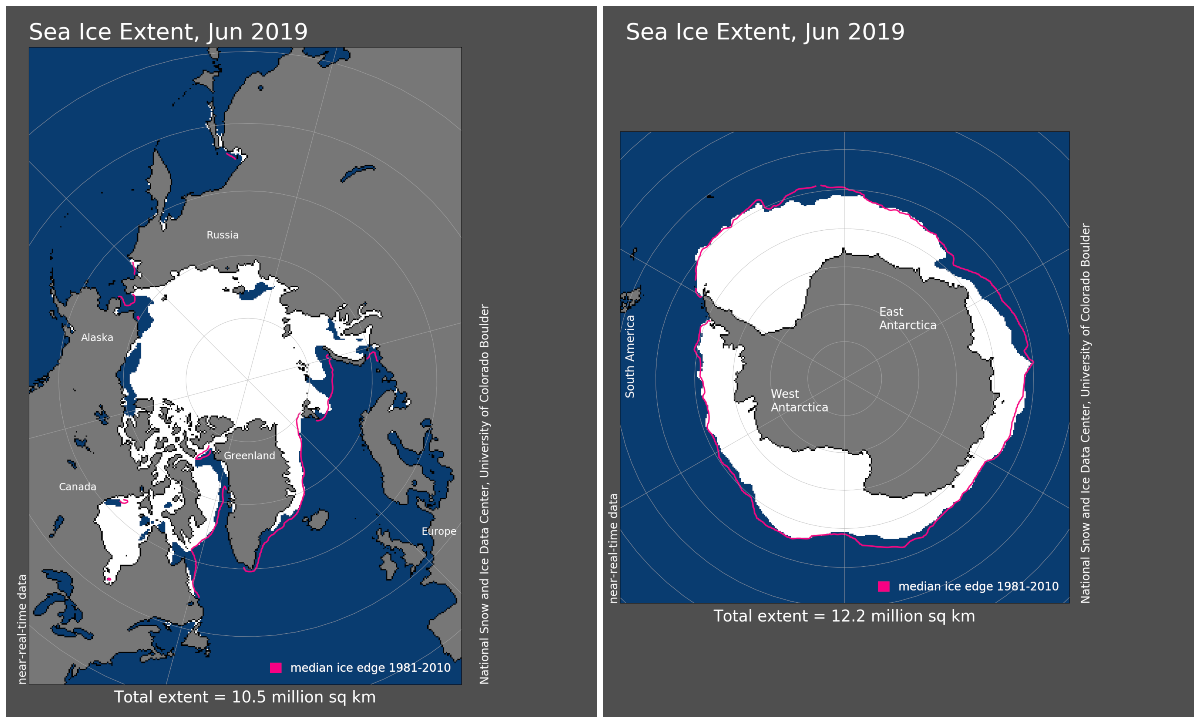
The National Oceanic and Atmospheric Administration (NOAA) reports the average global temperature for June was 1.71 degrees Fahrenheit above the 20th century average of 59.9 degrees. NOAA also reported record-breaking decreases in sea ice coverage in the Arctic and Antarctica.
“Our climate is warming,” Ahira Sánchez-Lugo, a climatologist at NOAA, tells TIME. “We have a new normal, we are in a new warmer climate. Just in the 21st century, we’ve set a new global world temperature record five times.”
Robert Rohde, lead scientist at Berkeley Earth, tells TIME that July is also likely to be the hottest July on record, as global temperatures continue to trend towards increasing heat.
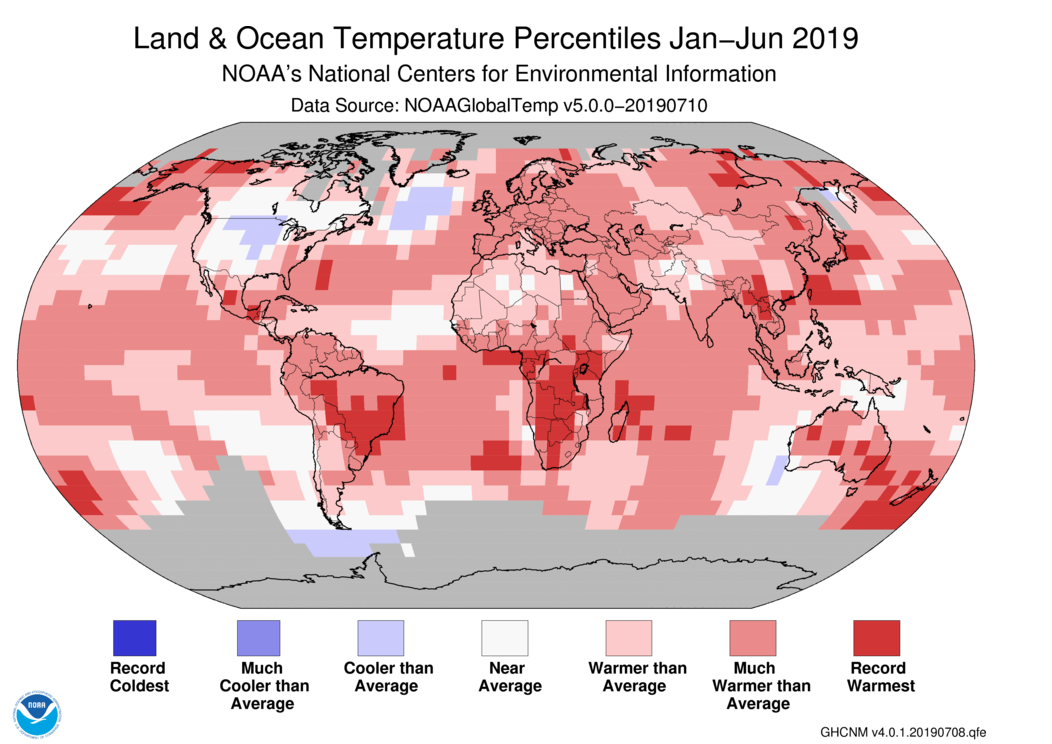
Regionally, hot June temperatures broke records in Europe, Africa and South America, and it was the hottest first half of the year for Alaska, Madagascar, New Zealand, Mexico, western Canada and eastern Asia.
Overall between January through June, the temperature averaged out to 1.71 degrees above the 20th century average of 55.3, tying with 2017 as the hottest year so far.
Rohde says this trend can be attributed to human emissions of greenhouse gases. “This trend will continue until humans find a way to change their behavior and stop modifying the atmosphere,” Rohde says.
He points out that while the trend continues upward, the world may not see consistently warmer temperatures. “It doesn’t happen continuously,” he says. “There are fluctuations, we don’t have a new hottest year every year or a new hottest month every month, but as we move forward we expect to set many records over time.”


Why does record-breaking heat matter?
Sánchez-Lugo says as the world gets warmer, populations can expect more frequent heatwaves, droughts and extreme weather.
“Our extremes will change,” she says. “Drought is expected to become more intense and more frequent, heatwaves too, and all of this has consequences. Drought can impact the quality of water, the quantity of water, crops, food might get more expensive if there’s a drought.”
As temperatures continue to increase globally due to greenhouse gas emissions, the world will begin to see fewer cool days, according to Rohde.
“These conditions will start to put stress on social, economic and technical systems designed for the historical climate,” he adds. For example, agricultural systems that depend on a certain amount of rainfall that gradually starts to decrease while temperatures gradually increase.
Sánchez-Lugo says we have already seen examples of climate change effecting parts of the U.S., pointing to above average rainfall in the U.S. Midwest in June that prevented the planting and growing of crops.
“This year there were pastures that were not even planted with corn because it was so wet,” she says.
In the longterm, climate change threatens ice melting in the Arctic and Antarctic, increasing sea levels, which is already occurring. In Antarctica, sea ice coverage was 8.5% below the 1981-2010 average, the difference of 62,000 square miles, the smallest Antarctic record for June. And in the Arctic, sea ice coverage was 10.5% below average, the second-smallest on record for June.

Where have people been impacted by severe heat?
In Europe, Austria, Germany and Hungary had the warmest June on record, but heat also increased in Switzerland and France, which saw its hottest day in history on June 28 — 113 degrees Fahrenheit.
Heatwaves in Europe can be especially dangerous for elderly people in regions that are not used to high temperatures, says Piers Forster, professor of climate physics at the Priestley International Centre for Climate at the University of Leeds.
“Particularly in Europe, when heatwaves occur it can be especially damaging to harvests,” he adds. “Crops can be heavily effected, and of course you create a lot more susceptibility to wildfires, that can burn down homes and that also creates worse air pollution as well.”
The entire continents of South America and Africa and parts of Alaska saw saw the warmest June on record. In Alaska, infrastructure damage has been caused by permafrost melting due to temperature rising.
Now much of the U.S. prepares for a weekend heatwave expected to reach 100 degrees Fahrenheit. Extreme heat is the most fatal weather hazard in the U.S., according to the National Weather Service, even more deadly than hurricanes and floods.

What can be done to change the rising temperature trend?
Sánchez-Lugo, Rodhe and Forster agree the world needs to halt the the emission of greenhouse gasses in order to end the global rise in temperature.
Forster says temperatures are expected to increase globally even if greenhouse gases are reduced. “So to prevent them from going up, we have to reduce our emission of greenhouse gases all the way to zero.”
179 countries have signed onto the Paris Climate Agreement to reduce greenhouse gas emissions globally with the goal of keeping the global temperature rise below 2 degrees Celsius, or 35.6 degrees Fahrenheit, above preindustrial levels. But the U.S. withdrew from the agreement in 2017.
Still, Forster is optimistic. “Countries around the world are taking it really seriously,” he says. “The thing is you have to get every country in the world to do it and you have to get every part of the economy interested. So that’s where the challenge is but I would say that humanity always rises to these challenges, so I’m personally quite optimistic.”

Links

Assessing The Global Climate In June 2019

NASA

Warmest June on record for the globe, record-low Antarctic sea ice extent 

Courtesy of Pixabay.com
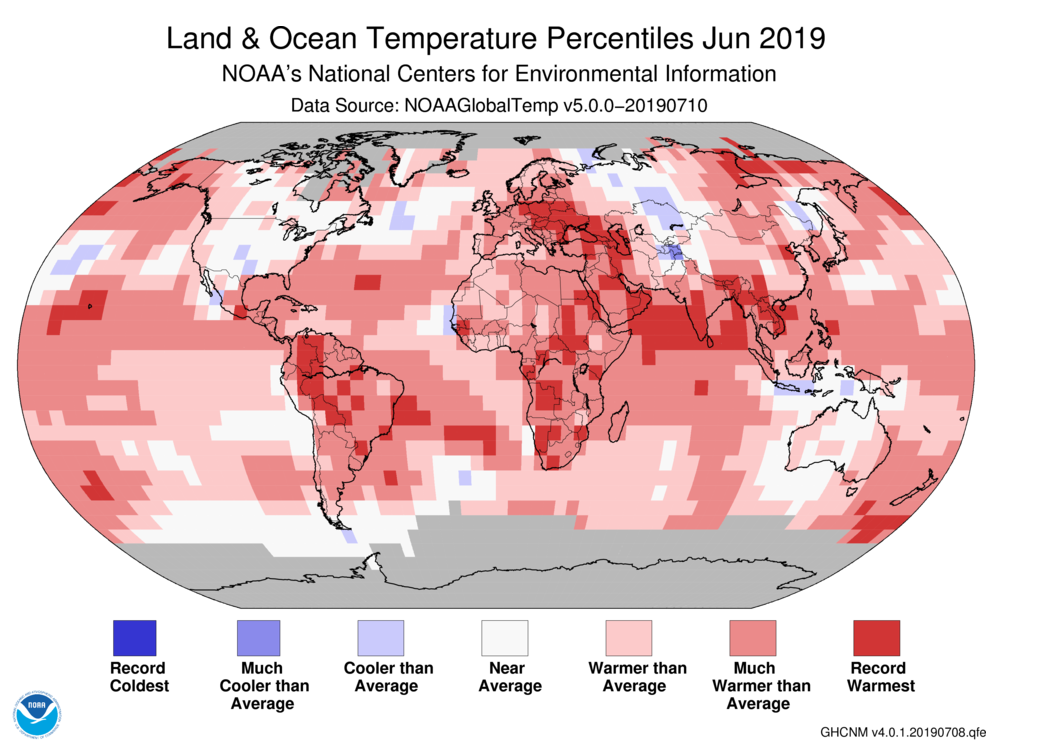
The global land and ocean surface temperature departure from average for June 2019 was the highest for the month of June in the 140-year NOAA global temperature dataset record, which dates back to 1880. The year-to-date temperature for 2019 was the second warmest January–June on record.

An annotated map of the world showing notable climate events that occurred around the world in June 2019.
This monthly summary, developed by scientists at NOAA National Centers for Environmental Information, is part of the suite of climate services NOAA provides to government, business, academia and the public to support informed decision-making.

June 2019 Temperature

LARGE IMAGE
The June temperature across global land and ocean surfaces was 1.71°F above the 20th century average of 59.9°F and was the highest for June in the 1880–2019 record. June 2019 bested the previous record set in 2016 by 0.04°F. 
  • Nine of the 10 warmest Junes have occurred since 2010. June 1998 is the only value from the previous century among the 10 warmest Junes on record, and it is currently ranked as the eighth warmest June on record.
  • June 2019 also marks the 43rd consecutive June and the 414th consecutive month with temperatures, at least nominally, above the 20th century average.
  • Record warm temperatures during June 2019 were present across parts of central and eastern Europe, northern Russia, Asia, Africa, South America, the north Indian Ocean, and across parts of the Pacific and Atlantic oceans. No land or ocean areas had record cold June temperatures.
The June globally averaged land surface temperature was 2.41°F above the 20th century average of 55.9°F. This value was also the highest June land temperature in the 140-year record, surpassing the previous record of +2.34°F set in 2015.
  • The most notable warm temperature departures from average were present across central and eastern Europe, north-central Russia, northeastern Canada and southern parts of South America, where temperatures were 3.6°F above the 1981–2010 average or higher. The most notable cooler-than-average temperatures were limited to parts of western Asia and Antarctica, where temperatures were at least 1.8°F below the 1981–2010 average or cooler. 
  • Regionally, South America, Europe, Africa, the Hawaiian region and the Gulf of Mexico had their warmest June in the 110-year record. Asia and the Caribbean region had their eighth and ninth highest June temperature since continental records began in 1910, respectively. Meanwhile, North America and Oceania had their coolest June since 2009 and 2012, respectively.
The June globally averaged sea surface temperature was 1.46°F above the 20th century monthly average of 61.5°F — tying with 2016 as the highest global ocean temperature for June on record. June 2019 also tied with August 2015, April 2016 and June 2016 as the 10th highest monthly global ocean temperature departure from average among all months (1,674 months) on record. The 10 highest global ocean monthly temperature departures from average have all occurred since September 2015.

Sea Ice and Snow Cover

LARGE IMAGE
June 2019 marked the 20th consecutive June with Arctic sea ice extent below average. This was the second smallest Arctic sea ice extent for June in the 41-year record at 475,000 square miles (10.5%) below the 1981–2010 average and 46,300 square miles above the record low set in June 2016, according to an analysis by the National Snow and Ice Data Center using data from NOAA and NASA. 
June 2019 marks the fourth consecutive June that the Antarctic sea ice extent was below average at 425,000 square miles (8.5%) below the 1981–2010 average. This was the smallest June extent in the 41-year record, surpassing the previous record set in 2002 by 62,000 square miles.

Year-to-date (January–June 2019)

LARGE IMAGE
The year-to-date temperature across global land and ocean surfaces was 1.71°F above the 20th century average of 56.3°F — tying with 2017 as the second highest for January–June in the 140-year record. Only January–June 2016 (+2.00°F) was warmer. 
  • The most notable warm temperature departures from average were present across parts of the Northern Hemisphere, specifically Alaska, western Canada and central Russia, where temperature departures from average were +5.4°F or higher. Meanwhile, the most notable cool temperature departures from average were present across much of the contiguous U.S. and southern Canada, where temperatures were at least 1.8°F below average or cooler.
  • Record-warm January–June temperatures were present across central South America, the southern half of Africa, New Zealand and its surrounding ocean, as well as parts of Alaska, western Canada, Mexico, the Bering Sea, the Atlantic Ocean, Madagascar and surrounding Indian Ocean, and across parts of eastern Asia. No land or ocean areas had record-cold temperatures during January–June 2019.
  • Regionally, five of six continents had a January–June temperature that ranked among the four highest such periods on record, with South America having its warmest year-to-date on record and Oceania having a near-record January-June temperature.
The year-to-date globally averaged land surface temperature was 2.68°F above the 20th century average of 45.0°F. This value was the third highest for January–June on record, behind 2016 (+3.35°F) and 2017 (+2.79°F).
The year-to-date globally averaged sea surface temperature was the second highest for January–June in the 1880–2019 record at 1.33°F above the 20th century average of 60.9°F. June 2016 (+1.51°F) was warmer.

Links

21/07/2019

Great Barrier Reef Authority Urges 'Fastest Possible Action' On Emissions

The Guardian - 

Great Barrier Reef Marine Park Authority says ‘further loss of coral is inevitable’
The Great Barrier Reef Marine Park Authority says it is ‘critical’ global temperature rises remain within 1.5 degrees. Photograph: Tory Chase
The federal agency that manages the Great Barrier Reef has made an unprecedented call for urgent action to reduce greenhouse gas emissions, warning only the “strongest and fastest possible action” will reduce the risks to the natural wonder.
The Great Barrier Reef Marine Park Authority has published a climate position statement that says the reef is already damaged from warming oceans and it is “critical” global temperature rises remain within 1.5 degrees.
The Coalition government has been criticised for overseeing four straight years of increases in national emissions and experts say it will not meet the country’s Paris target under current climate policy.
“Only the strongest and fastest possible action on climate change will reduce the risks and limit the impacts of climate change on the reef,” the authority said. “Further loss of coral is inevitable and can be minimised by limiting global temperature increase to the maximum extent possible.”
The climate statement was in development for more than a year and published late on Wednesday.
It says climate change is the single greatest threat to the reef and points to the “widespread impacts” already felt from back to back marine heatwaves in 2016 and 2017 that caused the mass wipe-out of corals.
“Of particular concern are projections that the reef could be affected by bleaching events twice per decade by about 2035 and annually by about 2044 if greenhouse gas emissions continue to increase at the current rate,” the authority said.
“If bleaching becomes more frequent and more intense, there will not be enough time for reefs to recover and persist as coral-dominated systems in their current form.”
The marine park authority’s statement says the reduction in emissions required for the reef to survive requires both national and international effort and an “urgent and critical” acceleration of policies to cut carbon pollution.
Any further increase in global temperatures will have “further negative impacts” for reef-dependent activities such as tourism, fishing and traditional use.
“These effects are likely to include loss of properties and infrastructure, loss of cultural and regional identity and, unless urgent action is taken, subsequent declines in regional economies,” the authority said.
Environment groups said on Thursday that such a clear statement from the government’s own agency should prompt the Morrison government to act faster to address the climate crisis.
Australia’s emissions have been rising since the repeal of the carbon price.
“The Great Barrier Reef is not dead yet, but the marine park authority makes it clear that it is already under stress from rising temperatures,” Christian Slattery, a campaigner for the Australian Conservation Foundation, said.
“As the marine park authority states, any additional increase in temperatures will have further devastating impacts on the reef and flow-on effects for tourism, fishing, recreation and traditional use.
“ACF urges the federal government to listen to the experts and treat this call to action with the seriousness and urgency it deserves.”
Imogen Zethoven, the strategic director at the Australian Marine Conservation Society, said the government’s $443m grant to the Great Barrier Reef Foundation would be “wasted unless the Morrison government takes radical action to drastically reduce greenhouse gas emissions to save our greatest natural icon and the jobs it supports”.
Any additional increase in temperatures will have further devastating impacts.
Australian Conservation Foundation
“The prime minister, a former managing director of Tourism Australia, knows how critical the reef is to the tourism industry and to Australia’s international reputation,” she said. “As the caretaker for the reef and a daily witness to its decline, GBRMPA is crying out for immediate action to reduce greenhouse gas emissions.”
After the May election, the prime minister, Scott Morrison, named Warren Entsch the special envoy for the Great Barrier Reef.
In an interview, Entsch said he wanted to focus on plastic waste and warned climate activists in northern Queensland had had a negative impact on the region’s economy.
Environment minister Sussan Ley said she accepted accept the scientific advice, “both that climate change is the biggest threat to the reef and that there are actions we can continue to take to build a more resilient reef.”
“The government is taking meaningful action to reduce global emissions and we investing $1.2bn in addressing threats such as water quality, marine litter and the crown of thorns star fish.”
In 2017, Australia avoided an “in danger” listing for the reef from Unesco’s world heritage committee.
But its status will be reassessed by Unesco next year and Australia must submit a state of conservation report to Unesco in December.
An outlook report for the reef from GBRMPA is also due soon.

Links

We Went To The Moon. Why Can’t We Solve Climate Change?

New York Times - John Schwartz

The original moon shoot inspired billions. Calling climate action a moon shot isn’t a perfect parallel — but maybe we should try it anyway.
Credit NASA/Reuters
Could a “moon shot” for climate change cool a warming planet?
Fifty years after humans first left bootprints in the lunar dust, it’s an enticing idea. The effort and the commitment of brainpower and money, and the glorious achievement itself, shine as an international example of what people can do when they set their minds to it. The spinoff technologies ended up affecting all of our lives.
So why not do it all over again — but instead of going to another astronomical body and planting a flag, why not save our own planet? Why not face it with the kind of inspiration that John F. Kennedy projected when he stood up at Rice University in 1962 and said “We choose to go to the moon,” and to do such things:
“ … not because they are easy, but because they are hard; because that goal will serve to organize and measure the best of our energies and skills, because that challenge is one that we are willing to accept, one we are unwilling to postpone, and one we intend to win …”


Credit Associated Press


But President Kennedy did not have to convince people that the moon existed. In our current political climate, the clear evidence that humans have generated greenhouse gases that are having a powerful effect on climate, and will have a greater effect into the future, has not moved the federal government to act with vigor. And a determined faction even argues that climate change is a hoax, as President Donald Trump has falsely stated at various times.
And the moon shot had a clearly defined goal: Land on the moon. A finish line for fighting climate change is less clear. Back to 350 parts per million of carbon dioxide in the atmosphere? (We have already passed 412 parts per million.)
Still, it should come as no surprise that Kennedy’s stirring words and accomplishments have made the idea of a moon shot one of the most enduring metaphors for our time. Roger Launius, a retired NASA chief historian and author of a new book, “Apollo’s Legacy: Perspectives on the Moon Landings,” said that “moon shot” has become shorthand for “a big push,” and it’s almost become a trope: ‘We need a ‘project Apollo for name-the-big-thing-of-your-choice’.”Climate change is certainly an urgent challenge. Rising levels of greenhouse gases are raising temperatures worldwide, leading to shifting weather patterns that are only expected to get worse, with increased flooding and heat waves, and drought and wildfires afflicting millions. The task of reversing that accumulation of greenhouse gases is vast, and progress is painfully slow.
The idea of a moon shot for climate has been gaining supporters. Beto O’Rourke and Kirsten Gillibrand use the idea in their presidential campaigns, as did Michael Bloomberg in unveiling his recently announced $500 million Beyond Carbon campaign. In a commencement speech this year at the Massachusetts Institute of Technology he said, “It is time for all of us to accept that climate change is the challenge of our time.” He concluded, “It may be a moon shot — but it’s the only shot we’ve got.”
Does the enduring metaphor fit the task of countering the grinding destructiveness of a warming planet?
Climate presents more complicated issues than getting to the moon did, said John M. Logsdon, historian of the space program and founder of the Space Policy Institute at George Washington University.
In 1970, Dr. Logsdon wrote a book, “The Decision to Go to the Moon,” that laid out four conditions that made Apollo possible. In the case of the space program, the stimulus was the first human spaceflight of the Russian cosmonaut Yuri A. Gagarin, which filled Americans with dread of losing the space race. In an interview, Dr. Logsdon said it has to be “a singular act that would force action, that you couldn’t ignore.” Other moon shot prerequisites, he said, include leaders in a position to direct the resources necessary to meet the goal on “a warlike basis,” with very deep national pockets — people like President Kennedy, who began the program, and Lyndon Johnson and Richard Nixon, who brought it to fruition.
Finally, Dr. Logsdon said, “the objective has to be technically feasible.” Scientists and engineers had told Mr. Kennedy that “there were no technical show stoppers in sending humans to the moon — it would just take a hell of a lot of engineering.”
What would be the “action-forcing stimulus” for a climate moon shot, he asked? He suggested it would have to be something deeply dramatic and immediate, like “Manhattan going under water.” What’s more, he noted, “Apollo did not require changing human behavior” as fighting climate change would, through the need for measures like carbon taxes or changes in consumption patterns.
One more important difference between sending people to the moon and solving a problem like climate change was cited in a recent editorial in the journal Nature, which noted that attempts to counter climate change have lobbyists fighting against them. The editorial said “for decades, energy corporations have stymied global efforts to make equitable reductions to greenhouse-gas emissions because such efforts would reduce their profits. Influential private companies are central to today’s Earth shots, but the historical moon shot approach will be ineffective if potential conflicts of interest are not addressed.”
Kate Marvel, a climate scientist at NASA’s Goddard Institute for Space Studies in New York City, lauded the inspiration that the moon shot provided, but said she had a less sweeping example of a good comparison to the challenge ahead: fixing the ozone hole. It required international cooperation, detailed in the Montreal Protocol of 1987, and a concerted effort of nearly 200 countries to rid the world of the chlorofluorocarbons that were damaging our atmospheric protection. “There are bumps on that road, but largely the ozone hole is on the road to recovery because of actions that humans took,” she said.
Yet she treasures a necklace that recreates the Apollo 11 trajectory from the Earth to the moon. “It’s incredibly nerdy,” she said, but it’s also a reminder of a national act that people think of “with nothing but good will.” And so, she said, comparing a climate push to the Apollo program makes a kind of sense. “Just because a metaphor is not exact,” she said, “doesn’t mean it’s not useful.”
If we did choose once again to do an important thing because it is hard, the task ahead would be more than technical, said Hal Harvey, chief executive of the research firm Energy Innovation. The deceptively simple goal, he said, should be to “decarbonize electricity, and then electrify everything.” That would involve building up renewable energy and dropping electrical generation from fossil fuel plants, and building up the use of technologies like heat pumps that can make home heating and cooling more efficient. China has invested heavily in electric buses, electric scooters, and other ways to stop burning fossil fuels. There are further advances in industrial processes and power systems engineering that will help, he said, ticking off a dizzying array of avenues that would allow society to reach those goals.
But mostly, he said, it will require a shift in national attitude.
“The moon shot technology we need is political will.”
Links

Former President Of Kiribati Tells SF To Step Up Fight As Climate Change Threatens To Swallow His Island Country

San Francisco Chronicle - 

This file photo taken on September 7, 2011 shows then Kiribati President Anote Tong in Auckland. Photo: AFP / Getty Images
Nestled in the middle of the Pacific Ocean is Kiribati — a country destined to be doomed, and eventually erased, by climate change. Scientists, the United Nations and even its former president, Anote Tong, all agree: The small island home to 116,000 people will be engulfed by rising sea levels.
It was shortly after taking office in 2003 that he realized the peril his country was in, Tong said in an interview with The Chronicle at the Fairmont hotel in San Francisco.
“The responsibility of my country fell squarely on my shoulders,” Tong said. “When the science started coming in, it was a matter of urgency.”
That science showed how “the results of sea level rise and increasing storm surge threaten the very existence and livelihoods of large segments of the population” in Kiribati, according to a United Nations report from August 2015.
In this March 30, 2004 file photo, Tarawa atoll, Kiribati, is seen in an aerial view. Photo: Richard Vogel / Associated Press
Tong would become renowned around the world as the man leading a country that could soon cease to geographically exist.
He’s in San Francisco this week to speak at the Climate and Ocean Conservation event at Salesforce Tower on Wednesday night. The event gathers CEOs and leaders from over 230 corporations to discuss and explore “climate resilience and ocean conservation.”
Tong caught the world’s attention when he purchased approximately 20 square kilometers of land in Fiji in 2014 — a purchase he describes as an “investment,” a place his people can migrate to just in case his people need it.
Some of Tong’s constituents were upset with him for suggesting an impending migration from their homeland.
“The media went on to extrapolate that I’m moving my people to Fiji, but I never, ever said that,” Tong said. “I had no plans to move people... but somebody else in the future might need to do it.”
The purchase also sent a worldwide message.
“It was a very loud statement to the international community,” Tong said. “They were not listening. And if you’re not listening, then you will never do anything for us.”
He’s now sending a statement to CEOs in the Bay Area, reminding them that companies can either be “complicit or helpful” in stopping the further warming of the planet.
Tong said one man does seem to be particularly silent and dismissive on the issue of climate change: President Trump.
“I’ve been disappointed by his lack of climate change initiative,” Tong said. “But he was elected... and people need to choose for themselves who they think will be strong on this.”
Since leaving office in 2016, he has spent his time speaking to leaders around the world on the global efforts needed to save countries like his own.
Tong said he admires the environmental awareness prevalent in San Francisco, but he said tech companies in Silicon Valley need to step up to expedite progress in combating climate change.
“This is a battle we’re in —a huge, unprecedented battle,” Tong said. “I wonder if these companies can use their resources to change our world for the better.”
When he visits cities like San Francisco, Tong said he sees potential to counteract the current administration’s policies.
“Your federal government isn’t helping, but that’s when cities like San Francisco and other states in your country step in,” Tong said.
In terms of specific changes he wants to see happen, Tong refers to the need for a rapid global response.
“Climate change is only now becoming known as a fight for the survival of humanity,” Tong said. “When I come here to speak, I also come here to inspire people to act quickly.”

Links

20/07/2019

One Climate Crisis Disaster Happening Every Week, UN Warns

The Guardian - 

Developing countries must prepare now for profound impact, disaster representative says
Aftermath of the damage left by Cyclone Kenneth in a village north of Pemba, Mozambique in May. Photograph: Mike Hutchings/Reuters 
Climate crisis disasters are happening at the rate of one a week, though most draw little international attention and work is urgently needed to prepare developing countries for the profound impacts, the UN has warned.
Catastrophes such as cyclones Idai and Kenneth in Mozambique and the drought afflicting India make headlines around the world. But large numbers of “lower impact events” that are causing death, displacement and suffering are occurring much faster than predicted, said Mami Mizutori, the UN secretary-general’s special representative on disaster risk reduction. “This is not about the future, this is about today.”
This means that adapting to the climate crisis could no longer be seen as a long-term problem, but one that needed investment now, she said. “People need to talk more about adaptation and resilience.”
Estimates put the cost of climate-related disasters at $520bn a year, while the additional cost of building infrastructure that is resistant to the effects of global heating is only about 3%, or $2.7tn in total over the next 20 years.
Mizutori said: “This is not a lot of money [in the context of infrastructure spending], but investors have not been doing enough. Resilience needs to become a commodity that people will pay for.” That would mean normalising the standards for new infrastructure, such as housing, road and rail networks, factories, power and water supply networks, so that they were less vulnerable to the effects of floods, droughts, storms and extreme weather.
Until now, most of the focus of work on the climate crisis has been on “mitigation” – jargon for cutting greenhouse gas emissions, and not to be confused with mitigating the effects of the climate crisis. The question of adapting to its effects has taken a distant second place, in part because activists and scientists were concerned for years that people would gain a false complacency that we need not cut emissions as we could adapt to the effects instead, and also because while cutting emissions could be clearly measured, the question of adapting or increasing resilience was harder to pin down.
Mizutori said the time for such arguments had ran out. “We talk about a climate emergency and a climate crisis, but if we cannot confront this [issue of adapting to the effects] we will not survive,” she told the Guardian. “We need to look at the risks of not investing in resilience.”
Many of the lower-impact disasters would be preventable if people had early warnings of severe weather, better infrastructure such as flood defences or access to water in case of drought, and governments had more awareness of which areas were most vulnerable.
Nor is this a problem confined to the developing world, she said, as the recent forest fires in the US and Europe’s latest heatwave had shown. Rich countries also face a challenge to adapt their infrastructure and ways of protecting people from disaster.
“Nature-based solutions”, such as mangrove swamps, forests and wetlands which could form natural barriers to flooding should be a priority, said Mizutori. A further key problem is how to protect people in informal settlements, or slums, which are more vulnerable than planned cities. The most vulnerable people are the poor, women, children, the elderly, the disabled and displaced, and many of these people live in informal settlements without access to basic amenities.
Regulations on building standards must also be updated for the climate crisis and properly enforced, she said. One of the governance issues cited by Mizutori was that while responsibility for the climate crisis and greenhouse gas emissions was usually held in one ministry, such as the economics, environment or energy department, responsibility for infrastructure and people’s protection was held elsewhere in government.
“We need to take a more holistic view of the risks,” she said.

Links

Lethal Heating is a citizens' initiative