14/09/2021

(AU SMH) News Corp About-Turn On Emissions Too Little, Too Late, Scientists Say

Sydney Morning Herald - Nick O'Malley | Amelia McGuire

Well before news broke that News Corp tabloids were to start promoting carbon emission reductions, rumours were spreading in the delicate ecosystem of Australian climate scientists, policy wonks and advocates.

Emails bounced around sharing titbits. Some reported fielding questions from unlikely quarters about 2050 net zero targets. Some were delighted, some sceptical and others downright distrustful.

Will not be muzzled: Sky News presenters Andrew Bolt, Tim Blair, Peta Credlin and Chris Kenny.

When The Sydney Morning Herald and The Age reported that News Corp papers were planning a climate push, it made news around the world.

Vanity Fair
asked if the apparent shift in the Australian mastheads might be reflected in the Murdoch empire’s US outlets such as Fox News and The Wall Street Journal.

The New York Times described to its readers News Corp’s Australian newspapers as places where “solid journalism often sits beside unrelenting ideology in articles that often do not carry an ‘opinion’ label”.

One of the Journal’s own former editors tweeted of the paper’s climate coverage, “No group has been more clueless, duplicitous or irresponsible on climate change than the WSJ edit and op-ed crew.”

He attached a string of climate sceptic headlines from the past six weeks.

It is hard to exaggerate how News Corp’s coverage of climate change – and of climate scientists themselves – have scarred the sector.

In his recent book The New Climate Wars, leading climatologist Michael Mann wrote that the company’s amplification of a false conspiracy known as “climategate” helped derail the Copenhagen climate summit in 2009, setting back global efforts to rein in warming by crucial years.

In Australia critics say the coverage has contributed to decades of policy inertia on the issue.

The headlines in the Murdoch papers were often brutal and sometimes brilliant.

 In February 2010, then climate change minister Penny Wong said Australia’s beaches could be eroded away over the coming century at a National Climate Change Forum. In response, the front page of The Australian read “Wong wipeout doesn’t wash with locals”.
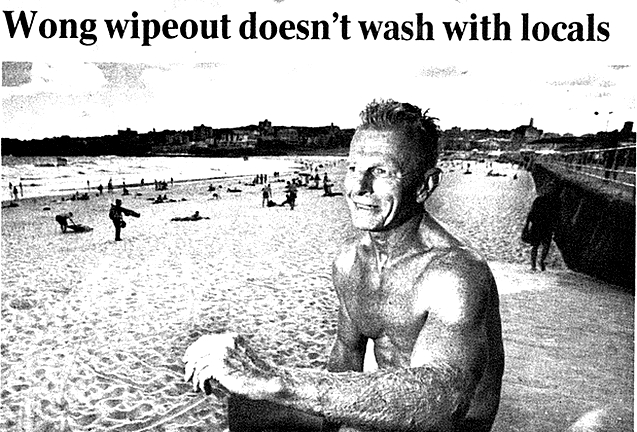

It quoted Bondi local Lee Boman who said he hadn’t noticed any sea level rise. It also featured Bondi regular Patrick Doab who said no one could predict how sea levels would change because it was “like the stock market”.

In 2011, Cate Blanchett was dubbed “Carbon Cate” on the front page of The Sunday Telegraph after fronting a TV campaign urging Australians to promote the Gillard government’s carbon tax. It positioned Blanchett as an out-of-touch millionaire and said then opposition leader Tony Abbott would “save” Australia from the tax. The tax was scrapped in July 2014.


In the lead-up to the 2019 federal election The Australian ran the headline “Carbon cut apocalypse: cost of the ALP energy plan”. The story quoted modelling by Brian Fisher that asserted Labor’s 45 per cent emissions reduction target would wipe $472 billion from the economy and drive electricity prices up by 50 per cent.


According to the Australia Institute, the modelling was a “complete outlier” compared to analysis of more than 20 other modelling exercises and Treasury models that found the economic impacts of high ambition targets small or negligible.

In December 2020, Wendy Bacon and Arunn Jegan analysed all news, features, opinion pieces, letters and editorials discussing climate change that appeared in The Daily Telegraph, Herald-Sun, Courier Mail and The Australian between April 2019 and March 2020.

They found 45 per cent of all coverage either rejected or cast doubt on consensus scientific findings. Their research asserted that most News Corp reporters do not promote sceptical views, but of 55 per cent of stories that accepted climate science, misunderstandings about that science were almost always promoted rather than explained, and the reporting on the effects of climate change was negligible.

It has been revealed UK Prime Minister Boris Johnson has bowed to pressure from the Morrison Government over climate change targets.

Half of the news and feature stories either had no source or one source.

Nearly two thirds of published opinion pieces were sceptical of climate science. The top five climate sceptics were Sky News presenters Andrew Bolt, Tim Blair, Peta Credlin, Peter Gleeson and Chris Kenny.

In a staff email obtained by The Sydney Morning Herald and The Age, News Corp Australia’s executive chairman Michael Miller told local staff that the company’s columnists and commentators would not be “muzzled” as part of their editorial campaign on climate change.

One media adviser at a leading environmental group this week said she believed slanted news coverage in News Corp was more dangerous than the commentary. “At least you know what you are getting in the opinion pages.”

One of the hallmarks of the coverage was that it was as willing to discredit the scientists as it was the science itself.

In one infamous instance the Daily Telegraph, the Herald-Sun and The Australian published stories attacking author and environmentalist Tim Flannery for buying a property near the waterfront north of Sydney.
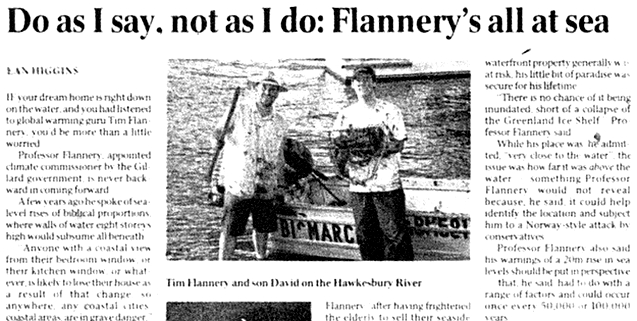

It did not matter that the house in question sat above the level of predicted sea-level rise, the coverage suggested that it proved climate change was a hoax and Flannery a hypocrite.

After one of the mastheads ran a story showing the home’s location Flannery was forced to take on extra security. He eventually won a retraction, an apology and legal costs.

Climate policy

It’s worth noting that the News Corp mastheads picked up the story from a segment on Ray Hadley’s show on 2GB, now a stablemate of this masthead.

According to Marian Wilkinson, whose recent book The Carbon Club is a forensic analysis of the interplay between the political, media and industry actors who have stalled action on climate in Australia for decades, News Corp’s coverage influenced other media in the country.

She believes even the ABC “pulled its punches” on climate coverage for fear it would look soft when compared with the Murdoch press’s hardline climate denialism.

Wilkinson is one of many who believe that Australian climate and energy policy has been rudderless for decades, but she does not blame News alone.

Rather she says the Murdoch empire helped derail climate action along with well-connected fossil fuel industry lobbyists and complicit politicians from both parties.

The result is the nation is now slowly engaging in the process of decarbonising its energy system, but years have been lost and billions of dollars of public money wasted, she says.

So far News Corp has not commented on – or denied – the coverage and its silence is being met with speculation. They did not respond to a request for comment about this article.

Wilkinson notes that if News Corp does shift its editorial stance it would be falling in line with the corporate and financial sectors and with major advertisers such as Woolworths and Coles.

Mann is one of many who note that such a move would also help solve a problem for Prime Minister Scott Morrison, who wants to announce a net zero target before or at the COP26 climate talks in Glasgow but faces trenchant opposition from some Nationals MPs.

“This may be more about giving Morrison cover going into an election year, by establishing the pathetically low bar of ‘net zero carbon by 2050’ as somehow constituting meaningful action, particularly given that he is being roundly criticised by the world community for his meager climate commitments going into COP26,” Mann said on Friday.

“‘Inactivists’ – polluters and politicians and media outlets such as News Corp that have enabled them – are moving away from outright denial because it’s no longer tenable.

“This is particularly true in Australia after having lived through the climate change-fuelled devastation of the Black Summer of 2019-20. Instead, as I describe in the book, they’ve turned to other tactics – delay, distraction, deflection, division, etc – in their effort to maintain the fossil fuel status quo.

“Focusing on a target of 2050, three decades away, kicks the can so far down the road that it’s largely meaningless.”

Though he welcomes the apparent shift in editorial direction, Flannery says the impact of its coverage extends beyond the politics of climate change.

He recalls meeting James Murdoch, who recently quit the company in part due to its climate coverage, at an awards dinner a decade or so ago.

“What you’ve done,” he told him, “is destroyed people’s faith in science, and that will play out in many ways and it will take many decades to undo that damage.”

Murdoch, he says, looked sheepish.

Links

(AU The Age) Australia Can Up Its 2030 Climate Change Target, But Will It Be Enough

The AgeMike Foley

Australia could exceed the carbon emission cuts required by the Paris Agreement, experts say, but it remains to been seen if the federal government’s climate action is ambitious enough to avoid dangerous global warming and international controversy.

Australia’s major trading partners are pressuring the federal government to match their goals ahead of the international climate change summit in Glasgow in November.

Australia is expected to increase its emissions reduction goals ahead of the Glasgow climate summit, but questions remain over whether it will be enough. Credit: Gareth Fuller/PA

Most wealthy nations have committed to cut emissions by about 50 per cent or more by 2030 and to reach net zero by 2050 at the latest. Australia has committed to a cut of 26 to 28 per cent by 2030, based on 2005 levels, with no deadline on net zero.

Energy and Emissions Reduction Minister Angus Taylor says Australia is on track to “meet and beat” the Paris target. The government will release an updated emissions reduction projection before the United Nations’ summit in Scotland.

Energy
Taylor adds carbon capture and storage to clean energy agency’s plans
Climate scientist and physicist Bill Hare, the director of policy analyst group Climate Action Tracker, said the federal government could release emissions reduction projections exceeding its goals.

“Australia could claim it was on track to reduce emissions by 28-30 per cent or slightly more by 2030,” Mr Hare said.

It could do so by raising the volume of renewable energy entering the power sector, along with the COVID-19 induced declines in industrial emissions, he said.

Renewable electricity gains would likely result from state government policies and businesses making new investments in the sector, he said.

Australian National University Climate Change Institute Professor Mark Howden said “emissions reduction targets are just the means to achieve the Paris goal”.

Australia would need to significantly increase its goals to be consistent with the global action required to limit warming to avoid the worst of climate change’s impacts.

Professor Howden said global emissions must fall 50 per cent by 2030 and reach net zero by about 2045 to limit warming to between 1.5 degrees and under 2 degrees.

“At a global level emissions have to reach net zero most likely by 2045, and we have to start reducing emissions very quickly right now,” Professor Howden said.

If global emissions continued to rise until 2050 and the world then miraculously went to net zero overnight, the build up of greenhouse gases would cause the temperature to rise for decades to come.

“Global emissions would need to fall by about 50 per cent by 2030 to limit a global temperature rise to less than 2 degrees,” Professor Howden said.

Coal
‘We’ll keep mining’: Australia resists climate policy pressure
Richie Merzian, climate and energy program director at the Australia Institute think tank and a former federal government international negotiator on climate policy, said “Australia will be called out at Glasgow” if it doesn’t match the commitments of countries like the US, UK, Japan and South Korea.

“Net zero is not even the bare minimum, it’s the entry fee,” he said. “All eyes will be on what countries are doing in the decisive decade, now, for 2030.”

The federal government’s “technology not taxes” is focused on investments in new technology to lower the cost of cleaner options including hydrogen, energy storage and green steel. The clean energy investment agency recently added soil carbon sequestration and carbon capture and storage to its priorities.

Mr Hare said there are no federal government policies mandating emissions reduction to spur speedy action, but a “comprehensive set of policies”, fuel efficiency standards for motor vehicles, more stringent building efficiency standards, phasing out the diesel rebate for mining companies and industry energy efficiency program could deliver big results, quickly.

Links

(AU SMH) Climate Damage Starting To Hit Us Where It Hurts - On The Beach

Sydney Morning HeraldMiki Perkins | Chloe Booker

Iain Harrison remembers clambering up the sandy dunes at the Inverloch surf beach when he was a toddler, more than 50 years ago. They were covered in spinifex and coastal daisies and when he made it to the top, there was a view of the sea.

When the Inverloch Surf Lifesaving Club was built a decade ago the dunes were still there, but now they have disappeared. In the eight years to 2020, the coastline in front of the club has moved landwards by about 50 metres, an average of about seven metres per year.

Inverloch Surf Lifesaving club President Warren Cook, pictured here with his daughter Jasmine. When the surf lifesaving club was built 10 years ago, it had no view of the sea but now the water is 30 metres from the door. Credit: Jason South

Mr Harrison is a member of the club and has always holidayed at Inverloch, 140 kilometres south-east of Melbourne.

He’s a horticulturist and has been aware of the scientific reality of global warming, and the accompanying sea level rise and intense weather, since the 1980s.

“I always thought I’d be outlived by the changes, but now they are accelerating and will have a major impact in the next 10 years,” he says.

“My greatest concern is how it will affect my two children, and what they are going to have to face.”


The club has lost two patrol towers to storms over the past few years and now uses a mobile tower that is towed onto the sand, says club president Warren Cook.

“We never used to have a view of the sea, but we’re now 30 metres from water’s edge at high tide.”

At nearby Anderson Inlet, also in Inverloch, the coastline has crept landwards by about 85 metres between 2006 and 2020.

Bass Coast Shire Council is part of a coalition of local councils in Melbourne’s south-east and regional areas urging the state government to take stronger action on climate action and sea level rise after experiencing significant erosion and storm damage.

Erosion next to the Kilcunda rail trail bike path

All this upheaval is expensive. In this financial year, Bass Coast Shire Council will spend $100,000 and pour 3000 cubic metres of sand onto a single area of beach at Inverloch. Next year, they’re budgeting for 4000 cubic metres.

And this is not limited to Inverloch, says the council, which is calling for greater state and federal support.

In a single year the coastline in front of the popular rail trail at Kilcunda, about 25 kilometres from Inverloch, has moved landwards by 14 metres, and the council has had to temporarily relocate this section of the trail further inland.

At Cowes East, on Phillip Island’s north shore, the sea has been kept at bay by regular top-ups of sand.


This year the council will build a 300-metre rock wall and eight timber barriers to secure the shoreline.

It has contributed $1.7 million and secured federal funding of $1.1 million, but it’s still about $1.6 million short and wants the state government to step in.

Simon Woodland, Bass Council’s manager for sustainable environment, says the area’s 40 kilometres of sandy coastline have always been dynamic, but climate change is ratcheting up the storm intensity that drives sand movement and the baseline sea level that underpins it.

“We often talk about climate change in terms of impacts on future generations but what we need to get our heads around is that we are the future generations, dealing with the consequences of decisions that were made for us decades ago,” he said.


“We’ve developed to the coastline in so many places and local councils are on the front line, facing ever-escalating challenges with the least resources of any tier of government.”

The sea level is projected to rise about 24 centimetres across Victoria by the 2050s. Geomorphologist David Kennedy, from the University of Melbourne, says climate change is also causing more intense storms, ocean surges and wind.

Victoria has also experienced a change in wind direction, meaning waves are, on average, travelling 2 or 3 degrees in a more westerly direction, which is starting to shift the sand on the state’s beaches, he says.

Planning for sea level rise needs an integrated, statewide approach or Victoria will end up with a highly-engineered coastline like Japan, Associate Professor Kennedy says. “We live in a dynamic zone, and it will become more dynamic in the future.”

Erosion at Cowes East

Bayside, which takes in Black Rock, Hampton and Sandringham, has one of the more thorough plans for addressing climate change. It plans to build a sea wall at Brighton and use fencing, sandbags and path closures to address erosion along its coastline, including protecting its iconic beachboxes.

“In the absence of broader leadership, councils, and the communities they represent, are at the frontline of dealing with climate change impacts,” says Bayside mayor Laurence Evans.

Mr Woodland says coastal councils across Victoria will be forced to have difficult conversations with residents about which developments are “defendable” against inevitable sea level change over decades.

“A lot of focus goes to protecting the built assets like roads and buildings behind the foreshore, but the foreshore itself holds all sorts of values, from wildlife habitat to culturally significant sites that date back thousands of years.”

Beach erosion locations on the Bass Coast


A spokesperson for the Victorian government said it had invested more than $60 million in marine and coastal projects since 2014.

“We continue to work with local councils on coastal adaptation plans which help protect Crown land and critical infrastructure from the impacts of storm surge, wave attack and rising sea levels.”

The state government is developing a Cape to Cape Resilience Project, which will study the impact of rising sea levels and changing wind and wave climates on the coastal area between Cape Paterson and Cape Liptrap.

Links

13/09/2021

(UK The Conversation) Climate Change: Ditch 90% Of World’s Coal And 60% Of Oil And Gas To Limit Warming To 1.5°C – Experts

The Conversation - | |

Evgenii Parilov/Alamy Stock Photo

Authors
  • is a PhD Candidate in Energy Systems, University College London
  • is a Senior Research Associate in Energy, University College London
  • is an Associate Professor in Energy Systems, University College London
Global mean surface temperatures reached 1.2°C above the pre-industrial average in 2020, and the Intergovernmental Panel on Climate Change warned in its recent report that Earth could hit 1.5°C in as little as a decade.

The 0.3°C separating these two temperatures make a world of difference.

Scientists believe that stabilising our warming world’s temperature at 1.5°C could help avoid the most serious effects of climate change.

Fossil fuels such as coal, oil and natural gas are the source of just over 80% of the world’s energy. Burning them accounts for 89% of human-derived CO₂ emissions.

To avert catastrophic warming, the global community must rapidly reduce how much of these fuels it extracts and burns. Our new paper, published in Nature, revealed just how tight the world’s remaining carbon budget is likely to be.

In order to hold global warming at 1.5°C, we found that nearly 60% of global oil and fossil gas reserves will need to remain in the ground in 2050. Almost all of the world’s coal – 90% – will need to be spared from factory and power plant furnaces.

Our analysis also showed that global oil and gas production must peak immediately and fall by 3% each year until mid-century.

Fossil fuels still provide most of the world’s energy. Rudmer Zwerver/Shutterstock

Even meeting these stringent limits may not be enough on its own to stabilise global warming at 1.5°C, however.

That’s because we based our estimates on a carbon budget compatible with just a 50% probability of limiting warming to 1.5°C.

Our model simply could not be pushed to a greater chance of achieving the 1.5C target because it was already at its limit, given our projections of fossil fuel demand in the near future.

Our analysis also relies on the large-scale deployment of technologies capable of removing CO₂ from the atmosphere sometime in the future.

By 2050, our scenario expects around four gigatonnes a year will be being captured by so-called negative emission technologies.

There remains a lot of doubt about whether it is even possible to sufficiently scale these technologies up in time.

So, to aim for a better chance of achieving the Paris Agreement’s goal and to lower the risk of relying on as yet unproven technologies, we argue that our estimates of how much of the world’s fossil fuels cannot safely be extracted should be treated as cautious underestimates. The world may need to be even more ambitious.

Fossil fuel rationing

We estimated how much fossil fuel production in each region must fall and how fast based on a global energy system model.

We allocated the remaining shares of fossil fuel production allowed within the budget based on the costs and carbon intensity of producing different oil and gas assets, and how cheap low and zero-carbon technologies are in different parts of the world.

Our analysis showed that total fossil fuel production is limited by a global carbon budget. Production growing in one region of the world will require a decrease in another to keep the global trajectory pointing downwards.

A mechanism such as the Global Fossil Fuel Registry – a public database of all known reserves – could provide the necessary transparency for an international effort, with the cooperation of governments and fossil fuel producers.

The US and Russia sit on half of the world’s coal but must leave 97% of it in the ground. Australia, which recently pledged to keep producing and exporting coal beyond 2030, would need to keep 95% of its reserves underground.

Oil-producing states in the Middle East must not extract around two-thirds of their reserves, while most of Canada’s tar sand oil must not be burned, along with all of the fossil fuel buried beneath the Arctic.

Our analysis suggests that many countries will need to move out of fossil fuel production relatively quickly, which raises concerns about how the transition can be managed fairly. Countries such as Iraq and Angola have a high dependency on fossil fuels for government revenues.

They will need support to diversify their economies in a managed way – including financial and technological assistance to develop new low-carbon industries – and to decarbonise domestically to reduce their own reliance on fossil fuels.

Fossil fuel production must fall most sharply in wealthier countries like the US. Robert Coy/Alamy Stock Photo

The necessary energy transformation highlighted in this research will require a range of policy levers, including measures that drive down fossil fuel consumption, such as banning petrol cars or promoting renewable electricity generation, and those targeting production itself, including restrictions on new fossil fuel extraction licenses.

Alliances between countries are also likely to be important to build political support for reducing fossil fuel production. The Beyond Oil and Gas Alliance, formed by Denmark and Costa Rica, has pressured other countries to halt investment in new oil and gas projects.

Phasing out global fossil fuel production at the rate suggested in our study is possible, but it will rely on some of the measures we’ve described expanding and gaining the support of large producing countries and companies – those which have benefited most from the fossil fuel era.

Links

(BBC) Climate Change: Vulnerable Nations Call For 'Emergency Pact'

BBC News - Matt McGrath

Image source Getty Images

The countries most vulnerable to climate change are calling for an "emergency pact" to tackle rising temperatures.

The group wants all countries to agree radical steps to avoid "climate catastrophe" at the upcoming COP26 meeting in Glasgow.

Green campaigners are urging a postponement of the gathering, citing problems with vaccines for delegates.

The Climate Vulnerable Forum (CVF) says the event is critical and cannot wait.

Representing some 1.2 billion people, the CVF consists of countries in Africa, Asia, the Caribbean, Latin America and the Pacific.

The group has been key in pushing the rest of the world to accept the idea of keeping the rise in global temperatures to under 1.5C this century.

This was incorporated into the Paris agreement in 2015.

Recent research from the Intergovernmental Panel on Climate Change suggests that the threshold will be passed in little over a decade at current rates of carbon emissions.

In less than two months, global leaders will gather in Glasgow for COP26, the most critical meeting on climate change since Paris.

Ahead of the Glasgow meeting, the CVF has issued a manifesto for what the conference must deliver to keep the planet safe and protect the most vulnerable.

Environmental groups have suggested postponing the meeting, on the grounds that vaccine distribution is inequitable and that delegates from poorer countries face huge bills for quarantine hotels when they arrive in the UK.

In Bangladesh, erosion continues as river levels keep rising. Image source EPA

However, the CVF member states insist the meeting must go ahead in person, and are calling for support and "facilitated access" to ensure inclusive participation.

The UK government has responded to these calls by agreeing to pay the quarantine hotel expenses of any delegate, observer or media from a developing country.

The vulnerable group says that progress on climate change has stalled and COP26 should move forward with what it terms a "climate emergency pact".

This would see every country put forward a new climate plan every year between now and 2025.

At present, signatories of the Paris agreement are only obliged to put forward new plans every five years.

The vulnerable nations say that richer countries must fulfil their obligations to deliver $100bn in climate finance per year over the 2020-24 period.

A man watches as the sea rushes in on the Marshall Islands. Image source Getty Images

The CVF nations want this money to be split 50-50 between cutting carbon and helping countries adapt to the threat posed by rising temperatures.

The countries also want the UK to "take full responsibility" for this aspect of the negotiations, saying it is vital to restore confidence in the Paris pact.

Among the other areas that the most vulnerable nations want to see progress on is the question of debt-for-climate swaps.

Many of the world's poorest countries have large debt burdens, and these have been exacerbated by the Covid-19 pandemic which has stretched finances even further.

In a debt-for-climate swap, a country can reduce what it owes to international creditors by directing the debt service payments to fund renewable energy or greater protection for nature.

Many campaigners have argued that the COP26 meeting should be postponed. Image source Getty Images

Many campaigners have argued that the COP26 meeting should be postponed.

One such restructuring was recently announced by Belize where the debt money will now go to support marine conservation projects instead.

"Vulnerable countries have unique needs - and public-private collaboration will be key to addressing them," said Nigel Topping, who's the UK's high-level climate action champion for COP26.

"Whether it is in debt for nature swaps such as the recent Belize announcement or in increasing public sector capability to structure investment projects to attract private finance, the aim is to accelerate progress in this area so that 2022 becomes the year of climate action solidarity."

Links

(NPR) Climate Change Is Making Natural Disasters Worse — Along With Our Mental Health

NPR

Crews set a backfire in an effort to gain control of the massive Caldor fire near the Tahoe basin in California on Aug. 26. Ty O'Neil/SOPA Images/LightRocket/Getty Images

Through fires and hurricanes, through lethal heat waves and flash floods, the world seems to be ending — or at least, that's what it feels like.

All around us, we're seeing the effects of climate change. Wildfires are raging through the West. Much of southeast Louisiana was flattened by Hurricane Ida, and parts of New York and New Jersey are digging out from disastrous flooding.

And if it seems like natural disasters are happening more and more often, that's because they are: Climate change has helped drive a fivefold increase in the number of weather-related disasters in the last 50 years. Climate change means disasters are happening simultaneously, too.

These disasters are getting more severe, too. Weather records are being broken thanks to climate change turning previously impossible occurrences into startling realities.

Environment
First Step To 'Eco-Grieving' Over Climate Change? Admit There's A Problem

As a result, many people are dealing with what's commonly referred to as "eco grief," a type of mental exhaustion that stems from accepting the harsh realities of climate change and feeling overwhelmed or hopeless.

Added to that is "disaster fatigue," another type of emotional tiredness that comes from dealing with an abundance of bad news and steadily occurring crises — like near-constant headlines of devastating disasters.

Jeffrey Garcia, an engineer living in Glen Burnie, Md., has grown up with an awareness of ecological problems thanks to a childhood spent in Albuquerque, N.M., where drought is a persistent specter, he said.

Today, he, like many others, is still troubled by what he sees as "cascading issues" and while he understands the nuance — the world isn't going to immediately burn down — there's still a persistent sense of dread, he explained to NPR. One that he tries to combat with knowledge and action.

"The voice of anxiety feeds on exaggeration and hyperbole. And while it is easy to feel that flash of fear ... there's over 7 billion people on this planet that all have a vested interest in [the worst] not happening," he said.

Environment
Should We Be Having Kids In The Age Of Climate Change?

Still, the instability of that future has led Garcia and his wife to reconsider whether to have children.

It's a sentiment that he's not alone in; Katie Oran, a 25-year-old wildfire planner working in Sacramento, Calif., feels much the same way.

"I think almost every single one of my friends, none of us want to have children," Oran said.

"Just because thinking about bringing children into an uncertain future doesn't necessarily seem fair. We talk a lot about where we should move, where is safe ... I don't really know if anywhere is safe [though]."

The string of disasters is making us anxious

If you're worried about the environment, you aren't alone. A poll conducted by the American Psychiatric Association last year showed that nearly 70% of adults in the country are at least somewhat anxious about what climate change will do to the planet, and slightly more than half are worried about what toll that will take on their mental health.

On Sept. 3, a motorist drives past houses damaged by Hurricane Ida in Grand Isle, La. Ida made landfall as a Category 4 hurricane, causing flooding, wind damage and power outages along the Gulf Coast. Sean Rayford/Getty Images

"We are burned out and our resilience is really down," Lise Van Susteren, a psychiatrist, author and environmental activist, told NPR. "It's making us raw to all of these new challenges that we face. They're coming too fast, too furious, and too many."

Life Kit
Good Anxiety Does Exist. Here's How You Can Benefit From It
An unfortunate side effect of being informed are the emotions, like helplessness, that come alongside that knowledge.

Some, like members of a climate change support group in Salt Lake City, deal with those feelings by banding together. But it's harder for people like Oran, whose jobs give them a front-row seat to the worst of what's happening to the planet.

It's scary, Oran said, not knowing exactly what will come next.

"There's a lot of unknowns about how already-occurring natural disasters will get worse, whether it's flooding or hurricanes, droughts, heat waves, wildfires, and so I think that with the unknowns and uncertainty, it's difficult to plan for the future," she said.

"And I think that we can work as hard as we can to retrofit homes and to build with non-combustible materials and to create defensible space around homes. But fire will come."

Taking action may be the answer — not just for the planet but for your mind

Worsening mental health amid ongoing disasters is something that's on the radar for mental health providers, too, Van Susteren says.

"We know that if we don't tend to what people are feeling, that they will turn inward on this and they will find themselves increasingly alone and under siege themselves internally," she said. "I've said as bad as the storms are outside, the storms inside are even worse."

The effects of climate change that we're seeing are already mentally draining (and for many who live in affected areas, directly damaging), but unfortunately, experiencing these natural disasters amid an ongoing global pandemic is exacerbating the situation. As Van Susteren explained, "The pandemic has made us more raw."

Climate
Enough With The Climate Jargon: Scientists Aim For Clearer Messages On Global Warming
As with any mental health problem, seeking professional support is encouraged whenever possible. Thankfully, there are therapists who specialize in climate anxiety, who can be found on directories — like this one — listing "climate-aware" mental health professionals.

Another solution? Action, however small, is a good way to start. Van Susteren suggests focusing on the three P's: personal, professional and political.

Reflecting on what you can do personally to combat climate change can mean examining your own carbon footprint and ways to lessen it.

Professionally, you can connect with those you work with to raise awareness and make changes at your workplace.

And finally, there's always work to be done politically.

"That means that we're all now charged with being enlightened citizens who can change leadership," Susteren explained. "Someone wise once said when the people lead, the leaders will follow. We need to make sure that elected officials who understand what we're up against are writing policy that reflects it."

Even in the midst of what feels like a burning world, there's always something you can do.

Links

12/09/2021

(Vox) What’s The Worst That Could Happen?

Vox

These five climate scenarios show us what the future of the planet could look like.

Extreme heat and dry weather created the conditions for massive wildfires around the world, like the blazes that torched Greece in August. STR/NurPhoto via Getty Images

How bad could climate change get?

Humans have already warmed the planet by at least 1 degree Celsius by burning fossil fuels that spew heat-trapping gases into the sky.

The oceans are rising, and deadly disasters like wildfires, heat waves, and flooding are becoming more destructive. Almost every part of the world is experiencing the effects of climate change.

That much is “unequivocal,” according to the latest report from the Intergovernmental Panel on Climate Change (IPCC), an international team of scientists convened by the United Nations.

What’s far less certain is just how bleak the future of our planet will be.

This critical question reaches beyond physical sciences into economics, sociology, and even psychology. Humans still have the power to slow the climate crisis — though with each day that goes by without sweeping societal changes to slash emissions, the outlook grows more grim.

The first installment of the IPCC’s sixth assessment report, which focuses on the physical science behind climate change, considers five scenarios that game out how humanity will respond, or not, to the specter of warming.

They reveal that some of the more extreme projections of the past are less likely to come to fruition. But every scenario in the report also overshoots one of the targets of the 2015 Paris climate agreement.

A best-case scenario now requires drastically more climate action than the world has achieved to date, and the window for action is closing.

However, “Scenarios are not predictions,” the report says. “Instead, they provide a ‘what-if’ investigation of the implications of various developments and actions.”

In short, these scenarios show how scientists are grappling with the capriciousness of human behavior. What happens if more countries are taken over by nationalists? Or if clean technology makes a radical leap forward? Or if countries and corporations actually start to buckle down and throttle emissions?

Our planet has many possible futures that depend on human decisions. These visions of tomorrow emphasize that we have profoundly and irreversibly changed the world, but also that much of the potential warming is still in our hands.

Five stories about the future of our climate, explained

Read between the many lines of the nearly 4,000-page IPCC report and you will see that it actually tells five different stories about the future, complete with their own little narratives.

Here’s the backdrop for these stories: The planet is undergoing a massive, uncontrolled experiment, rapidly revealing what happens when 2.6 million pounds of carbon dioxide per second (and still rising) are added to the atmosphere. All of humanity is participating in this experiment, whether directly contributing to it or feeling its impacts.

But it’s an immensely frustrating experiment because the subjects (all of us) are constantly messing with the controls. How much more Earth will warm up in the coming century hinges on what people will do. And what people are doing is changing.

It’s increasingly clear that many of the factors that helped bring the world to the current point will not persist into the future — unchecked population growth, a massive surge in coal mining, too few clean energy options.

With the 2015 Paris climate agreement, countries agreed in principle to limit warming this century to less than 2°C, with an additional target of staying below 1.5°C. These goalposts didn’t exist when the IPCC put out its last comprehensive report in 2013.

And with improvements in measurement, simulations, and studies of the historical climate, researchers have a much better grasp of climate sensitivity — the range of expected warming if carbon dioxide levels in the atmosphere were to double, compared to their levels in the 19th century.

For decades, the best estimate for climate sensitivity ranged between 1.5°C and 4.5°C. Now scientists set the range between 2.5°C and 4°C, with 3°C as the most likely value.

After honing down how the planet will respond to carbon dioxide, the next step is to figure out how much carbon dioxide will be emitted. To do this, scientists have imagined how humanity will progress from here on out.

They’ve considered population growth, advances in clean energy, and an observer effect, in which alarming climate science spurs action to limit greenhouse gas emissions.

Their five stories are known as shared socioeconomic pathways (SSPs), each of which makes different assumptions about shifts in policy, economics, and technology.

Here are the scenarios in the latest report:

1) SSP1-1.9 — This scenario has been described as “taking the green road.” It’s the most ambitious and hardest-to-achieve storyline.

It envisions a gradual but concerted shift toward clean energy, with few political barriers in adapting to and mitigating climate change.

This entails a rapid drawdown of fossil fuels, widespread deployment of clean energy, increasing energy efficiency, and lower resource demands. By the middle of the century, humanity will zero out its contributions to climate change.

This scenario also assumes inclusive global development that lifts all countries. It imagines improvements in education and health that would help stabilize population growth, with the total declining slightly to 7 billion people.

To create this future, humans would likely need to achieve a global philosophical shift away from the pursuit of economic growth and toward improvements in human well-being.

While every scenario in the new IPCC report will likely overshoot the 1.5°C target, under SSP1-1.9, global average temperatures would eventually decline below this level by 2100.

It’s also worth noting that 1.5°C of warming is no picnic; that’s still warmer than the world is today, leading to effects like increasing the frequency and intensity of heat waves and extreme rainfall.


Global surface temperatures vary widely under different emissions pathways. IPCC


2) SSP1-2.6 — This pathway envisions that the world will eventually get its act together on climate change, but more slowly than in the optimistic path of SSP1-1.9.

It envisions an economy with net-zero emissions after 2050. SSP1-2.6 also expects the global population to reach 7 billion people. The result is a world that will warm up to 1.8°C, with a likely range between 1.3°C and 2.4°C by 2100.

It may not seem like much, but this increase in warming compared to SSP1-1.9 has major ripple effects.

Sea levels will have risen between 30 and 54 centimeters by the end of the century, up from the 24 cm of rise that has already occurred. That would inundate major coastal metropolises on a regular basis and put another 10 million people around the world at risk from coastal flooding.

A world with 2°C of warming would double the number of people exposed to extreme heat compared to a 1.5°C scenario. And every additional bit of warming would bring more environmental declines and exposure to climate hazards.

3) SSP2-4.5 — Sometimes described as “middle of the road,” this scenario lines up with what countries have pledged to do so far about climate change.

If every country actually fulfilled its existing obligations, their emissions would lead to about 2.7°C of warming by 2100, with a likely range between 2.1°C and 3.5°C.

Under this scenario, the Arctic Ocean would likely be ice-free in the summer, which could have ripple effects on weather all over the world.

On top of the devastating effects in the first two scenarios, scientists expect that 3°C of warming would cause a significant drop in global food production, far more extreme heat, and more devastating flooding from extreme rainfall.

This storyline presumes that future global development patterns will not radically shift from historical trends. Inequalities will still persist between countries and development will be slow, but there will be international cooperation on environmental goals. The global population in this scenario would peak at 9.6 billion people.

4) SSP3-7.0 — In this narrative, nationalism is resurgent and countries retreat from international cooperation, focusing instead on their own economic goals.

“I sort of jokingly refer to this as Trumpworld,” said Zeke Hausfather, director of climate and energy at the Breakthrough Institute and a contributing author to the latest IPCC report.

“It’s a reasonable storyline for what a worst-case world could look like.”

This would lead to countries exploiting their own fossil fuels resources more.

Investments in education and technological development would decline.

Population growth would slow in industrialized countries but remain high in developing countries, with the total reaching 12.6 billion people.

Solving climate change would become a low international priority.

SSP3-7.0 also accounts for high levels of heat-trapping gases, other than carbon dioxide, including aerosols and methane.

By the end of the century, sea levels will have risen catastrophically — between 46 cm and 74 cm in this scenario — and the world will have warmed by roughly 3.6°C, with a range between 2.8°C and 4.6°C.

Fortunately, this scenario is on the fringes of what’s plausible, scientists say. “That’s not the world we’re heading toward right now, but it’s certainly a world you could see happening,” Hausfather said.

5) SSP5-8.5 — Imagine a world where humanity doesn’t just do nothing about climate change but continues to make it worse.

This scenario envisions global economic growth across the board fueled by burning coal, oil, and natural gas, with the planet’s population leveling off at 7 billion people.

While resources are devoted to adapting to climate change, there is little effort to mitigate emissions.

The net result would be 4.4°C of warming, with a range between 3.3°C and 5.7°C. As if large-scale coastal inundation and extremely destructive weather weren’t enough, parts of the planet would become unlivable during the hottest times of the year.

This odd combination of assumptions and results makes this the most dire but one of the least plausible scenarios. However, it helps scientists probe the upper limits of their models.

Why the IPCC decided on these particular storylines

The five SSPs in the new IPCC report are sorted based on the level of “radiative forcing” — how much energy the atmosphere would trap by the end of the century, in watts per square meter.

So the SSP1-1.9 pathway is expected to cause 1.9 watts per square meter of radiative forcing by 2100. Radiative forcing is directly related to how much the planet will heat up on average.

These scenarios were developed in the wake of the 2015 Paris climate agreement.

That’s when nearly every country in the world agreed to limit warming this century to less than 2°C above pre-industrial levels, with a high-bar target of keeping warming below 1.5°C.

SSPs consider what humans need to do to meet those goals — and they also account for changes in technology, like rapidly falling prices of renewable energy, which hadn’t yet occurred when the IPCC published its last assessment report in 2013.

The low-end scenarios are meant to illustrate what would happen if the world actually did meet its climate objectives.

Climate models then digest the assumptions in each of these scenarios to yield estimates of how the climate will change under each one.

It’s important to remember that these scenarios are not exact forecasts of the future.

The scientists who created them are not making judgments about which ones are most likely to come to pass.

“We do not consider the degree of realism of any one scenario,” said Amanda Maycock, an associate professor of climate dynamics at the University of Leeds and an author of the future climate scenarios chapter, in an email.

SSPs are meant to illustrate the mechanisms of climate change, factoring in human decisions that will determine the scale of the problem.

How should people plan for the future under climate change?

In all of these potential futures, climate change will continue for years to come. Decades of past pollution, and our ongoing reliance on fossil fuels, are already baked in.

“If we would bring down our CO2 emissions to zero today, there would be no further warming from CO2 — but of course that is impossible,” said Joeri Rogelj, director of research at the Grantham Institute at Imperial College London and an IPCC author.

Even the most aggressive climate action would lead to a phase-out over time, not a sudden end to emissions. “There is only that steep a pathway we can follow until we get to zero emissions,” he added.

But humans still have the power to determine the longer-term path. Right now, the world is somewhere between scenario 3 (SSP2-4.5) and scenario 4 (SSP3-7.0).

“The five illustrative scenarios behave quite similarly over the next 20 years (2021-2040) with average global temperature anomalies differing by less than one-tenth of a degree,” said Maycock. “By mid-century (2041-2060) the scenarios start to diverge more strongly.”

Water levels in California’s Lake Oroville reached record lows this year amid extreme heat and a massive drought, threatening hydroelectric power production. Justin Sullivan/Getty Images

These scenarios reveal just how much of a challenge it will be for the world to change course.

It will require seismic shifts across the global economy and will take years to yield results. Yet many decisions about the future (where to build homes, how much food to grow, what places are no longer livable) have to be made today. That’s where it can be useful to have a range of possibilities.

A more dire future could result from a reversal of many climate change policies currently in place. On the other hand, moving to a lower emissions trajectory would require drastic reductions in greenhouse gas emissions.

In 2018, the IPCC looked specifically at what it would take to limit warming to less than 1.5°C, the high-ambition target under the Paris climate agreement.

They found that global emissions would have to plummet by more than 50 percent from where they are now by 2030.

But this possibility is getting less and less likely: Since that report, greenhouse gas emissions have only grown, and atmospheric concentrations of carbon dioxide reached record highs.

The biggest obstacles to rapidly reducing warming are not laws of nature, but the modern fossil fuel-dependent economy humanity has constructed for itself. “This warming is not really because of inertia in the physical system, but rather inertia in how quickly we can bring down emissions to zero,” said Rogelj.

So how can people prepare for the future?

The most prudent course of action is to work toward the best-case scenario while preparing for some of the worst consequences of climate change.

The low-end scenarios, like scenario 1 (SSP1-1.9), illustrate the minimum amount of warming the world will have to endure.

The middle pathways align roughly with the current trajectory of greenhouse gas emissions.

The high-emissions storylines are much less likely, but they are not impossible. There could be feedback loops or tipping points in the global climate system that scientists have yet to uncover, which could accelerate warming beyond what’s expected with humanity’s emissions.

So future warming past 4°C, which would lead to truly catastrophic consequences, cannot be completely ruled out.

The storylines themselves should also serve as motivation to aggressively limit climate change. The differences between them highlight that there are immense dividends for lowering greenhouse gas emissions, and severe consequences for failing to do so.

Even small increases in warming are consequential, and the impacts of climate change are already visible today in phenomena like melting ice caps, rising sea levels, and more destructive extreme weather.

But the flip side is that all efforts to mitigate climate change are meaningful, even if the world overshoots its targets.

All the warming that’s avoided will save lives and property and will enhance human welfare.

There may be a point of no return, but there is no point at which our actions don’t matter.

Links

Lethal Heating is a citizens' initiative