10/03/2025

Women and girls are on the frontline of climate change – but their stories are seldom heard

Jacob Lund/Shutterstock

The Conversation -

AUTHOR
PhD Candidate in Journalism
City St George's
University of London
Women and girls are disproportionately affected by the climate crisis.

In 2024, I reported on a heatwave in Iran where temperatures exceeded 50°C in some provinces. Through “off-the-record” conversations, I learned that the extreme heat was causing women to suffer heatstroke, menstrual problems, even miscarriages.

Yet, when I analysed the media coverage, there was little mention of this. Most articles focused on how the government had to shut down schools and offices.

I reached out to women in different parts of Iran, including mothers, students and medical professionals. Some spoke to me anonymously, but even women in leadership positions within the government or environment sector wouldn’t talk for fear of a reaction from the state intelligence apparatus.

This is a pattern I’ve seen throughout my research and reporting. If women cannot safely speak out, their struggles remain invisible.

Women are leading, but where’s the coverage?

Here’s the irony: while women are missing from climate reporting, they are in fact leading many environmental efforts. Evidence suggests that women are more likely than men to volunteer for environmental causes or act in an environmentally friendly way, for example. Countries with more women in political leadership tend to have stronger climate policies.

Though, there is some imbalance in media coverage of women too. 

For example, Swedish activist Greta Thunberg has been recognised in media consumed mostly in wealthier countries in Europe, North America and Australasia (what is often called the global north). But in Asia, Africa and Latin America (often called the global south) where climate change is hitting hardest, I have found women leading environmental movements rarely get the same level of attention.

This is despite the fact there are numerous women environmental leaders in this part of the world. 

In Iran, wildlife and conservation activists Niloufar Bayani and Sepideh Kashani were imprisoned and tortured for over six years after being falsely accused of espionage by the intelligence arm of the Islamic revolutionary guard corps.

Their work was dedicated to protecting Iran’s environment, particularly the critically endangered Asiatic cheetah, highlighting the risks faced by those advocating for conservation under repressive regimes

Bayani wrote a manifesto about the climate crisis and educated women in Tehran’s notorious Evin prison in 2023, when she was still serving a decade-long sentence. 

Wrongfully imprisoned conservation scientist Niloufar Bayani courageously spoke out against the torture she has endured in #Iran state custody: https://t.co/bs8izkXzzt. #EarthDay #FreeNiloufarBayani pic.twitter.com/lnmDRMXmzh
— Center for Human Rights in Iran (@ICHRI) April 22, 2021
Another woman, Juliet Kabera of Rwanda, is an advocate for banning plastic bags and single-use plastics and attended global treaty negotiations to tackle plastic waste and cut global production. These women, and their work and sacrifices, are often missing from media coverage about the environment.

My PhD research on environmental reporting in the Middle East and North Africa, which echoes other work in this area, found that women are often depicted as victims of climate disasters rather than experts, leaders or solution-makers. Women in the global north are more frequently included in discussions about climate policy, activism or research, than their counterparts in the global south.

When the media misses the perspectives of women living through crises, we miss their ideas and experience. As a result, environmental policies may not reflect the breadth of the problem, or address the needs of those who are most affected.

If women are more impacted by climate change and are leading the fight, why aren’t they also leading the conversation in the media? 

Australia: Cyclones and Climate Change - Lethal Heating Editor BDA

There is strong evidence linking climate change to changes in cyclone behaviour affecting Australia, particularly demonstrated by recent events like Cyclone Alfred (March 2025). 

Here's the breakdown:

Climate Change Connection to Cyclone Intensity

  1. Warmer oceans fuel stronger cyclones
    Sea surface temperatures off Australia's east coast reached record highs between October 2024 and February 2025, providing energy for Cyclone Alfred to intensify rapidly.
    Warmer waters increase wind speeds and rainfall capacity, with global studies showing cyclones now retain strength longer and move more slowly.

  2. Increased rainfall intensity
    Alfred delivered up to 40% of Brisbane’s annual rainfall in 24 hours, a trend tied to climate-driven evaporation rates.
    For every 1°C of warming, rainfall intensity increases by at least 7%—a factor amplified in slow-moving cyclones like Alfred.
  3. Higher storm surges
    Sea levels have risen 20 cm since 1900 due to fossil fuel emissions, exacerbating Alfred’s storm surge.
    This allowed floodwaters to penetrate further inland, threatening 20,000 homes in Brisbane alone.

Southward Shift in Cyclone Tracks

  • Cyclone Alfred’s path toward Brisbane and northern NSW marks an unusual southward shift, attributed to expanding warm ocean zones.
    Research indicates cyclones are increasingly forming in subtropical regions due to:

    • Poleward expansion of warm ocean currents.
    • A 30 km per decade coastal creep in cyclone intensity zones since 1982.
  • Southern cities like Brisbane lack cyclone-resistant infrastructure, heightening disaster risks.

Slower Cyclones = Prolonged Damage

Alfred’s slowed movement over southeast Queensland resulted from weakened steering winds—a phenomenon linked to climate-driven circulation changes. This caused:

  • Extended heavy rainfall and flooding.

  • Sustained wave heights exceeding 8 meters, worsening coastal erosion.

  • Power outages and infrastructure strain affecting millions.

Scientific Consensus and Uncertainties

While the CSIRO notes that specific cyclone paths remain hard to attribute directly to climate change, key trends are clear:

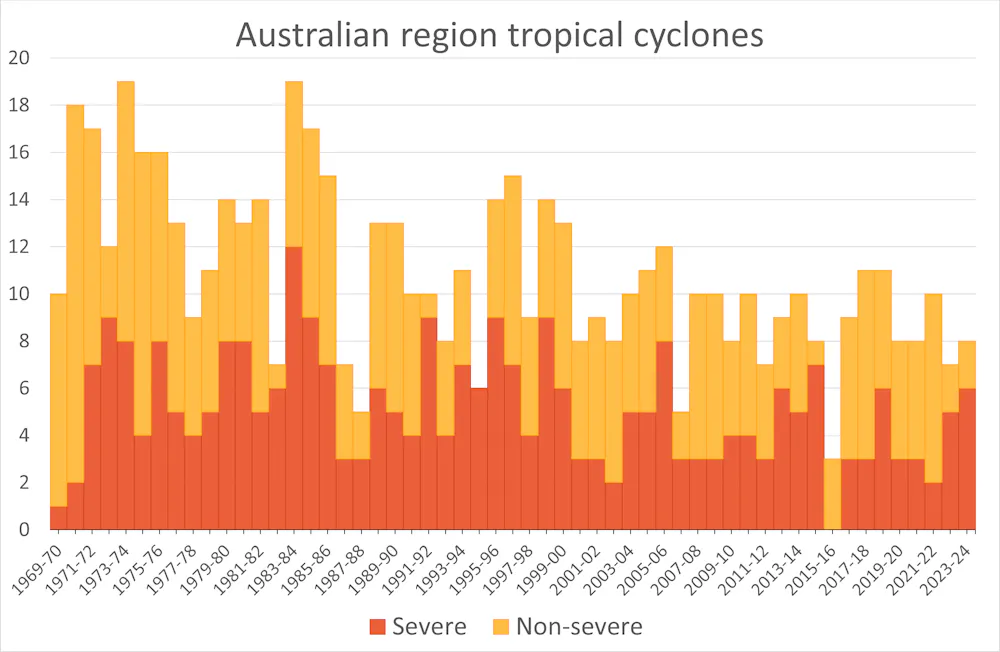
  • Fewer cyclones overall, but a higher proportion are severe (Category 3+).

  • Slower decay over land, increasing inland flooding risks.

  • The IPCC and Australian Academy of Science warn of more intense cyclones and southward expansion.

Policy Implications

Prime Minister Anthony Albanese’s assertion that climate change intensifies disasters aligns with Climate Council and ClimaMeter analyses, though CSIRO emphasizes nuanced attribution timelines. Regardless, Alfred’s impacts underscore the urgency of emissions reduction and adaptive infrastructure in southern regions.
Cyclone Alfred exemplifies how climate change is reshaping Australia’s disaster profile, demanding updated preparedness strategies for unprecedented weather extremes.

Links

09/03/2025

China announces plans for major renewable projects to tackle climate change

A general view of a Taiyuan New Energy Co wind farm, during an organised media tour, in Jiuquan, Gansu province, China October 17, 2024. REUTERS/Tingshu Wang/File Photo


Reuters

BEIJING: China says it will develop a package of major projects to tackle climate change as it moves to bring its carbon dioxide emissions to a peak before 2030 and become carbon neutral by 2060.

The world's largest producer of climate-warming greenhouse gas said it would develop new offshore wind farms and accelerate the construction of "new energy bases" across its vast desert areas, the National Development and Reform Commission, the country's economic planner, said in an official report published on Wednesday.

"China will actively and prudently work towards peaking carbon emissions and achieving carbon neutrality," the report read.

Among the proposed projects cited in the report by the state planning agency was a controversial hydropower facility on the Yarlung Tsangpo river in Tibet, which has raised concerns in India about its potential impact on downstream water flows.

It also said it would develop a direct power transmission route connecting Tibet with Hong Kong, Macao and Guangdong in the southeast.

However, coal will remain a key fuel, with the NDRC report saying the country will continue to increase coal production and supply this year even as it plans for trials of low-carbon technology at its coal-fired power plants and to promote initiatives aimed at substituting fossil fuels with renewables.

China has been struggling to strike a balance between fostering economic growth and meeting its environmental goals.

The NDRC said the 3.4% reduction in the amount of carbon emissions per unit of economic growth last year "fell short of expectations", blaming rapid growth in energy consumption as well as extreme weather.

China is not expected to meet its five-year goal to bring carbon intensity down by 18% by the end of this year, and it has not yet announced an annual target for 2025.

It will also struggle to meet a separate target to cut the amount of energy consumed per unit of growth by 13.5% by the end of this year, despite exceeding expectations with a 3.8% reduction last year, analysts said.

"Despite the world record expansion of renewables, an inconvenient truth is that China's economy hasn't become much more energy efficient in recent years," said Yao Zhe, global policy advisor with Greenpeace in Beijing.
 
Links

08/03/2025

Cyclone Alfred is slowing – and that could make it more destructive. Here’s how climate change might have influenced it

The Conversation -

Cyclone Alfred has now been delayed, as the slow-moving system stalls in warm seas off southeast Queensland. 

Unfortunately, the expected slow pace of the cyclone will bring even more rain to affected communities.

This is because it will linger for longer over the same location, dumping more rain before it moves on. Alfred’s slowing means the huge waves triggered by the cyclone will last longer too, likely making coastal erosion and flooding worse.

Cyclone Alfred is unusual – the first cyclone in half a century to come this far south and make expected landfall.

When unusual disasters strike, people naturally want to know what role climate change played – a process known as “climate attribution”. Unfortunately, this process takes time if you want details on a specific event.

We can’t yet say if Alfred’s unusual path and slow speed are linked to climate change. But climate change is driving very clear trends which can load the dice for more intense cyclones arriving in subtropical regions. These include the warm waters which fuel cyclones spreading further south, and cyclones dumping more rain than they used to.

So, let’s unpick what’s driving Cyclone Alfred’s behaviour – including the potential role of climate change.

A Bureau of Meteorology update on Cyclone Alfred dated Thursday, March 6.

Not necessarily climate linked: Alfred’s southerly path

Many cyclones make it as far south as Brisbane – but they’re nearly all far out at sea. Weather patterns mean most cyclones heading south are diverted to the east, where remnants can hit New Zealand as large extratropical storms.

The fact that Alfred is set to make landfall is very unusual. But we can’t yet definitively say this is due to climate change. Cyclones are steered by winds and weather patterns, and the Coral Sea’s complex weather makes cyclone paths here very hard to predict.

Alfred’s abrupt westward shift is due to a large region of high pressure to its south, which has pushed it directly towards heavily populated areas of southeast Queensland and northern New South Wales. These steering winds are not very strong, which is why Alfred is moving slowly.

In 2014, researchers showed cyclones are reaching their maximum intensity in areas further south in the southern hemisphere and north in the northern hemisphere than they used to. In 2021, researchers also found cyclones were reaching their maximum intensity closer to coasts, moving about 30 km closer per decade.

Climate link: Warmer seas

Cyclones typically need water temperatures of 26.5°C or more to form.

More than 90% of all extra heat trapped by greenhouse gas emissions is stored in the seas. The oceans are the hottest on record, and records keep falling. But normal seasonal variability and shifting ocean currents are still at work too, and we can get unusually warm waters without climate change as a cause.

What we do know is that ocean temperatures around much of Australia have been unusually warm.

The northeastern Coral Sea, where Cyclone Alfred formed, experienced the fourth-hottest temperatures on record for February and the hottest on record for January. 

In the Coral Sea, sea surface temperatures were the fourth highest on record in February 2025 and the highest on record in January 2025. This figure shows the trend over time for February. Bureau of Meteorology, CC BY-NC-ND

We also know Australia’s southern waters are warming up too.

The energy available to power tropical cyclones in subtropical regions has also increased in recent decades, due largely to rising ocean temperatures. 

Average sea surface temperatures in central and southern Queensland on Thursday March 6th. Point Danger is on the Gold Coast. Bureau of Meteorology, CC BY-NC-ND

Climate link: Fewer cyclones but more likely to be intense

In the northern hemisphere, researchers have found a trend towards fewer cyclones over time. But of those which do form, a higher proportion are more intense.

It’s not fully clear if the same trend exists in the southern hemisphere, though we are seeing fewer cyclones forming over time.

This summer, eight tropical cyclones have formed in Australian waters. Six were classified as severe (category 3 and up). Historically, Australia has experienced a higher proportion of category 1 and 2 cyclones, which bring weaker wind speeds.

On average, we see about 11 cyclones form and 4-5 make landfall. There has been a downward trend in the number of cyclones forming in the Australian region in recent decades.

Fewer cyclones, but more likely to be intense: this figure shows the number of severe (Category 3 and up) and non-severe tropical cyclones (Category 1 and 2) since 1970/71. Bureau of Meteorology, CC BY-NC-ND


Climate link: Cyclones dumping more rain

The intensity of a cyclone refers to the speed of the wind and size of the wind-affected area.

But a cyclone’s rain field is also important. This refers to the area of heavy rain produced by storms when they’re at cyclone intensity and afterwards as they decay into tropical lows.

The rate of rainfall brought by cyclones in Australia isn’t necessarily increasing, but more cyclones are moving slowly, such as Alfred. This means more rain per cyclone, on average.

Rising ocean temperatures mean more water evaporates off the sea surface, meaning forming cyclones can absorb more moisture and dump more rain when it reaches land.

Why are cyclones slowing down? This is likely because air current circulation in the tropics has weakened. This has a clear link to climate change. Wind speeds have fallen 5 to 15% in the tropics, depending on where you are in the world. It’s hard to pinpoint the change clearly in our region, because the historic record of cyclone tracks isn’t very long.

For every degree (°C) of warming, rainfall intensity increases 7%. This is well established. But newer research is showing the rate may actually be double this or even higher, as the process of condensation releases heat which can trigger more rain.

Clear climate link: Bigger storm surges due to sea level rise

Sea levels are on average about 20 centimetres higher than they were before 1880.

When a cyclone is about to make landfall, its intense winds push up a body of seawater ahead of it – the storm surge. In low lying areas, this can spill out and flood streets.

Because climate change is causing baseline sea levels to rise, storm surges can reach further inland. Sea-level rise will also make coastal erosion more destructive.

Huge swells have forced beach closures ahead of Cyclone Alfred’s arrival. Jason O'Brien/AAP


What should we take from this?

We can’t say definitively that climate change is behind Cyclone Alfred’s unusual track.

But factors such as rising sea levels, slower cyclones and warmer oceans are changing how cyclones behave and the damage they can do.

Over time, we can expect to see cyclones arriving in regions not historically affected – and carrying more rain when they arrive.

Links

07/03/2025

Heatwaves, fires, torrential rain, fish kills: Australia’s summer of climate extremes

Sydney Morning Herald - Caitlin Fitzsimmons

Australian summer smashed temperature records yet again, fuelling climate disasters around the country, while the weather bureau has predicted a hot autumn.

A Sydneysider shelters in the shade at Bondi on a hot day in January. Credit: Dion Georgopoulos
The season was marked by bushfires in Victoria and Tasmania, heatwaves that stretched from Sydney to Perth, record-breaking deluges in tropical north Queensland, and marine heatwaves that killed coral and fish around the entire continent.

Scientia Professor Matthew England, a climate scientist at the University of NSW, said climate change had profoundly altered Australian summers over the past couple of decades.

“When I was a kid growing up, summer was the season Australians looked forward to, but these days there’s a collective trepidation about summer because it’s the season where the worst climate extremes are playing out,” England said.

“It’s the season that we’re most fearful or anxious about – what sort of heatwaves will we have, what bushfire risks will come about, where will the flooding rains be?”

There is more to come – the Bureau of Meteorology’s long-range forecast for March to May shows a high likelihood of warmer-than-average days and nights and an increased chance of unusually hot days and nights across the country. Rainfall is likely to be in the typical range for most of Australia, including NSW and Victoria.

While the weather bureau will release a more detailed climate summary next week, a spokesperson said summer had been much warmer than usual for most of Australia.

Heating Australia

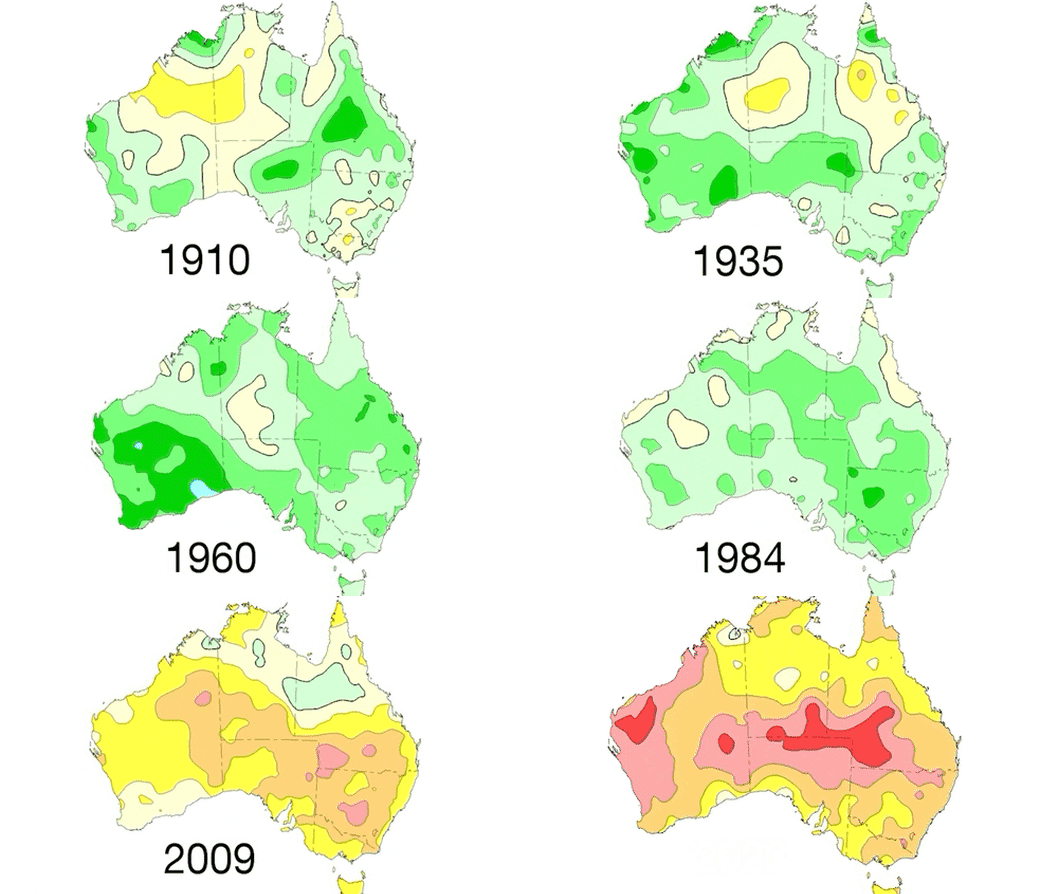
Heating Australia: Average temperatures from 1910 to 2024

 Average temperatures from 1910 to 2024. Bureau of Meteorology

“Every state and territory had above-average daytime and night-time temperatures,” the spokesperson said. “Parts of the west and some central areas had their warmest summer on record.”

This comes after 2024 was confirmed as the hottest year on record globally, followed by news from Europe’s Copernicus Climate Change Service that January 2025 was the world’s hottest ever January.

For Australia, it was the second-warmest January since records began in 1910, with BoM figures showing the average temperature sitting 2.15 degrees above the 1961-90 benchmark. It followed the third-warmest December since 1910, with the national average temperature 1.88 degrees above the long-term average.

An early morning walker exercises in Brighton-le-Sands ahead of a sweltering January summer day. Credit: Sam Mooy
The highest daytime temperature of the summer anywhere in the country was 49.3 degrees at Geraldton Airport in the Mid West of Western Australia on January 20, the weather bureau said. The hottest night-time temperature of the summer was at Leinster Aero in WA, which was 34.8 degrees overnight on February 9.

Summer was wetter than usual for parts of the country’s east and north-west, but drier than average across parts of the country’s south and central areas, including large parts of NSW and the Northern Territory and most of Victoria. Large areas also had summer rainfall that was close to average.

The monsoon did not reach Darwin until February 7, the latest since records began. The previous record was January 25 in 1973.

However, the monsoon trough was established over Queensland from the end of January and also briefly in northern WA. The coastal area between Townsville and Ingham in Queensland had its highest February monthly rainfall on record, with some areas receiving 1.5 metres of rain over three days, causing massive river flooding.

Flooding in Macknade in North Queensland in February. Credit: Nick Moir 
The wettest day of the summer anywhere in the country was February 3 at Paluma Ivy Cottage in Queensland, which recorded 745.2mm in one day.

Australia has had seven tropical cyclones in our region so far this season. On February 14, Tropical Cyclone Zelia was the first of the season to cross Australia’s mainland, causing high rainfall in the Pilbara region of WA.

The extreme weather events and associated natural disasters also included bushfires in Victoria and Tasmania, and a marine heatwave that caused coral bleaching in the Great Barrier Reef and Ningaloo Reef in WA, the death of about 30,000 ocean fish off the Pilbara coast, and a mass mortality event in salmon farms in Tasmania.

A farmer and Country Fire Authority volunteer monitors the fire beside his property near the Grampians in December. Credit: Justin McManus

The Climate Council has released a heat map tool revealing how Australian electorates would fare under a high-emissions scenario leading to global warming of 4.4 degrees by 2100.

The electorate of Parkes in north-western NSW would face 120 days a year over 35 degrees by 2090, up from an average of 55 days now. In Sydney, north shore electorate Bradfield would have 21 hot days, up from five, while neighbouring Bennelong would increase from six to 23.

The seat of Mallee in Victoria would have 58 days over 35 degrees by 2090, up from 25. The Casey electorate in east Melbourne would increase from three hot days to 14, while bayside Goldstein would increase from seven to 20 hot days.

The hottest electorate in Queensland would be Kennedy, with an increase from 110 days above 35 degrees on average to 214, while the electorate of Brisbane would face an increase in hot days from two to 24, and hot nights above 25 degrees from one to 33.

Links

06/03/2025

As far south as Sydney’: Why cyclones are growing deadlier and heading our way

Sydney Morning Herald - Caitlin Fitzsimmons


Years of intense recurring marine heatwaves around Australia’s coast are causing the cyclone danger zone to extend further south to take in Brisbane and northern NSW, with scientists fearing that the tropical storms could one day even threaten Sydney.

Not only is the range of tropical cyclones extending north and south of the equator due to climate change, the storms are expected to be more intense, carry more moisture and move more slowly, causing them to dump more rain over the areas they hit.

In the northern hemisphere hurricanes and typhoons are increasing the risk for major cities such as New York, Boston and Tokyo, as the tropical zone has increased its latitude by 1-2 degrees every decade for the past several decades.

Professor Liz Ritchie, from Monash University and the Australian Centre of Excellence for 21st Century Weather, said there was evidence that cyclones were already moving further south in Australia, and much clearer evidence they were moving further north in the North Atlantic and the Pacific Northwest.


“There’s an expectation that they will be able to move further south here, and there are already some results that show that over the last five to 10 years, they have already started to move further south,” Ritchie said.

“That could be a function of warmer sea surface temperatures or a function of how we’ve recorded and tracked these things in the past … but they do look like they’re moving further south both off our west coast and off our east coast, as well as in both the South Pacific and the south Indian Ocean.”

Tom Mortlock, head of climate analytics Asia-Pacific at Aon and an adjunct fellow from the Climate Change Research Centre at the University of NSW, said the trends for the past 60 years were unclear, but several climate models suggested a southward shift would occur.

“There are projections that with a warming ocean and a warming atmosphere, that we may see a higher chance of cyclones tracking further south than we have done over the historical period in the future,” he said.

A 2021 peer-reviewed article in Nature Geoscience found that 21st-century tropical cyclones “will most probably occupy a broader range of latitudes than those of the past 3 million years” with a distinct poleward shift.

Historical tropical cyclone activity across Australia between 1981 and 2017. Credit: Geoscience Australia


On Tuesday morning Cyclone Alfred was sitting about 500 kilometres to the east of Brisbane and the Sunshine Coast as a category 2 system. The Bureau of Meteorology expects it to gradually move south and then take a sharp turn to the west to make landfall north of Brisbane from late Thursday into Friday.

The worst effects would be south of the cyclone in Brisbane, the Gold Coast and the Northern Rivers, BoM said, including intense winds, rainfall and coastal swells.

Scientists said if the cyclone hypothetically changed direction, it was possible for it to travel as far south as Sydney.

“We actually have sea surface temperatures that are warm enough to sustain tropical cyclones as far south as Sydney at the moment, which is unusual,” Mortlock said.

Mortlock said a cyclone would only form if ocean waters were about 26-27 degrees and it would peter out unless there was also continued marine heat along its path. Australia has a marine heatwave around most of its coastline, a recurring phenomenon every summer for the most of the past decade.

Ritchie said: “If Alfred happened to track down and didn’t make landfall near Brisbane but came down towards Sydney, it could potentially follow that little tongue of warm water and stay fairly intense before it came inland. That is absolutely true but it’s not going to happen [this time].”

A tropical cyclone is a low-pressure system generated in the tropics that gets its energy from warm sea surface temperatures, spins up and then releases that energy as it makes landfall. It is the same type of storm as a hurricane or typhoon, though it spins in opposite directions on either side of the equator.

Alfred would be first tropical cyclone to impact NSW since Nancy in 1990. Mortlock said tropical cyclones were usually downgraded by the time they made landfall in southern Queensland or northern NSW, but the ex-tropical cyclones or tropical storms were often “messier” with more widespread impact.

Heating Australia

Heating Australia: Average temperatures from 1910 to 2024

Average temperatures from 1910 to 2024. Bureau of Meteorology

Mortlock said there was also a clear and continuing trend over several decades for a decrease in the number of cyclones making landfall on the Australian east coast, bucking the global trend of more cyclones. However, he said the cyclones that did hit the Australian continent were expected to be more severe.

Ritchie said the risk of cyclones causing floods was increasing because a warmer atmosphere could hold more water and the storms tended to stay in one place for longer, dumping rain in one location. She said this had occurred with Cyclone Jasper in December 2023.

“When we think of severity, we’re often talking about the winds, but it’s one of the important changes that we seem to be already seeing, is the amount of rainfall that can come out of these systems,” Ritchie said.

Links

05/03/2025

Earth’s strongest ocean current could slow down by 20% by 2050 in a high emissions future

The Guardian -

Melting Antarctic ice is releasing cold, fresh water into the ocean, which is projected to cause the slowdown
Antarctic Circumpolar Current (in yellow). Climate models show the current could slow down 20% by 2050. Illustration: Dr Taimoor Sohail

In a high emissions future, the world’s strongest ocean current could slow down by 20% by 2050, further accelerating Antarctic ice sheet melting and sea level rise, an Australian-led study has found.

The Antarctic Circumpolar Current – a clockwise current more than four times stronger than the Gulf Stream that links the Atlantic, Pacific and Indian oceans – plays a critical role in the climate system by influencing the uptake of heat and carbon dioxide in the ocean and preventing warmer waters from reaching Antarctica.

Using Australia’s fastest supercomputer and climate simulator, Gadi, located at Access National Research Infrastructure in Canberra, the researchers used climate models to analyse the impact of changing temperature, ice melting and wind conditions on the Antarctic Circumpolar Current.

The results, published in Environmental Research Letters, revealed a clear link between meltwater from Antarctic ice shelves and circumpolar current slowdown, and comes less than a week after another paper anticipated a weakening in vital Atlantic Ocean currents.

What they found suggested a “substantial reconfiguration of Southern Ocean dynamics”, with “far-reaching impacts on global climate patterns, oceanic heat distribution, and marine ecosystems”.

Co-author Assoc Prof Bishakhdatta Gayen, from the University of Melbourne, described the result as “quite alarming”.

He explained that as melting Antarctic ice released cold, fresh water into the ocean, this sank and spread towards the equator. That flow of fresh water changed the density variation in the ocean, a key driver of movement, causing the slowdown.

“The ocean is extremely complex and finely balanced. If this current ‘engine’ breaks down, there could be severe consequences, including more climate variability, with greater extremes in certain regions, and accelerated global warming due to a reduction in the ocean’s capacity to act as a carbon sink,” Gayen said.

Sea ice near Horseshoe Island in Antarctica. The drastic fall in sea ice coverage for the the third year in a row has scientists concerned there may a fundamental shift under way. Photograph: Anadolu Agency/Getty Images


Co-author and climate scientist Dr Taimoor Sohail said the slowdown could lead to a “vicious cycle”, where more warm water reaches the Antarctic shelf accelerating ice melting and further weakening the current.

This could also disrupt ecosystems and food webs, he said, as the oceanic current helps to prevent invasive species – such as rafts of southern bull kelp – from reaching the fragile continent, or redistributed them.

“Concerted efforts to limit global warming – by reducing carbon emissions – will limit Antarctic ice melting, averting the projected slowdown,” Sohail said.

Dr Edward Doddridge, a physical oceanographer at the University of Tasmania who was not involved with the study, said it was significant and surprising, given previous studies had indicated that the northern parts of the Antarctic Circumpolar Current were accelerating due to ocean warming.

Doddridge said it was important to investigate the ways that ocean currents might change, given more than 90% of the extra heat trapped on Earth had been stored in the oceans, which then moved the heat around in ways that affected the climate and weather in different places around the world.

Monash University climate scientist Dr Ariaan Purich, who was not involved with the paper, said dramatic changes were already under way in the oceans around Antarctica.

Fresh water stored in Antarctic ice sheets and shelves was melting at an accelerating rate, she said, and every summer since 2022 – for the first time in recorded history – the extent of sea ice surrounding the continent had dropped below 2m square kilometres.

“We need to know what the ocean is doing and how much heat and carbon the ocean is taking up so that we can better project the climate that we’re experiencing here on land in Australia, and that we can better adapt for that climate,” she said.

Links

Lethal Heating is a citizens' initiative