05/03/2019

How The Weather Gets Weaponized In Climate Change Messaging

New York Times - Brad Plumer


Clearing snow in Buffalo, N.Y., in January. Credit Lindsay Dedario/Reuters
WASHINGTON — In the summer, when heat waves scorch cities or heavy rains flood the coasts, some climate scientists and environmentalists will point out any plausible connections to global warming, hoping today’s weather will help people understand tomorrow’s danger from climate change.
Then winter comes. And, like clockwork, those who want to deny the established science that humans are warming the planet will try to flip the script. In January, when large swaths of the country were gripped by bitter cold, President Trump took to Twitter to mock climate fears: “Wouldn’t be bad to have a little of that good old fashioned Global Warming right now!”
Welcome to the weather wars. As battle lines harden between supporters and opponents of climate action, both are increasingly using bouts of extreme weather as a weapon to try to win people to their side. Weather, after all, is one of the easiest things for people to bond over or gripe about, a staple of small talk and shared experience that can make it a simple but powerful opportunity to discuss global warming.
But, as Mr. Trump’s words show, it’s also a framing device that can be easily abused. That raises the stakes for how scientists, who have long tried to distinguish between short-term weather fluctuations and long-term climate shifts, draw out and discuss the links between the two.
“Weather, and especially extreme weather, is how most people will experience climate change,” said Susan Joy Hassol, director of the science outreach nonprofit group Climate Communication. “You don’t experience the slow change in average temperature. What you experience are the changes in extreme weather that are brought about. So how we talk about that is really important.”
One reason that the weather can offer a potent messaging opportunity may boil down to human psychology. Climate science itself is often complex and abstract. It can be tough to feel, on a gut level, the implications of a chart showing global temperatures ticking up over time, or statistics showing that, on average, 95-degree days or torrential downpours are becoming more frequent.
But an unusual weather event that hits today, like a brutal heat wave or heavy storm, is more visceral. Laboratory experiments have found that people’s beliefs about global warming can be swayed by their immediate environment. Put someone in a hot room and they’re more likely to agree the planet is warming. Thirsty people become more alarmed by drought forecasts.
Psychologists have suggested these visceral experiences make it easier for our brains to imagine future states of the world, and therefore make them seem more likely. An exceptionally hot or cold day, other studies have found, can play the same role.
Some messengers have long realized that emotion and immediacy can be a powerful force.
“Trump is a branding guy,” said David B. Srere, co-chief executive and chief strategy officer at Siegel+Gale, a brand consultancy. “He knows his audience and understands how to tell a clear, simple story. Climate advocates and the scientific community need to get better at understanding their audience and figure out how to tell a simple, repeatable story of their own.”
In recent years, some climate scientists have focused on trying to turn flare-ups of severe weather into teachable moments. “This is what global warming looks like,” scientists said during the summer of 2012, a season of widespread droughts, wildfires and extreme heat advisories.
And they have become increasingly comfortable drawing those connections.
Back in 2005, after Hurricane Katrina devastated New Orleans, many researchers responded cautiously, saying it was difficult to attribute a single event to global warming. A few noted that rising ocean temperatures could make hurricanes more destructive, on average, in the future. But even that was fairly abstract.
Over time, that messaging has shifted.
Partly that’s because, as climate models have improved, scientists have been able to demonstrate more rigorously how rising greenhouse gas emissions have made recent heat waves or droughts more intense or more likely to occur — a budding field known as “extreme weather attribution.” Scientists have also refined their communication strategies, using metaphors like “loaded dice” to talk about how global warming is now making certain severe weather events more likely.
“The conversation today couldn’t be more different than it was a decade ago,” said Hunter Cutting, director of strategic communications for Climate Nexus, a nonprofit group focused on climate issues. “Back then, at best, you might get scientists talking about what effects we could see by the year 2100. Now we’re seeing leaders connect the dots in a much more direct way.”
That strategy, though, can cut both ways. Deniers of climate change have also sought to use the daily weather to shape perceptions. Senator James Inhofe, Republican of Oklahoma, once brought a snowball to the Senate floor to suggest that global warming wasn’t a problem. When cold spells strike, Mr. Trump will ridicule worries about climate change:


Parrying Mr. Trump’s tweets can be a challenge, some supporters of action on climate change concede. He can drive the conversation: One recent survey from Media Matters, a liberal watchdog group, found that broadcast television networks rarely discuss global warming when extreme weather is unfolding. But they do often note the president’s climate comments.
Scientists and environmentalists have tried various tactics to push back. They might note that record hot days are becoming far more frequent than record cold days, and that no one expects global warming to eliminate snow altogether. Or they’ll reiterate that the ups and downs of daily weather aren’t the same as broader long-term shifts in the Earth’s climate, and that a single cold day can’t disprove global warming anymore than a single hot day proves it.
Still, a casual observer could be forgiven for feeling a bit of whiplash after that line. After all, haven’t we been hearing that severe weather is a manifestation of climate change when it’s hot out?
Flooding in Townsville, Australia, in February. The area, in northeastern Queensland State, has seen unusual amounts of rain this year. Credit Ian Hitchcock/Getty Images
Marshall Shepherd, a professor of atmospheric science at the University of Georgia, isn’t convinced that the president’s tweets about cold weather have staying power.
“I see Trump’s tweets as an opportunity to discuss the science,” he said. “To the 9 or 10 percent of the population that are going to be dismissive of climate science no matter what, there’s not much you can say to them. But a lot of people out there are legitimately curious” about how global warming can be real if it’s cold out today.
That raises the question of whether the messaging skirmishes around severe weather and climate change are swaying public perceptions, or whether each side is just preaching to those who are already converted.
There are some signs opinion is shifting. One recent survey by researchers at Yale and George Mason University found that 69 percent of Americans were “worried” about global warming, an 8-point increase from the previous spring. One possible explanation, the researchers suggested, was the spate of extreme weather disasters in 2018, from wildfires to hurricanes, along with increased efforts by scientists and even local TV weathercasters to put that in a climate context.
“For a long time, Americans saw climate change as a distant threat,” said Edward Maibach, a professor at George Mason who works on climate change communication. “But as of our most recent survey, I don’t feel I can say that anymore. We’re seeing a lot of movement on people understanding that climate change is already happening.”
Others are more cautious about interpreting these trends. One 2017 study, for instance, found that people who experience extreme weather are, for a short period, more likely to support climate adaptation measures than they were before. But the effect was modest and diminished over time.
It may be that people mentally adjust to unusual weather patterns quickly, updating their idea of what counts as normal. Politics may also play a role: In a polarized country, many Americans are already hardened in their beliefs about global warming.
Partly for that reason, David M. Konisky, an associate professor in the School of Public and Environmental Affairs at Indiana University and an author of that 2017 study, said he wonders whether better messaging can dramatically shift opinions. “It might be that climate has become so wrapped up in one’s identity and worldview that it’s not the sort of thing that’s susceptible to better messaging,” he said.
Wanyun Shao, an assistant professor of geography at the University of Alabama, lands in the middle. Her research has found that Democrats and Republicans do perceive severe weather differently: Democrats tend to see it as part of a broader pattern of climate change, Republicans as more of an aberration. But, she has also found, a consistent string of shifting weather — year after year of increasing summer heat, for instance — does start to chip away even at conservative doubt about global warming.
“For some people, it takes more time,” she said. “But eventually people start trusting their own experiences.”

Links

Are Our Cities Effectively Planning For Climate Change?

The Conversation - 

Many cities have plans in place to adapt to or mitigate the effects of climate change. But are they credible? An ongoing study looks into the question. David Blackwell/Flickr, CC BY-NC-ND
In 2006, pioneering cities such as London (United Kingdom) and Durban (South Africa) started integrating climate change in their policies and plans in order to prepare infrastructures, communities, ecosystems and institutions for its most likely impacts.
Since then, many cities large and small around the globe have followed their example. Important global and regional city networks to promote action on climate change have been created (C40) and global commitments, such as the Global Covenant of Mayors, have been signed.
From megacities to small towns, those taking action all have their say. And for this reason, cities have an increasing role in the international negotiations. This was demonstrated after the Paris Agreement in 2015, when there was no question on the significant contribution of non-state actors in fighting against climate change.

Only 47% of 885 European cities have plans
So far, meaningful studies have attempted to track the progress made to date on urban adaptation. A large-scale study of 885 European cities found that only 47% have adaptation plans in place, be they focused on adaptation (26%) or a combination of adaptation and mitigation (reduction of greenhouse gas emissions).
A December 2016 study using a database of 401 global cities with more than 1 million inhabitants found that only 18% report adaptation initiatives. Other country-specific studies have been developed in Canada, the United States, Spain, Italy and the United Kingdom. Most of these studies share a significant bias on developed countries and the focus has been made on the existence of policies to assert the progress made on adaptation.

Assessing cities
While such progress is good, how do we know if these plans will effectively reduce future risks? One first needs to consider whether those plans are politically and economically credible – whether they are based on sound scientific knowledge and whether city agents and civil society will support the planned activities and projects.
To help answer these question, we developed and tested a new approach in four pioneering cities (Durban, Quito, Copenhagen and Vancouver). In the study we develop metrics to assess adaptation policies’ credibility by finding out whether they’re financially secured, if the right climatic assessments have been developed and whether citizens’ opinions have been taken into consideration.

Some are more exposed to climate change impacts and pollution than others. Makoko, in the Lagos region of Nigeria, is known for its laguna “slum”.

The legitimacy of adaptation policies is crucial. Every public action needs to be transparent and every policy needs to be built on a participatory process. Adaptation efforts must also protect those more exposed to climate change impacts. At the same time, adaptation measures may benefit some communities and not others; losers and winners of climate change adaptation need to be considered.
Our conclusions? There is still work to be done even in the cities that are most advanced in climate adaptation efforts, particularly regarding the establishment of legitimate processes with stakeholders and communities, the establishment of adequate monitoring systems, the definition of a sustainable budget for implementation and finally, the consideration of risks and uncertainty that climate change inherently brings.

Calculating future risks
In this line, a January 2017 study calculated the future probability and associated economic damages of climatic impacts linked to sea-level rise through the 21st century in 120 large coastal cities all over the world.
It was found that uncertainty has a critical role in decision-making: there might be events with a potential for high economic damage yet a very low probability of occurring; there are also lower-impact events that have a much higher probability. We tend to plan for the high-probability, low-impact events and disregard those that have lower probability but a greater potential for damage. If we look at the 5% of the worst cases, this may have important implications for cities as the consequences may be catastrophic from an economic, social or environmental perspective. An important example is Hurricane Sandy, which struck New York City in 2012. Afterward, the city prepared the “Stronger, More Resilient New York” plan, released in 2013.
This work also identified the need to define the level of risk that cities would be willing to accept. As with any other type of risk, climatic risks cannot be completely eliminated with reasonable resources. What is possible and what is feasible are two different things.
To take an exaggerated example, it will be always possible to build 4-meter walls to prevent a river from flooding. However, this is hardly realistic or practical from an economic, environmental or social point of view. To reduce the risk of floods in the most exposed areas in Bilbao, Spain, the city recently opened the Deusto canal. The project will reduce the magnitude of the impacts from increasing rainfalls and high tides, but cannot eliminate them completely.
Do current city adaptation plans considering climatic risks in these terms? How much risk are cities planning for?
Deusto canal, Bilbao. http://www.zorrotzaurre.com/
Tracking cities
To answer such questions, our ongoing research project, “Are cities preparing for climate change?”, tracks urban adaptation efforts in 136 coastal cities.
First, we have been documenting adaptation-related policies in these 136 cities that have an impact on coastal management. Here it is is essential to take into account not only local policies, but also but regional and national ones. We will assess which policies are likely to be implemented and sustained in the long term (credibility) and later, we will evaluate if the planned measures have the capability to reduce future risks.
For example, in Montevideo (Uruguay) we analysed national and metropolitan adaptation policies. We are now particularly looking at the Plan Climático de la Región Metropolitana de Uruguay (metropolitan plan) and assessing whether it is credible and how coastal measures have been defined to address their specific future risks.
Aerial view of Montevideo, Uruguay. Rabble/Flickr/Wikimedia, CC BY
Protecting biodiversity and coastal ecosystems and controlling urbanisation in areas that tend to erode, as Montevideo does, is a good indicator of future adaptability to extreme events.
While our final results of our tracking study may only come in 2020, we hope that it will serve as an example in sectors other than urban coastal adaptation. We also hope that it will be used by the cities themselves to improve their climate planning skills and adjust their strategies according to the climate change risks they may face in a future that it is closer every day.

Links

Climate Change In Court

Pursuit, University of Melbourne - 

A recent court ruling could signal a new direction for Australian climate law after the appropriateness of a proposed fossil fuel development was put on trial
Getty Images
Dr Laura Schuijers is an Environmental Lawyer and Postdoctoral Research Fellow, Melbourne Sustainable Society Institute, Faculty of Architecture, Building and Planning, University of Melbourne.
Last month, Chief Justice Preston of the New South Wales Land and Environment Court handed down what has been heralded as a landmark decision dismissing on appeal the proposal of Gloucester Resources to construct a new open-cut coal mine in the state’s Hunter Valley.
The Chief Justice found that, as well as creating unacceptable impacts for local residents, the proposed Rocky Hill Coal Project would adversely impact upon measures to limit dangerous anthropogenic climate change.
The Chief Justice found that “all anthropogenic GHG emissions contribute to climate change”. Picture: Getty Images
 Dismissing the notion that has been relied upon in Australian courts in previous cases that one mine in Australia represents only a small fraction of global emissions, he found that all of the direct and indirect greenhouse gas (GHG) emissions of the Rocky Hill Coal Project will negatively impact on the environment, since “all anthropogenic GHG emissions contribute to climate change”.

The carbon budget and the wrong time test
What’s particularly significant about this case is that it’s the first time that Australia’s share of the so-called ‘global carbon budget’ – derived from the Paris Agreement goal to limit global warming to well below 2°C above pre-industrial levels and ideally to no more than 1.5°C – has been heard in a court and used as a reason to dismiss a fossil fuel project.
Emeritus Professor Will Steffen from the Australian National University provided an expert testimony to the court explaining the carbon budget approach and why the remainder of Australia’s coal reserves need to “be left in the ground, unburned”.
Referring to leading peer-reviewed science, he explained the imperative of fossil fuel phase-out in Australia if global emission reduction targets are to be achieved, commenting “it doesn’t take an Einstein to work that out, that you cannot reduce emissions by increasing them.”
From this has emerged what has been dubbed as the ‘wrong time test’.
To pass the test, a proponent of a fossil fuel project needs to establish why their project should be approved “at a time when what is now urgently needed, in order to meet generally agreed climate targets, is a rapid and deep decrease in GHG emissions”. The test does not imply that the Paris Agreement prohibits new fossil fuel developments.
It was argued in court that if the coal was not mined here, then it would be mined somewhere else. Picture: Getty Images
 However, it recognises that a practical consequence of reaching the emission reductions required to achieve the 1.5 to 2°C goal is that coal production needs to reduce rather than expand. Given that context, new proposals must be considered very carefully.
The factual evidence laid out in the case demonstrates that what’s at stake are the serious and tangible risks that climate change poses for countries including Australia.

The market substitution argument
The Rocky Hill judgment rejects an argument known as the “market substitution” or “perfect substitute” argument. The logic of this argument is that if coal is not mined in Australia and ultimately burned somewhere, then an exact (rather than a more environmentally friendly) substitute will be mined and burned elsewhere.
This argument, colloquially known as the “drug-dealer’s argument”, was behind Justice Griffith’s 2016 decision in the Federal Court that Adani’s Carmichael Coal Mine should be approved. He wasn’t persuaded that Adani’s mine would have a net impact on global GHG emissions, even though it would be the largest coal mine in the Southern Hemisphere.
In the Rocky Hill case, the Land and Environment Court heard a claim that if the coal was not mined in Gloucester, then it would be mined somewhere else like India or Indonesia, and overall global emissions wouldn’t be affected.
Chief Justice Preston rejected this argument as logically flawed, pointing to the fact that the proponents of the argument have no evidence of market forces to support it, that countries around the world are reducing emissions to comply with their Paris targets, and that developed nations such as Australia should take the lead – a concept enshrined in the Paris Agreement. He says:
“The potential for a hypothetical but uncertain alternative development to cause the same unacceptable environmental impact is not a reason to approve a definite development that will certainly cause the unacceptable environmental impacts.” 
Developed nations like Australia should take the lead on reducing emissions to comply with their Paris targets. Picture: Getty Images
 The Chief Justice’s approach might be new for Australia, but it follows a trend emerging in foreign courts. The market substitution argument, criticised by scholars in the United States, has already been rejected by the US 10th Circuit Court of Appeals as being an irrational assumption contrary to basic supply and demand principles.

An anomaly or a new direction?
The Rocky Hill case is not binding for other state and territory courts, nor for the Federal Court, and for this reason it could turn out to be an anomaly.
The case was a “merits review” as opposed to a “judicial review”, meaning that the court was able to step into the shoes of the original decision-maker – the NSW Planning Minister – and determine whether his decision not to approve the mine was the correct or preferable one.
In other cases, courts may only be able to consider whether the decision was made within the bounds of the law. In cases like this, courts are interested in whether the decision-maker took into consideration the factors that he or she needed to, and do not tend to judge whether the weight given to climate change vis-à-vis other relevant factors was appropriate.
What this essentially means is that it is generally government ministers who hold the power to determine, guided by the law, what influence climate change considerations will ultimately bear on a mine approval. The court’s role is limited.
Given that Australia’s 20-year-old national environment law does not mention climate change in its 527 provisions, and that Australia does not have a national climate law or any formal codification of its Paris commitments, it’s arguable that the law does not really provide very much guidance to these decision-makers.
Under the Paris agreement, Australia’s aim is to reduce emissions by 26 to 28 per cent on 2005 levels by 2030. Picture: Getty Images
While some state and territory legislation does recognise climate change, what is required varies significantly from state to state. So, in turn, do the judgments of different (and less specialised) courts.
Legal scholars have argued that climate change needs to be seen as a matter that is of importance to the whole country, even in the context of specific projects located in one state or territory. Therefore, that it should be relevant for ministers whenever they are weighing up a new fossil fuel development. But the law is not clear and has, as a result, been interpreted in various and sometimes conflicting ways.
Despite these factors, the reasoning in the Rocky Hill case could well prove difficult to argue with in future cases considering the appropriateness of new fossil fuel developments. And it certainly signals a wind of change.
The wrong time test reflects the current global imperative to reduce emissions, which is relevant to Australia as a signatory of the Paris Agreement, and it also applies that context to individual projects. It provides a much-needed means to recognise the cumulative effects caused by each fossil fuel project to the greater problem of climate change, and to the flow-on environmental, social and economic impacts facing Australia.
Its basis is grounded in strong scientific evidence. For these reasons, it should be persuasive for Australian courts that have in the past struggled to articulate climate change as a “significant” rather than “speculative” or “remote” issue.
Through the Rocky Hill case, Australian courts now have a clear example of how the need to reduce emissions, on account of the threats to Australia posed by climate change, and on account of Australia’s foreign commitments, can be applied to decisions about individual projects.
The court’s rejection of the market substitution argument is also a position that we are likely to see reinforced if the argument is tested in another court. If the argument is indeed illogical and flawed, then it would be strange to see it succeed in an analogous context.
Australia’s 20-year-old national environment law does not mention climate change in its 527 provisions. Picture: Getty Images
 From what we have seen in the Rocky Hill case and abroad, it would be difficult, even if the argument was considered, for a proponent to be able to show that its proposal would not have any net impact on global emissions and is therefore acceptable.
If the Rocky Hill case is anything to go by, the winds may just be too strong now for the historical ‘not our problem’ type arguments that Australia has relied on in the past to withstand them.

Links

04/03/2019

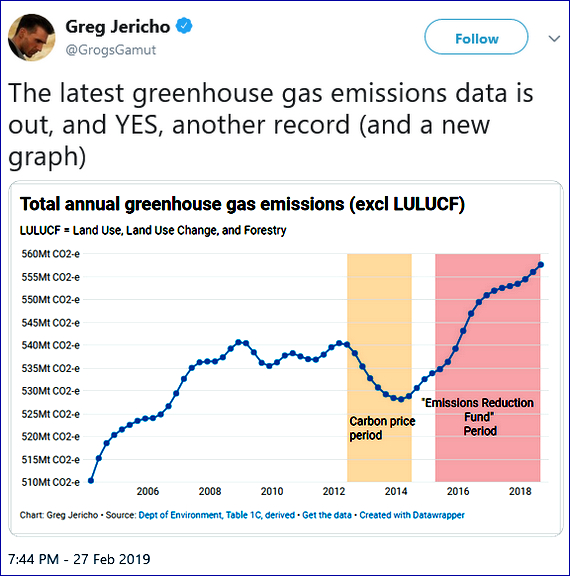
Angus Taylor Again Falsely Claims Australia's Greenhouse Emissions Are Falling

The Guardian - 

The energy minister repeats PM’s line that emissions fell by 1% when the government’s own figures show the opposite
Angus Taylor repeatedly stated emissions had decreased by 1% in an interview on the ABC’s Insiders program. Photograph: Lukas Coch/AAP
The energy minister has again insisted Australia’s emissions are going down, when the government’s official figures show emissions continue to increase, as the government struggles to sell the latest incarnation of its energy policy.
In an interview with the ABC program Insiders, Angus Taylor repeatedly stated emissions had decreased by 1% repeating the line first said by the prime minister, Scott Morrison, that Australia would meet it’s Paris commitments in “a canter”.
“Yes, they’re coming down and the department rightly believes they’re going to continue to go down and the result of this is we will reach, not just our Kyoto targets and still in the Kyoto period, we will reach our Paris targets,” he said.
The latest report released by the environment department, looking at emissions between September 2017 and September 2018, showed total emissions in Australia had increased by 0.9%, continuing a pattern of increases over the past five years.


That rise in emissions was largely due to an increase in liquid natural gas exports, but other sectors, including stationary energy, transport and waste sectors also contributed.
Emissions in the electricity sector did continue to decrease, with brown coal supply down by 12.3% while energy generation from renewable sources increased by 14.2%.
The last substantial fall in Australian emissions occurred after the Gillard government put a price on carbon, which was immediately derided as a “carbon tax” by the Abbott opposition, a claim Tony Abbott’s chief advisor, Peta Credlin later admitted was not true and was just “brutal retail politics” which won Abbott the election.
Since then, the Coalition has struggled to settle on an energy policy, with its most serious attempt, the national energy guarantee, leading to the demise of Malcolm Turnbull’s prime ministership.
Under pressure from moderates and the electoral reality the Coalition needs to hold on to its inner city ‘small l Liberal’ seats if it is to have a chance at retaining power, Morrison unveiled a new energy policy late last month, announcing what amounts to a reboot of Tony Abbott’s Direct Action policy.
The emissions reduction fund only amounts to $200m a year. With the election less than three months away, the government has officially signed off on the expansion of the Snowy hydro-project, which began under Turnbull’s leadership, and committed at least $56m to the construction of the Marinus link, the so-called “battery of the nation” project, which would send Tasmania’s renewable power to the mainland.
However a feasibility study into the success of the Tasmanian interconnector project made it clear that its benefits would be realised “when approximately 7,000MW of the national electricity market’s present coal-fired generation capacity retires”, which would mean accelerating the removal of coal from the system.
“The largest single influencing factor in the economic feasibility and timing of Marinus Link is the trajectory of coal-fired generation retirement in the national electricity market,” the feasibility report concluded.
The government has not ruled out underwriting coal-fired generation projects in the future, with resources minister Matt Canavan admitting last week to Sky News the number was “around 10”, after Taylor repeatedly declined to put a figure on it.
But to underwrite coal-generation projects, while supporting the Tasmanian ‘battery of the nation’ project, the success of which relies on the removal of coal from the system, would establish a situation where the government was competing with itself, potentially making one project un-viable.
In his Sunday interview, Taylor still declined to put a figure on how many coal projects the government was considering underwriting, stating “I’m the energy minister, I am not going to commit to a number here and now”, but he said more competition was good, despite the contradiction in projects.
“You put your finger on it – we want more competition,” he said.
“We want more competition, not less. And if what we’re doing with Snowy 2.0 and what we’re doing with battery of the nation and what we’re doing with underwriting results in more competition against ourselves, as you put it, that is a great thing because the result of that is lower prices, keeping the lights on and avoiding the situation we had in Victoria in January – 200,000 houses lost their lights.
“Portland Aluminium smelter had to go off-line. If the battery of the nation had been up and running when that happened, it wouldn’t have happened.
“We got to address this. It is urgent. That’s why we’re doing it a number of ways. It will result in more supply, it will result in more competition as you rightly point out and that will drive down prices.”

Links

The Future Of Farming In The Era Of Climate Change

ABC - Micaela Hambrett

Farmers are having to be increasingly vocal about their prospects in the wake of climate change. (Supplied: FCA)
Seemingly relentless climate-related headlines paint a picture of an agricultural industry under siege.
It has sparked concern among people like Nigel Gibson, who like many others have increasingly taken steps in their own suburban lives to prepare for the impacts of climate change.
But recent weather events have left Mr Gibson wondering if enough was being done for agricultural communities on a broader scale.
"Will farmers need to move or can they transition to other opportunities?" he asked ABC Central West NSW's Curious project.
"I feel this is something no-one is talking about."
It is true traditional agriculture is being increasingly tested, and until recently conversations around it evolving were largely taboo.
According to many on the ground, rural and regional Australia are now at a critical point in turning conversations into action.
But this is something farmers, by their adaptive nature, are well placed to do.

A redistribution of agricultural zones
Across Australia, our climate zones are moving. It's something Professor Mark Howden, the director of the ANU Climate Change Institute, has been tracking professionally for more than 27 years.
"What we're seeing is a couple of things; one is the whole of Australia is warming, although at slightly different rates and in different places," he said.
"What used to be conditions that we found further north in temperate terms are now happening further south, so you have your temperature migration happening.
"The other thing that's going on is the rainfall patterns are effectively following that.
"So the cold fronts that used to bring most of the rainfall to Perth across to Canberra now tend to be tracking further south and that rain is falling now over the Southern Ocean."
A side-by-side illustration depicting the southerly migration of Australia's rainfall zones. On the left is Australia's seasonal rainfall based on historical date; on the right, how seasonal rainfall zones have changed according to data from 2000 to 2015. (Supplied: David Stephens, Australian Export Grains Innovation Centre)
The implication for the agricultural industry from these climatic migrations varies from region to region in speed and scale.
Professor Howden cites high-rainfall grazing zones as an example.
"What used to be called the high-rainfall grazing zones — around Goulburn or down towards Melbourne or just inland in WA — those are zones that used to be too wet for cropping.
"But now, because the rainfall has reduced by about 20 per cent, they are actually good for cropping."
Climate migrations are changing what is possible to cultivate and where and therefore changing the land use for certain areas.
But those in both research and farming alliances stress this is not a reason to panic but rather time for an overdue assessment of what is happening in rural and remote Australia and how communities can meet and manage the changes.

The political climate
Conversations around climate change have been held back by controversy and politics, stymieing meaningful policy change for people in farming communities.
It's something Farmers for Climate Action (FCA) chief executive Verity Morgan Schmidt is tackling.
The first agricultural climate alliance in Australia, FCA is advocating for climate solutions both on and off farm — and changing the conversation in a sector that has traditionally been climate conservative.
"We find there's a lot of reluctance at a federal level to actually base policy on science, and that means, as farmers and rural communities, that you are making decisions within a policy framework that isn't actually the best informed, and that's deeply concerning," she said.
Farmers for Climate Action CEO Verity Morgan Schmidt with Rockhampton grazier Mick Alexander. (Supplied: FCA)
As a result, Ms Morgan Schmidt believes agricultural communities have been left at a huge disadvantage.
"It consistently sets you up to fail," she said.
"If you don't take into account the speed at which our climate is changing, if you don't take into account, for example, shifting inflows into the Murry-Darling Basin or rainfall zones shifting south, it's very hard to build a sustainable farm operation because you are operating on a policy framework that is at best outdated.
"But it's also very difficult for you to do sustainable planning at community level."
In August last year, FCA released its Rural Futures report that confronted climate change-related issues facing many regional communities.
"[The report] stared a lot of these issues in the face and went, 'Right, how do we do things differently, how do we kickstart a conversation with these communities so that we are not walking blindly into that cycle of decline?'" Ms Morgan Schmidt said.
"How can we diversify regional economies, particularly some of these economies that have been through a boom-bust cycle of drought, mining and extracted industries?
"How do we recognise that the climate is making it increasingly challenging for us to continue agriculture in many of these regions?"

The ultimate early adapters
Anika Molesworth is a young farmer from Broken Hill in New South Wales who in 2017 was the state's finalist for Young Australian of the Year.
Ms Molesworth's family moved on-farm at the start of the Millennium drought, and growing up in the grip of climate extremes shaped her early understanding of its role in agriculture and galvanised her commitment to change in the industry.
She has emerged as a strong voice in the next generation of farmers, comfortable discussing the realities of climate change and realistic about its limitations.
"I think farmers are an incredibly innovative, adaptive and resilient breed of people," she said.
"They have always been adapting to changes in temperatures and rainfall seasonal variability and they've done a phenomenal job of it.
"But I think the rate and the scale of the environmental changes being driven by climate change mean that we really have to start thinking outside the box.
Riverina farmer Anika Molesworth on her family's property near Broken Hill in New South Wales. (AOTY)
 "Agritourism, insect farming off waste resources, bush tucker foods — there are options out there, but it's not traditional agriculture in that sense.
"We need support structures, new ideas, people helping us transition to these other production industries."
She believes the first step needs to come from the energy sector to buy more time for other industries to develop response strategies.
"The easiest way to put the brakes on what we are experiencing is to transition away from dirty fossil fuel energy to clean, renewable energy; that then takes the pressure off other industries."
When asked what life will look like if action isn't taken, Ms Molesworth is absolute.
"It has to happen, it's a simple as that.
"We are already seeing these terrible outcomes of mismanagement of natural resources impacting huge parts of Australia, our ecosystem, the biodiversity, the communities.
"We really need to be working together on these issues. Not happening is not an option."
Farmers attend a workshop on combating climate change, as part of Associate Professor Lauren Rickards' Critical Breaking Point study. (Supplied: Birchip Cropping Group)
Thinking outside the box
There are instances of agricultural industries moving their operations in response to climate change, most notably the wine industry's migration south to Tasmania.
There are also individual examples of private enterprise packing up and moving in response to climate limitations.
And while some degree of human migration is likely to be necessary eventually due to climate change, overwhelmingly how rural communities should be thinking is what new, sustainable land use their region could migrate to.
"Agricultural zones that have been our primary grazing zones are drying out, but there's advantage there," said Associate Professor Lauren Rickards, co-leader of the Climate Change Resilience research program at RMIT.
But realising it will require a real-time rewiring of traditional thinking about agriculture, policy and incentives.
"We've got to look past the rusted-on, siloed ideas — so, agricultural land might become energy production land, but the opportunity for that town is not going to be realised if agriculturalists keep talking to agriculturalists," she said.
"To get those new, different alternatives in there like wind farms, solar farms, bio fuels or even new wheat crop varieties; it feels like we're not having the big enough conversations about broad enough options.
"I think a lot of creativity is possible if we actually bring together a broader range of people."
Australia's cropping belt appears to be moving south. The blue areas represent increases in cropping farms in the 2000s relative to the 1990s. Red represents decreases. (Supplied: ANU (Neal Hughes)
Need for a bigger picture
David Littleproud, the Minister for Agriculture and Water Resources, says measures are being put in place by the Commonwealth to help rural communities.
"Every year, the Federal Government puts $300 million into research, development and expansion to give our farmers the tools, the cutting-edge science to adapt to a changing climate," he said.
"The Future Drought Fund will also go towards an investment — a $100 million dividend each year to look like climate adaptation."
But Ms Morgan Schmidt believes these measures are reactionary and operating in a policy vacuum.
"The reality is it's always going to be a band-aid solution. We need to stop thinking in short-term approaches to managing this," she said.
"If we look at the drought summit that was heralded when the new PM Scott Morrison came in saying that drought was his top priority — the summit didn't even include climate scientists.
"If we are not actively engaging in a conversation about what the future of our regional areas look like under climate change, then we are going to struggle to ever get drought policy right."

Grains for solar
Peter Mailler says successive governments have failed to see agriculture as socially imperative and climate change has been ignored. (ABC News)
Peter Mailler, a farmer from Boggabilla on the NSW-Queensland border, read the writing on the wall and transitioned part of his grain operation for solar farming in 2015.
He believes the Commonwealth is yet to provide any powerful or realistic market incentive to migrate rural communities away from unsustainable farming practices.
"If you want practice change in agriculture, there has to be a market signal to incentivise it, and at the moment it's not there.
"The transition to solar, for me, is a no-brainer. And in terms of mitigating our economic risk, diversifying out of agriculture is really important at being able to sustain the agricultural enterprise."
But planning and policy roadblocks throughout the set-up meant the Maillers actually had to go back to agriculture to subsidise the project.
Solar panels on Peter Mailler's family's property at Boggabilla in New South Wales. (ABC News)
"At the moment, the lack of policy consistency is slowing it down and hampering [new technology transitions]," Mr Mailler said.
"If the Government want structural change in agriculture, they have got to provide incentives, they have got to make it commercially viable."

A practical solution for a practical problem
Peter Mailler describes a dearth of political leadership addressing the impact of climate change impact on agriculture, just when the problems faced couldn't be more complex to solve.
He believes there need to be a collective, government led response to the threats facing agriculture, rather than the responsibility of solution resting with individuals.
"The problem is beyond my internal business strategy. We've invested in solar and some other things, but unless the country moves with it, we're doomed to fail and it's a really bad situation."
"As a farmer, I can't farm they way I really want to - I'm doing my best. But I know that I'm compromising on any long term strategy just to survive at the moment. And that terrifies me."
Associate Professor Lauren Rickards sees alliances like Lock the Gate as opportunities for new thinking about climate change solutions for rural communities. (ABC News: Dan Cox)
Ms Morgan Schmidt sees this void as an opportunity for rural communities to take their futures into their own hands, especially at a local government level.
"Communities tend to be less bound by the politics of fear and dare to imagine a different future," she said.
"However, we need to ensure they have the information flow so these communities have the courage to ask: 'How do we start diversifying our economies?'"
Farmers like Ms Molesworth believe the industry needs to run towards the problem, not away from it.
"I think we're in for a very bumpy ride in the next few years [and] the next few decades," she said.
"But if we use our wisdom, if we use our technology, if we use our knowledge, we should be able to support farmers who are in the more fragile regions, like I am, and we should be able to support the new farmers coming through too."
A 'climate smart' agriculture workshop in Mackay, part of a push to equip communities directly with climate change skills. (Supplied: FCA)
Who asked the question?
Nigel Gibson grew up in Brisbane, where he still lives and works.
"I have made my career in technology and the last 30 years in supporting science and research in Australia.
"I guess my reason to ask why we are not doing more for climate change and if farmers should move is pure logic as the centre of Australia is like a hot plate in
summer.
"There are challenges, but shouldn't the Australian government be giving us some direction?"
Mr Gibson said the issue is serious and wants to see conversation across the country.

Links

Youth Climate Strikers: 'We Are Going To Change The Fate Of Humanity'

The Guardian - 

Exclusive: Students issue an open letter ahead of global day of action on 15 March, when young people are expected to strike across 50 nations


Teen climate activist Greta Thunberg speaks at four school strikes in a week.

The students striking from schools around the world to demand action on climate change have issued an uncompromising open letter stating: “We are going to change the fate of humanity, whether you like it or not.”
The letter, published by the Guardian, says: “United we will rise on 15 March and many times after until we see climate justice. We demand the world’s decision makers take responsibility and solve this crisis. You have failed us in the past. [But] the youth of this world has started to move and we will not rest again.”
The Youth Strikes for Climate movement is not centrally organised, so keeping track of the fast growing number of strikes is difficult, but many are registering on FridaysForFuture.org. So far, there are almost 500 events listed to take place on 15 March across 51 countries, making it the biggest strike day so far. Students plan to skip school across Western Europe, from the US to Brazil and Chile, and from Australia to Iran, India and Japan.
At least 500 protests are planned for 15 March
“For people under 18 in most countries, the only democratic right we have is to demonstrate. We don’t have representation,” said Jonas Kampus, a 17 year old student activist, from near Zurich, Switzerland. “To study for a future that will not exist, that does not make sense.”
Young environmental activist Jonas Kampus, from Zurich Switzerland. Photograph: Dominik Waser
The letter says: “We are the voiceless future of humanity ... We will not accept a life in fear and devastation. We have the right to live our dreams and hopes.” Kampus helped initiate the letter, which was created collectively via a global coordination group numbering about 150 students, including the first youth climate striker, Sweden’s Greta Thunberg.
The strikes have attracted some criticism and Kampus said: “We wanted to define for ourselves why we are striking.” Another member of the coordination group, Anna Taylor, 17, from north London, UK, said: “The importance of the letter is it shows this is now an international movement.
Taylor said: “The rapid growth of the movement is showing how important it is and how much young people care. It is vital for our future.” Janine O’Keefe, from FridaysForFuture.org, said: “I’ll be very happy with over 100,000 students striking on 15 March. But I think we might reach even beyond 500,000 students.”
Thunberg, now 16 years old and who began the strikes with a solo protest beginning last August, is currently on holiday from school. She was one of about 3,000 student demonstrators in Antwerp, Belgium on Thursday, and joined protesters in Hamburg on Friday morning.
In recent days, she has sharply rejected criticism of the strikes from educational authorities, telling the Hong Kong Education Bureau: “We fight for our future. It doesn’t help if we have to fight the adults too.” She also told a critical Australian state education education minister his words “belong in a museum”.
The strikes have been supported by Christiana Figueres, the UN’s climate chief when the Paris deal to fight global warming was signed in 2015. She said: “It’s time to heed the deeply moving voice of youth. The Paris Agreement was a step in the right direction, but it’s timely implementation is key.” Michael Liebreich, a clean energy expert, said: “Anyone who thinks [the strikes] will fizzle out any time soon has forgotten what it is to be young.”
In the UK, about Taylor said more than 10,000 students went on strike on 15 February: “I’m anticipating at least double that on 15 March.”

Thousands of UK students strike over climate change

The strikes would not end, Taylor said, until “environmental protection is put as politicians’ top priority, over everything else. Young people are cooperating now, but governments are not cooperating anywhere near as much as they should”. She said students were contacting her from new countries every day, including Estonia, Iceland and Uganda in recent days.
Kampus, who was invited to meet the Swiss environment minister, Simonetta Sommaruga, on Wednesday, said: “The strikes will stop when there is a clear outline from politicians on how to solve this crisis and a pathway to get there. I could be doing so many other things. But I don’t have time as we have to solve this crisis. My dream is to have a life in peace.”

Links

Lethal Heating is a citizens' initiative